Live Updates
UPDATE — Jul 30, 2:31 PM CT: US declares strikes on Iran complete as explosions echo across the region
The United States has completed its military strikes against Iran, with explosions heard across the region, per The Jerusalem Post. The report indicates a pause in the active US offensive that followed the Jordan base attack and the ongoing US-Saudi operations in Iraq.
The Post did not detail fresh casualty figures or specific targets in this latest phase. It remains unclear whether Iran will respond to the conclusion of the American bombardment.
Kingdom Exploration's read: even a stated end to strikes leaves markets on edge, as any Iranian retaliation or disruption near Gulf shipping and export routes keeps a risk premium on crude prices.
UPDATE — Jul 30, 1:11 PM CT: US launches heavy strikes on Iran following Jordan base attack
The United States has launched heavy strikes on Iran in the wake of the attack on a base in Jordan, according to One News Page. The development marks a significant escalation, with US military action now reaching directly onto Iranian territory rather than confined to the earlier operations in Iraq.
Details on specific targets, weapons and casualties were not immediately available in the report. Kingdom Exploration's read: direct US strikes inside Iran raise the risk of retaliation against energy infrastructure and shipping in the Gulf, a scenario that could threaten oil supply flows and push crude prices higher.
UPDATE — Jul 29, 6:02 PM CT: Iran launches fresh missile attacks amid ongoing US-Saudi strikes in Iraq
Iran has launched new missile attacks as US-Saudi strikes continue inside Iraq, 1News reports. The development marks a fresh escalation in the exchange that began with Washington's claim it thwarted a "surprise" Iranian attack and struck targets alongside Saudi forces.
Details on the missiles' targets and any damage were not immediately available from the outlet. The salvo follows earlier IRGC claims that it had targeted a US air base and CENTCOM's Jordan headquarters.
Kingdom Exploration's read: sustained missile exchanges near major Gulf production and export routes keep a war-risk premium in crude, with markets watching for any threat to supply infrastructure or shipping.
UPDATE — Jul 29, 1:31 PM CT: US-Saudi airstrikes in Iraq reportedly kill ~20 Iranian advisers
US-Saudi airstrikes in Iraq killed approximately 20 Iranian advisers, per @DinoLeadingNews on X. The strikes mark a sharp widening of the confrontation beyond the initial thwarted attack, extending direct military action onto Iraqi soil.
Kingdom Exploration's read: with Iranian personnel now reportedly killed in a US-Saudi operation, the risk of retaliation against energy infrastructure and shipping in the Gulf climbs. Any threat to Iraqi output or to traffic through the Strait of Hormuz — the conduit for roughly a fifth of global oil — could push crude sharply higher. Figures remain unverified and the situation is developing.
UPDATE — Jul 29, 7:54 AM CT: IRGC claims it targeted US air base and CENTCOM headquarters in Jordan
Iran's Islamic Revolutionary Guard Corps (IRGC) has claimed it targeted a US air base and CENTCOM headquarters in Jordan, per IBTimes India. The claim marks a sharp escalation following reports that the US said it thwarted a "surprise" Iran attack and struck alongside Saudi forces.
No independent confirmation of damage or casualties has been reported, and the source did not provide figures. Kingdom Exploration's read: any direct strike on US military infrastructure in the region raises the risk of a wider confrontation that could threaten Gulf oil supply routes and shipping.
Oil markets tend to price in geopolitical risk quickly when US assets in the Middle East are targeted. We will update as details are verified.
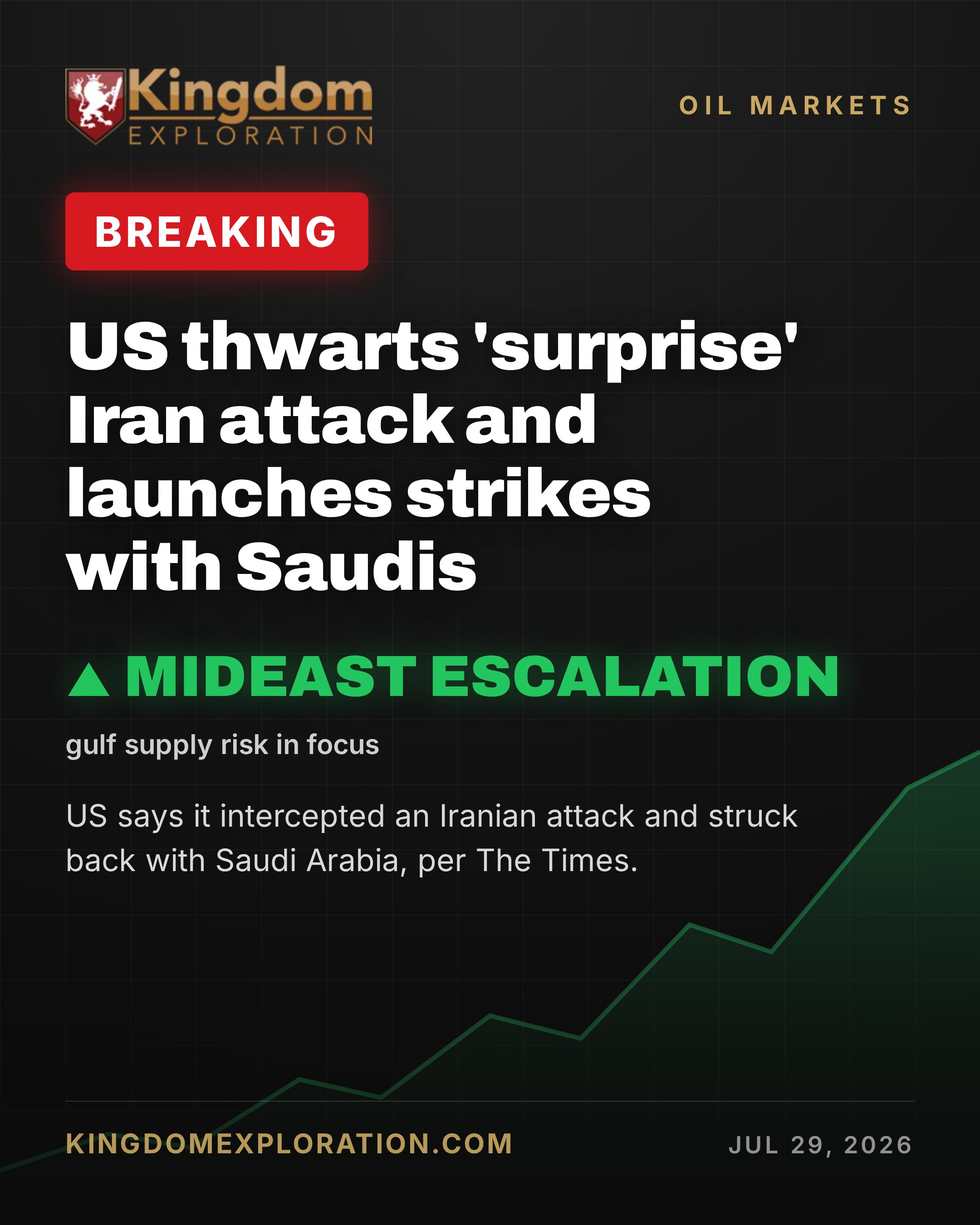
The United States said it thwarted a "surprise" Iranian attack and, together with Saudi Arabia, launched strikes in response, according to a report published by The Times roughly an hour ago. The development marks a sharp escalation in the Persian Gulf, a region that sits at the heart of global crude supply and shipping.
What Just Happened
Per The Times, US forces intercepted what was described as a "surprise" Iranian attack and then carried out strikes in coordination with Saudi Arabia. The report frames the events as a direct military exchange involving three of the region's most consequential actors: the United States, Iran, and Saudi Arabia.
Beyond the headline, granular operational details were not available in the source at the time of writing. What is clear is that a defensive interception has been followed by offensive action involving a leading OPEC producer, a combination that oil markets tend to watch closely.
The Numbers
The Times report did not disclose specific figures — no casualty counts, no strike totals, and no barrels-per-day impact were provided in the available summary. Kingdom Exploration will update this story with concrete data as verified numbers emerge.
What matters for context: Saudi Arabia is one of the world's largest crude producers and exporters, and the Persian Gulf is a critical corridor for a significant share of seaborne oil. Any military activity in this theater raises the stakes for the physical flow of barrels, even before hard figures are confirmed.
Why Oil Prices Could Rise
Escalation between the US, Iran, and Saudi Arabia strikes at the core of the global supply picture through several channels:
- Supply at risk: Saudi production and export infrastructure are central to global balances. Direct involvement by Riyadh in a military exchange elevates the perceived risk to those flows.
- Risk premium: Traders typically price in a geopolitical premium when Gulf tensions spike, lifting crude even when no barrels have actually been lost.
- Shipping and chokepoints: The Persian Gulf feeds narrow maritime routes. Heightened conflict raises insurance costs and can complicate tanker traffic, tightening the market at the margin.
- Spare capacity questions: If a major producer's assets are perceived to be under threat, the market's cushion of spare capacity looks thinner, amplifying price sensitivity.
Kingdom Exploration's read: markets rarely wait for confirmed supply losses in situations like this. The mere combination of a thwarted attack and retaliatory strikes involving a top OPEC exporter is the kind of catalyst that can move crude before the full facts are known.
What to Watch Next
- Official confirmation and detail from US, Saudi, and Iranian authorities on the scope of the strikes.
- Any reported damage to oil production, processing, or export facilities.
- Movements in tanker traffic, freight rates, and marine insurance in the Gulf.
- OPEC and producer signals on output and any spare-capacity response.
- Front-month Brent and WTI reaction as trading absorbs the news.
Reporting sourced from The Times. Developing story.
About Kingdom Exploration
Kingdom Exploration LLC is an Oklahoma-based oil and gas exploration company. Learn more at kingdomexploration.com.

