Live Updates
UPDATE — Jul 29, 10:51 AM CT: Perm refinery AVT-5 unit hit, 3 critical columns damaged in drone strike
A Ukrainian drone strike has damaged the AVT-5 unit at the Perm Oil Refinery, hitting three critical distillation columns, per X account @NOELreports. The AVT-5 is a primary crude distillation unit; damage to its columns can force a shutdown of associated processing capacity.
Kingdom Exploration's read: strikes on primary distillation columns are among the hardest refinery components to repair quickly, meaning any offline capacity could stay down for an extended period. Repeated hits deep inside Russia keep a supply-risk premium under crude prices as fuel processing capacity is degraded.
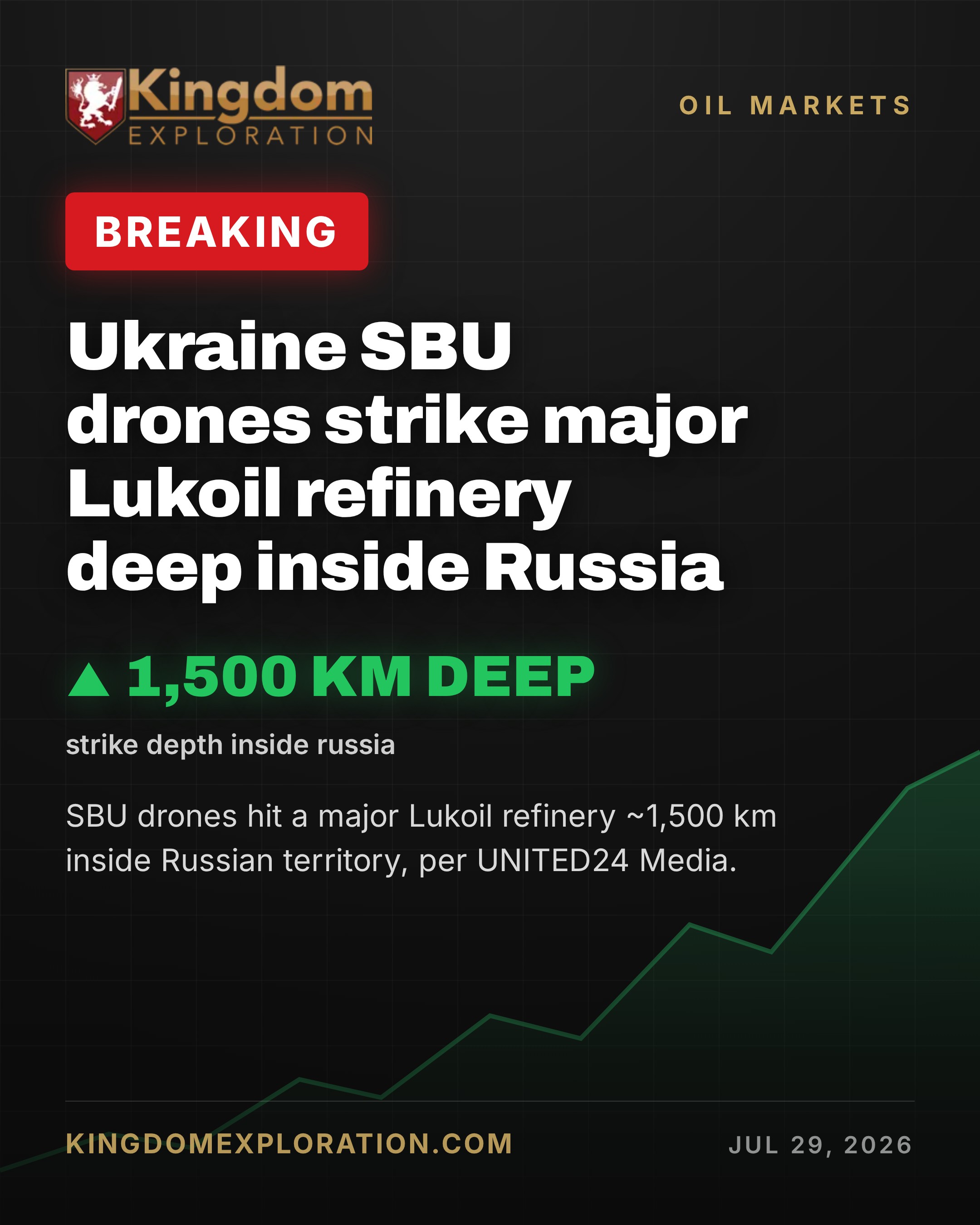
Ukraine's Security Service (SBU) carried out a long-range drone strike on a major Lukoil refinery located roughly 1,500 kilometers inside Russian territory, according to UNITED24 Media. The strike, reported minutes ago, marks another deep-penetration attack on Russia's downstream energy infrastructure.
What Just Happened
Per UNITED24 Media, SBU drones reached and hit a major Lukoil refining facility located approximately 1,500 km deep inside Russia. The distance underscores the growing reach of Ukraine's long-range drone campaign, which has increasingly targeted refineries, fuel depots, and export-linked energy assets far from the front line.
Details on the extent of damage, the specific facility, and any impact on throughput were not immediately available in the initial report. This remains a developing story.
The Numbers
The single concrete figure confirmed in the initial reporting is the strike distance: roughly 1,500 kilometers inside Russian territory. UNITED24 Media described the target as a major Lukoil refinery, but production volumes, processing capacity, and any offline output figures were not specified in the available report.
- Strike depth: ~1,500 km inside Russia
- Target: A major Lukoil refinery
- Operator: Ukraine's SBU (drone strike)
Kingdom Exploration will update these figures as verified numbers on damage and throughput become available.
Why Oil Prices Could Rise
Attacks on refining infrastructure introduce a supply-side risk premium into crude markets. When a major refinery is damaged, several mechanisms can pressure prices higher:
- Refined product tightness: Reduced refining capacity can crimp domestic fuel supply and reshape crude flows, adding volatility across the barrel.
- Risk premium: Deep-strike attacks signal that Russian energy assets far from the border remain vulnerable, keeping traders alert to further disruptions.
- Export uncertainty: Damage to downstream facilities can ripple into export logistics and force crude to be redirected or stored, tightening available supply elsewhere.
Kingdom Exploration's read: repeated strikes deep inside Russia keep a persistent geopolitical risk premium embedded in global crude, even before any confirmed volume comes offline. Markets tend to price the threat of escalation, not just the measured damage.
What to Watch Next
- Confirmation of which Lukoil refinery was hit and the scale of the damage.
- Any reported reduction in refining throughput or fuel output.
- Russian official response and potential retaliation affecting energy corridors.
- Movement in Brent and WTI benchmarks as markets digest the escalation.
- Whether this signals an intensifying pattern of deep-strike attacks on refining assets.
Reporting sourced from UNITED24 Media. Developing story.
About Kingdom Exploration
Kingdom Exploration LLC is an Oklahoma-based oil and gas exploration company. Learn more at kingdomexploration.com.

