Live Updates
UPDATE — Aug 20, 2:51 PM CT: CENTCOM: US forces redirect 67 vessels, disable 3, board 2 to enforce Hormuz blockade
US Central Command has released fresh enforcement figures for the Strait of Hormuz, reporting that American forces redirected 67 vessels, disabled 3 and boarded 2 to enforce the Iran blockade, per ANI News. The tally underscores an intensifying military posture at the world's most critical oil chokepoint.
The updated numbers point to active interdiction rather than a passive presence, with US forces now directly controlling which ships move and which are stopped. Kingdom Exploration's read: sustained boardings and disablements signal transit will stay throttled, keeping a supply-risk premium on crude as traders price in prolonged disruption through Hormuz.
UPDATE — Aug 18, 7:06 AM CT: China's COSCO and China Merchants halt oil tankers through Strait of Hormuz
Two of China's largest state-linked shipping firms — COSCO Shipping Energy Transportation and China Merchants Energy Shipping — have halted oil tanker transits through the Strait of Hormuz, per NewsCord.
The move marks a major escalation in the shipping fallout from the contested blockade, pulling Chinese-controlled crude carriers off the world's most critical oil chokepoint. Roughly a fifth of global oil supply normally passes through Hormuz.
Kingdom Exploration's read: with Chinese majors now joining Western operators in avoiding the strait, effective tanker capacity through Hormuz shrinks further, tightening the supply of barrels able to reach market and keeping upward pressure on crude prices.
UPDATE — Aug 17, 9:27 AM CT: Hormuz traffic collapses to 17% of normal as ADNOC vessels hit, Iran route now only visible path
Vessel transits through the Strait of Hormuz have collapsed to just 17% of normal levels, according to Breakbulk.News. The outlet reports that ADNOC vessels have been struck and that the Iran-authorized route is now the only visible path for shipping through the chokepoint.
The near-total halt marks a sharp escalation from the disruption already documented on this page. With roughly a fifth of global oil transiting Hormuz in normal conditions, a collapse to 17% of usual traffic threatens to choke off a significant share of seaborne crude and LNG flows.
Kingdom Exploration's read: with commercial operators avoiding all but the Iran-sanctioned corridor, supply risk is concentrating rapidly - the kind of squeeze that pressures crude prices higher until safe passage is restored.
UPDATE — Aug 14, 3:26 PM CT: Trump says Strait of Hormuz will 'soon be US territory'
President Trump has declared that the Strait of Hormuz will "soon be US territory," according to Apa.az, marking a sharp escalation in his rhetoric after earlier claims of "total control" over the waterway.
The statement follows the US-enforced blockade under which American forces have intercepted vessels and disabled tankers accused of violating transit rules. No further operational details were provided in the report.
Kingdom Exploration's read: roughly a fifth of global oil flows through Hormuz, so any move toward outright US sovereignty claims raises the stakes for shippers, insurers and Gulf producers. Escalating rhetoric keeps a war-risk premium embedded in crude prices as long as passage remains contested.
UPDATE — Aug 13, 8:42 AM CT: Iran declares no ship may transit Hormuz without its authorization
Iran's state news agency IRNA reports that Tehran has declared no vessel may transit the Strait of Hormuz without its prior authorization, per IRNA English. The announcement directly contests US claims of "total control" over the waterway and sets up dueling authorities over the world's most critical oil chokepoint.
Kingdom Exploration's read: two nations now each asserting sole clearance rights over Hormuz raises the risk of confrontation for any tanker caught between competing demands. Roughly a fifth of global oil supply moves through the strait, and shippers face paralyzing uncertainty over whose permission counts. Any disruption to transit volumes would tighten crude supply and pressure prices higher.
UPDATE — Aug 12, 11:26 AM CT: Trump says US intends to 'keep' control of Strait of Hormuz
President Trump says the United States intends to retain control of the Strait of Hormuz, telling reporters "I think we will keep it," per Euronews.com. The comment escalates earlier signals that Washington could maintain its grip on the waterway after seizing control amid the ongoing blockade enforcement.
The remark points to an open-ended US military presence in the strait, rather than a temporary operation. Kingdom Exploration's read: markets treat an indefinite US hold as a longer-term supply risk premium, keeping crude sensitive to any escalation around the chokepoint through which roughly a fifth of global oil flows.
UPDATE — Aug 12, 10:02 AM CT: Trump says US has 'total control' of Hormuz, signals it may keep hold of strait
President Trump says the United States now has "total control" over the Strait of Hormuz and suggested Washington intends to maintain its grip, according to The Jerusalem Post. "I think we will keep it," Trump said, per the outlet.
The remarks follow the resumption of the US-enforced blockade and the interception of dozens of vessels near the waterway. They point to an open-ended American military presence in one of the world's most critical oil chokepoints, through which a large share of seaborne crude transits daily.
Kingdom Exploration's read: framing the strait as under lasting US control raises the stakes for any Iranian response and keeps a persistent risk premium in play for crude markets as shipping remains disrupted.
UPDATE — Aug 11, 8:32 PM CT: US hits Iran-bound cargo ship with Hellfire missiles
The United States struck a cargo ship bound for Iran using Hellfire missiles, according to Українські Національні Новини (УНН). The strike marks a further escalation in the US enforcement of its blockade around the Strait of Hormuz.
Details on the vessel, its cargo and casualties were not immediately provided in the report. The outlet did not specify the ship's flag or exact location.
Kingdom Exploration's read: direct kinetic strikes on shipping bound for Iran raise the risk premium on crude, as roughly a fifth of the world's oil passes through Hormuz. Any disruption to traffic — or wider retaliation — could tighten supply and push prices higher.
UPDATE — Aug 11, 2:46 PM CT: US military disables Panama-flagged tanker for violating Hormuz blockade
The US military has disabled a Panama-flagged tanker after it violated the blockade in the Strait of Hormuz, The Hill reports. The development marks a fresh escalation as US forces continue enforcing control over the critical waterway.
Kingdom Exploration's read: with US forces now actively disabling vessels that defy the blockade, transit through the Strait of Hormuz — the passage for roughly a fifth of global oil supply — is becoming increasingly untenable for commercial shipping, keeping upward pressure on crude prices.
UPDATE — Aug 11, 8:37 AM CT: US forces fire on Panama-flagged vessel near Strait of Hormuz
US forces opened fire on a Panama-flagged vessel near the Strait of Hormuz, according to a Wall Street Journal report cited by Fox Business. The outlet did not specify casualties, the extent of damage, or what prompted the engagement.
The incident marks a sharp escalation as US forces continue confronting shipping in and around the world's most important oil chokepoint, through which a large share of global crude and LNG transits.
Kingdom Exploration's read: direct fire on a commercial vessel raises the risk premium for tankers transiting Hormuz. Any disruption to traffic through the strait can tighten seaborne crude supply and pressure prices higher until conditions clarify.
UPDATE — Aug 10, 2:59 PM CT: Trump Says U.S. Has Mineswept Entire Strait of Hormuz, Holds Sole Control
President Donald Trump says the United States has mineswept the entire Strait of Hormuz and now holds sole control of the waterway, per scanx.trade. No independent corroboration or operational detail accompanied the claim in the report.
Kingdom Exploration's read: the assertion of U.S. "sole control" over the strait marks a sharp escalation in the confrontation triggered by Iran's blockade attempt. Roughly a fifth of global oil supply transits Hormuz, so any claim of contested or forcibly cleared passage keeps a heavy risk premium on crude until traffic and safety are verifiably restored.
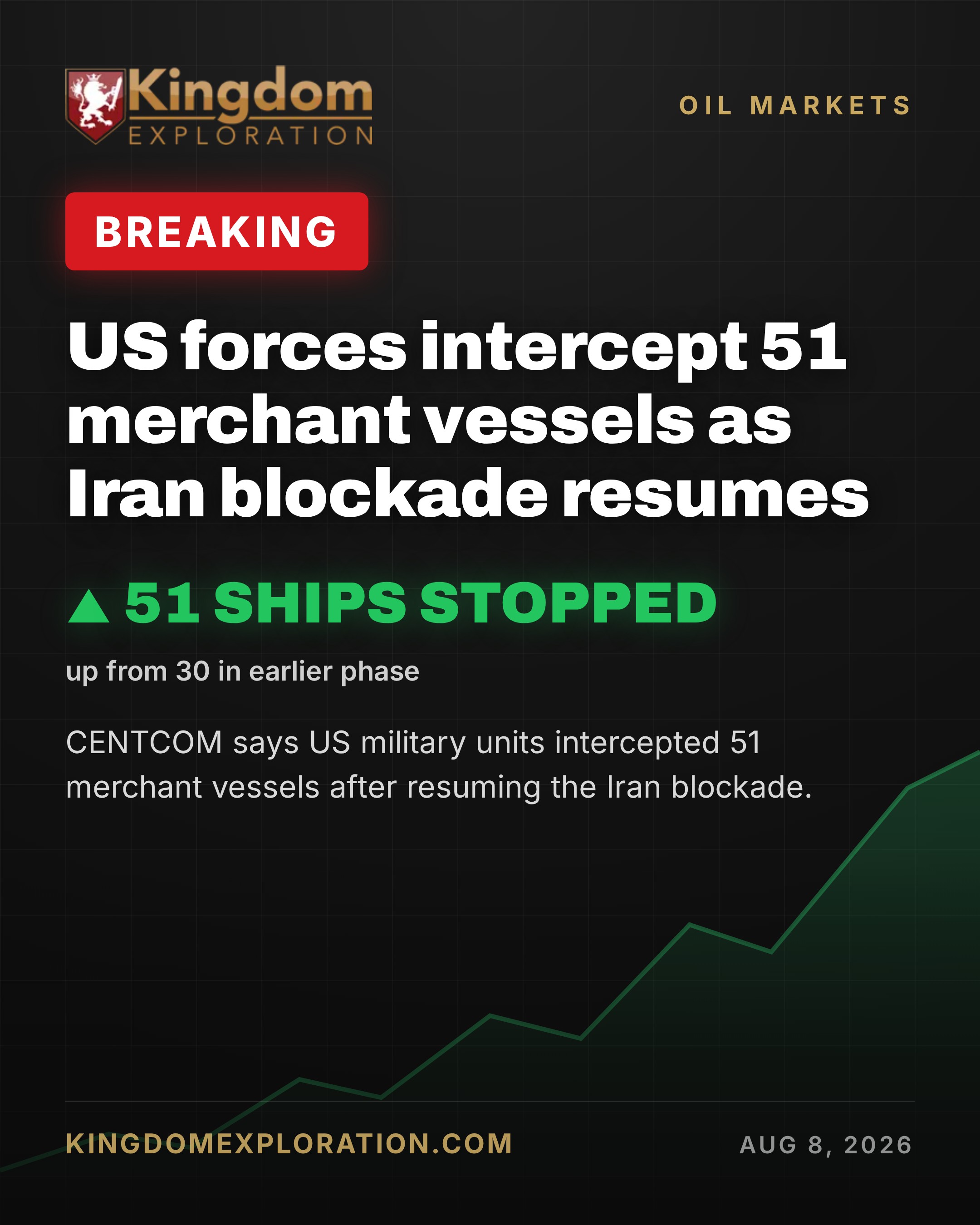
US military units have intercepted 51 merchant vessels following the resumption of the Iran blockade, US Central Command (CENTCOM) announced, per ukranews.com. The disclosure, reported roughly 23 minutes ago, marks a sharp escalation from earlier operations and signals a widening naval standoff in one of the world's most critical energy corridors.
Related coverage: CENTCOM: 30 Commercial Vessels Redirected in Iran Blockade
What Just Happened
According to CENTCOM, as reported by ukranews.com, US military units intercepted 51 merchant vessels after the Iran blockade was resumed. The figure represents a significant jump from the 30 commercial vessels that CENTCOM previously said had been redirected during the earlier phase of the operation.
The renewed blockade activity and the higher vessel count point to an intensifying confrontation affecting commercial shipping traffic. For an energy market that depends heavily on the uninterrupted movement of tankers, any large-scale interference with merchant traffic draws immediate attention from traders and risk managers.
The Numbers
- 51 merchant vessels intercepted by US military units after resumption of the blockade, per CENTCOM via ukranews.com.
- 30 commercial vessels redirected in the earlier phase, per prior CENTCOM reporting - meaning the intercepted count has climbed materially.
- Report published approximately 23 minutes before writing; details remain limited.
No cargo breakdown, tanker classification, or price data was provided in the available source. Kingdom Exploration is reporting only the figures released so far.
Why Oil Prices Could Rise
Interdiction of merchant traffic near a major chokepoint feeds directly into crude's geopolitical risk premium. When naval forces intercept dozens of vessels, shippers reassess routing, insurers reprice war-risk coverage, and charter rates can climb - each of which raises the effective cost of moving barrels to market.
The mechanism is straightforward: if a meaningful share of the 51 intercepted vessels carry crude, refined products, or LNG, even temporary detention removes supply flexibility from the system. Buyers competing for cargoes that can move without interference tend to bid up prompt prices, while the fear of further escalation adds a premium on top of physical fundamentals.
Kingdom Exploration's read: the doubling of the intercepted vessel count from 30 to 51 in successive updates is the detail that matters most here. A rising tally suggests the operation is broadening rather than winding down, and markets typically price escalation before they price resolution.
What to Watch Next
- Vessel cargo detail: whether any of the 51 intercepted ships are confirmed tankers carrying crude or products.
- Iran's response: any countermeasures affecting the surrounding shipping lanes.
- Insurance and freight: war-risk premiums and tanker charter rates as the standoff continues.
- Further CENTCOM updates: whether the intercepted count keeps climbing beyond 51.
- Benchmark reaction: Brent and WTI moves as traders reprice supply risk.
Reporting sourced from ukranews.com. Developing story.
About Kingdom Exploration
Kingdom Exploration LLC is an Oklahoma-based oil and gas exploration company. Learn more at kingdomexploration.com.