Live Updates
UPDATE — Aug 5, 6:41 AM CT: Tehran warns it will 'sink' US Navy ships if blockade around Iranian ports continues
Iran has issued a direct threat to the US Navy over its naval blockade of Iranian ports, warning it will "sink" American vessels if the operation continues, per Marine Insight. The warning marks a sharp escalation in rhetoric as commercial shipping continues to be diverted from the region.
Kingdom Exploration's read: an explicit threat against US warships raises the risk of direct military confrontation in one of the world's most critical oil-shipping corridors. Any exchange of fire near Iranian ports could disrupt crude flows and inject a fresh risk premium into oil prices, even before any physical supply is lost.
UPDATE — Aug 4, 12:56 PM CT: CENTCOM says 45 commercial vessels now diverted amid Iran blockade
The US now says it has diverted 45 commercial vessels in connection with the Iran blockade, up from the 35 reported earlier, per Breakingthenews.net.
The rising vessel count signals the disruption to regional shipping is widening rather than easing, with more traffic being rerouted away from affected waters.
Kingdom Exploration's read: each additional diverted vessel adds friction to crude and product flows through one of the world's most critical maritime corridors, keeping upward pressure on oil prices and freight costs as long as the blockade persists.
UPDATE — Aug 2, 11:46 AM CT: US redirects 35 vessels as Iran blockade disrupts shipping
The number of commercial vessels redirected amid the Iran blockade has risen to 35, up from the 30 previously reported by CENTCOM, per Breakingthenews.net. The outlet reported the figure roughly five minutes ago, signaling the disruption to maritime traffic is widening.
Kingdom Exploration's read: an expanding count of rerouted ships points to growing friction along a critical crude corridor. Even without a formal closure, forcing more vessels off their planned routes lengthens voyages and raises the risk premium baked into oil prices, as tankers and traders reassess passage through the affected waters.
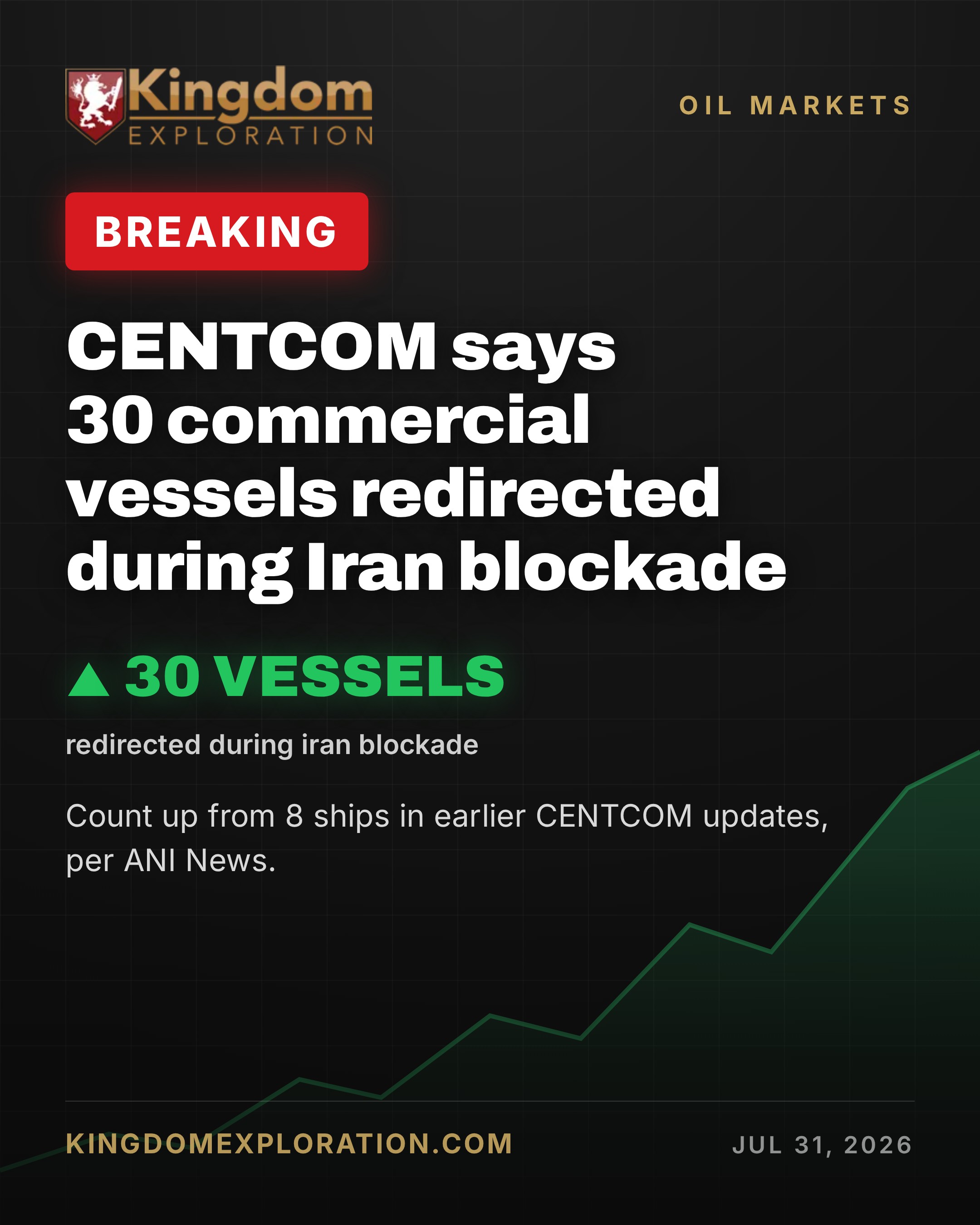
The U.S. Central Command (CENTCOM) said that 30 commercial vessels have now been redirected so far during the ongoing naval blockade on Iran, according to ANI News in a report published minutes ago. The figure marks a sharp escalation from the eight ships reported redirected in earlier updates, signaling that the disruption to regional shipping is widening.
Related coverage: US Tightens Naval Blockade on Iran; 8 Ships Redirected
What Just Happened
Per ANI News, CENTCOM reported that a total of 30 commercial vessels have been redirected during the U.S.-led naval blockade of Iran. This is the latest tally in a fast-moving situation and represents a significant jump from the previously reported count of eight redirected ships covered in our earlier reporting.
The rising number underscores that the blockade is actively reshaping commercial maritime traffic in one of the world's most sensitive energy corridors. Each redirected vessel represents cargo — potentially including crude oil, refined products, and other goods — being forced onto alternate routes or held in place.
The Numbers
- 30 commercial vessels redirected so far, per CENTCOM via ANI News
- Up from 8 vessels reported in earlier coverage
- Report published approximately 18 minutes ago
These are the only confirmed figures from the source. The specific cargo composition of the redirected vessels and the exact routes affected were not detailed in the available reporting.
Why Oil Prices Could Rise
A naval blockade affecting Iranian waters sits at the heart of global oil-supply anxiety. Iran is a major crude producer and its coastline borders the Strait of Hormuz, the chokepoint through which roughly a fifth of the world's oil flows. When commercial vessels are redirected or delayed, the market prices in the risk that barrels may not reach buyers on schedule.
Three mechanisms tend to lift crude prices in scenarios like this:
- Supply at risk: A rising count of redirected vessels signals that physical flows of oil and products are being disrupted, tightening available supply.
- Risk premium: Traders add a geopolitical premium to prices when a key producing region faces military action, even before actual barrels are lost.
- Spare capacity strain: If Iranian volumes are curtailed, the burden shifts to other producers' spare capacity — and any doubt about whether that cushion is adequate amplifies price moves.
The escalation from 8 to 30 redirected vessels is exactly the kind of trend that keeps a risk premium elevated, because it suggests the situation is intensifying rather than stabilizing.
Kingdom Exploration's read: The vessel count is the tell here. A jump from single digits to 30 in a short window tells the market this blockade is broadening, not easing — and that is what keeps a geopolitical premium baked into crude until traffic normalizes.
What to Watch Next
- Further CENTCOM updates: Whether the redirected-vessel count keeps climbing in coming hours and days.
- Strait of Hormuz traffic: Any signs of broader disruption to the chokepoint that could affect global crude flows.
- Tanker and insurance rates: Rising war-risk insurance premiums and shipping rates would confirm the market is pricing in sustained disruption.
- Producer and OPEC response: Any signals about spare capacity being tapped to offset disrupted volumes.
This remains a developing situation, and the figures reported here reflect the latest available count from CENTCOM as relayed by ANI News.
Reporting sourced from ANI News. Developing story.
About Kingdom Exploration
Kingdom Exploration LLC is an Oklahoma-based oil and gas exploration company. Learn more at kingdomexploration.com.