Live Updates
UPDATE — Aug 30, 3:51 PM CT: IRGC reports casualties in US strike on Larak Island, per Shafaq News
Iran's Revolutionary Guard Corps says the latest US strike on Larak Island — near the mouth of the Strait of Hormuz — has caused casualties, according to Shafaq News. The IRGC did not immediately specify numbers in the report.
The confirmation of casualties marks a fresh escalation days after Washington resumed direct attacks on Iranian positions guarding the strait, and follows the earlier strike on missile launchers in the same area.
Kingdom Exploration's read: casualties raise the risk of an Iranian retaliation cycle around the world's most critical oil chokepoint, where flows have already collapsed. Any further disruption to the roughly 5 million barrels a day still moving through Hormuz keeps upward pressure on crude.
UPDATE — Aug 30, 3:22 PM CT: US strikes Iran's Lark Island in first attack in weeks, per Al Jazeera
The US has struck Iran's Lark Island, Al Jazeera reports, marking the first US attack on Iranian territory in weeks and shattering a relative lull since the earlier assault on Larak Island's missile launchers near the Strait of Hormuz.
Al Jazeera did not specify targets or damage in its initial report; further details were not immediately available. The strike lands with the US-Iran truce already expired and Hormuz traffic near a standstill.
Kingdom Exploration's read: a renewed kinetic exchange at the mouth of the world's most critical oil chokepoint keeps a fresh war-risk premium on crude, with roughly a fifth of global seaborne oil transiting Hormuz.
UPDATE — Aug 30, 2:36 PM CT: US strikes Iranian missile launchers on Larak Island near Strait of Hormuz
The United States has struck Iranian missile launchers on Larak Island, located near the Strait of Hormuz, according to Axios reporting relayed via X (@DinoLeadingNews). The strike marks a direct US military action on Iranian territory close to the world's most critical oil chokepoint.
No casualty figures or additional operational details were provided in the initial report. Larak Island sits at the eastern end of the strait, a position from which Iran can threaten tanker traffic transiting the waterway.
Kingdom Exploration's read: a confirmed US strike on Iranian launchers marks a sharp escalation from blockade and standoff to direct kinetic exchange. With Hormuz already choked, any deepening of the shooting war raises the risk premium on crude and keeps traffic through the strait dangerously thin.
UPDATE — Aug 28, 4:16 PM CT: Iran's oil exports fall near zero even as broader Persian Gulf flows recover
Iran's own crude exports have collapsed to near zero, Iran International reports, even as broader Persian Gulf shipping flows show signs of recovery after weeks of disruption around the Strait of Hormuz.
The divergence points to a sharpening split: sanctions, blacklisting and the standoff over Hormuz transit rules have effectively frozen Tehran's barrels out of the market, while other Gulf producers begin moving cargoes again.
Kingdom Exploration's read: losing Iranian barrels tightens global supply at the margin, but any recovery in wider Gulf flows could ease the acute price pressure that built as the US-Iran truce expired. The balance between these two forces will drive crude in the days ahead.
UPDATE — Aug 28, 3:46 PM CT: IRGC declares Strait of Hormuz closed to all ships
Iran's Revolutionary Guard Corps (IRGC) says the Strait of Hormuz is now closed to all ships, according to Iraq's official news agency (واع). The announcement marks a hardening from earlier reports, when only some tankers were passing with Iran's approval.
No further operational details were provided. Kingdom Exploration's read: a blanket closure of the world's most important oil chokepoint — through which Hormuz flows had already sunk to roughly 5 million barrels a day — removes the last conditional transit lane that had kept limited crude and product moving. If enforced, it threatens a fuller supply disruption at a moment when the US-Iran truce framework has already collapsed.
UPDATE — Aug 28, 12:58 PM CT: Centcom says US forces redirected 75 vessels away from Iranian ports
US Central Command says American forces have redirected 75 vessels away from Iranian ports, according to thenationalnews.com. The move signals an intensifying US effort to enforce its naval blockade around Iran and choke off traffic tied to Iranian terminals.
The figure adds hard numbers to a campaign that has already throttled the Strait of Hormuz, where flows have sunk and thousands of seafarers remain stranded aboard stalled ships.
Kingdom Exploration's read: diverting 75 vessels tightens an already stressed supply chain through the world's most critical oil chokepoint, keeping upward pressure on crude as buyers scramble for alternative routes and cargoes.
UPDATE — Aug 28, 10:07 AM CT: IMO: ~6,000 seafarers stranded aboard 400 vessels unable to leave Strait of Hormuz
Around 6,000 seafarers aboard roughly 400 vessels remain unable to leave the Strait of Hormuz, CBS News reported, citing the UN's International Maritime Organization (IMO), per MTV Lebanon.
The figure underscores how deeply choked the world's most critical oil chokepoint has become as Iran keeps traffic restricted and passage subject to its approval. Hundreds of ships and their crews are effectively trapped, unable to transit in either direction.
Kingdom Exploration's read: 400 stuck vessels represents a massive volume of cargo — including crude and products — frozen in place. The longer that tonnage sits immobilized, the tighter physical supply gets downstream, keeping upward pressure on prices and freight risk.
UPDATE — Aug 27, 1:36 PM CT: Qatar PM heads to Tehran as Hormuz oil flows sink to 5 million barrels a day
Qatar's prime minister is traveling to Tehran in a bid to defuse the Hormuz standoff, as crude flows through the strait have collapsed to about 5 million barrels a day, per the International Business Times (Singapore Edition).
The chokepoint normally carries roughly a fifth of global oil consumption, so a drop to 5 million b/d marks a steep reduction in the volume of crude reaching world markets.
Kingdom Exploration's read: a high-level Gulf mediation mission signals that regional players see the current disruption as unsustainable. Until traffic recovers, the shrinking flow keeps upward pressure on oil prices firmly in place.
UPDATE — Aug 26, 12:46 PM CT: US allies cast doubt on Trump's claim Hormuz has been demined, per Bloomberg
US allies are publicly questioning President Trump's assertion that the Strait of Hormuz has been cleared of mines, Bloomberg reports. The skepticism from Washington's own partners undercuts claims that the world's most critical oil chokepoint is safe for tanker traffic.
Kingdom Exploration's read: contradictory messaging on whether Hormuz is navigable keeps insurers, owners and traders in the dark. As long as allies dispute the all-clear, vessels are likely to stay away, prolonging the squeeze on the roughly one-fifth of global oil that normally moves through the strait.
UPDATE — Aug 26, 11:36 AM CT: Iranians cheer and mourn Khamenei's death, per The Guardian Nigeria News
Iranians are reacting with a mix of celebration and grief following the death of Supreme Leader Khamenei, The Guardian Nigeria News reports. The development follows earlier reports that Mojtaba Khamenei had been "very seriously" wounded, and marks a potential turning point in the leadership crisis gripping Tehran amid the collapsed US-Iran truce.
Kingdom Exploration's read: a sudden leadership vacuum at the top of Iran's power structure injects fresh uncertainty into an already volatile Strait of Hormuz standoff. With traffic through the world's key oil chokepoint already reduced to single digits and a naval blockade in force, questions over succession and command could sharply raise the risk premium on crude as markets weigh whether escalation or de-escalation follows.
UPDATE — Aug 26, 9:12 AM CT: Trump says Iran's Supreme Leader Mojtaba Khamenei alive but 'very seriously' wounded
US President Donald Trump says Iran's Supreme Leader Mojtaba Khamenei is alive but has been "very seriously" wounded, according to Anadolu Ajansı. The report offers no further detail on the circumstances or the source of the injuries.
The claim marks a sharp escalation in the US-Iran standoff over the Strait of Hormuz, which remains largely shut following the expiry of the 60-day truce. A crisis at the very top of Iran's leadership raises the risk of a chaotic Iranian response and further disruption to tanker traffic through the world's most critical oil chokepoint.
Kingdom Exploration's read: any confirmed strike on Iran's supreme leader would inject extreme uncertainty into oil markets, where roughly a fifth of global crude flows through Hormuz.
UPDATE — Aug 26, 7:57 AM CT: IRGC says Iran and Oman seal Hormuz revenue-sharing deal, strait stays shut if US objects
Iran's Revolutionary Guard Corps says Tehran and Oman have finalised a revenue-sharing arrangement for the Strait of Hormuz, but warned the waterway will remain closed if Washington objects, NDTV Profit reports.
The announcement formalises the transit-fee framework Iran has been pushing on "authorised" vessels, tying Hormuz access to a bilateral deal with Oman rather than the lapsed US-Iran understanding. It leaves the closure conditional on US acceptance.
Kingdom Exploration's read: framing continued access around a Tehran-Muscat pact hardens Iran's control narrative and keeps a large share of Gulf crude flows hostage to US-Iran friction, sustaining the supply-risk premium in oil.
UPDATE — Aug 25, 4:21 PM CT: Iran says Hormuz stays closed despite temporary Oman deal, per Middle East Eye
Iran's deputy foreign minister said the Strait of Hormuz will remain closed despite a temporary deal reached with Oman, Middle East Eye reports. The comment signals Tehran intends to keep the chokepoint restricted even as diplomatic contacts continue in the region.
Kingdom Exploration's read: the framing of an Oman-brokered arrangement as merely "temporary" undercuts hopes that traffic through Hormuz will normalise soon. With roughly a fifth of the world's oil typically transiting the strait, any prolonged closure keeps a firm risk premium under crude and leaves shippers reliant on Iran's case-by-case approvals.
UPDATE — Aug 24, 7:31 PM CT: Ship struck in Strait of Hormuz hours after Trump's "Economic D-Day" campaign, per TWZ
Another vessel has been struck in the Strait of Hormuz, coming just hours after the unveiling of what TWZ describes as Trump's "Economic D-Day" campaign against Iran. The outlet reports the strike as the latest incident in the increasingly contested waterway.
Details on the vessel, cargo and casualties were not immediately available in the report. The strike adds to a mounting tally of ships hit in and around Hormuz in recent days as US-Iran tensions escalate past the expired truce.
Kingdom Exploration's read: a fresh strike landing so soon after a new US pressure campaign keeps a war-risk premium bid into crude, with any confirmed damage to tankers threatening the roughly one-fifth of global oil that transits the strait.
UPDATE — Aug 24, 6:46 PM CT: 'Unknown projectile' hits oil tanker off Oman, UKMTO reports
An oil tanker was struck by an "unknown projectile" off the coast of Oman, according to the UK Maritime Trade Operations (UKMTO), per Gulf News. The report emerged roughly 11 minutes ago; further details on the vessel, casualties or damage were not immediately available.
The incident widens the zone of maritime risk beyond the Strait of Hormuz itself, extending toward the Gulf of Oman shipping lanes that feed tanker traffic in and out of the region.
Kingdom Exploration's read: another confirmed strike on commercial shipping raises the war-risk premium on Gulf crude flows and could keep pressure on prices as owners weigh whether transit remains viable.
UPDATE — Aug 24, 11:32 AM CT: Iran blacklists 45 tankers, including 5 owned by South Korea's Sinokor, over Hormuz rules
Iran has blacklisted 45 tankers for violating its Strait of Hormuz transit regulations, including five vessels owned by South Korea's Sinokor, per news.sbs.co.kr. The move puts a named list of ships in Tehran's crosshairs as it enforces its "authorised" transit and service-fee regime.
Kingdom Exploration's read: naming specific owners escalates the standoff from broad threats to concrete enforcement, raising the risk of confiscations or clashes involving the listed fleet. With Hormuz traffic already at single digits, any further removal of compliant capacity tightens an already stressed corridor that handles a large share of seaborne crude, keeping upward pressure on oil prices.
UPDATE — Aug 23, 4:31 PM CT: Kuwaiti giant oil tanker struck in Iranian drone strike off Dubai coast
A Kuwaiti very large oil tanker has been hit in an Iranian drone strike off the coast of Dubai, News On AIR reports. The strike takes the escalating conflict beyond the Strait of Hormuz itself and into the wider Gulf waters near a major shipping and commercial hub.
Kingdom Exploration's read: an attack on a large crude carrier near Dubai signals that Iranian targeting is widening geographically, raising the risk premium on every barrel moving through the Gulf. Fresh strikes on tankers threaten to further choke the already single-digit traffic through Hormuz and keep upward pressure on oil prices.
UPDATE — Aug 23, 3:47 PM CT: US claim of 40 tankers exiting Hormuz contradicted by tracking data showing zero
The US claimed 40 tankers exited the Strait of Hormuz in a single day, but a vessel-tracking agency recorded zero departures over the same period, per news.antiwar.com. The report highlights a stark gap between Washington's messaging that the waterway is functioning and independently observed traffic.
Kingdom Exploration's read: if tracking data is showing no tanker departures, the strait remains effectively frozen despite official statements that it is open. Roughly a fifth of global oil flows through Hormuz, so a genuine standstill - versus the reassurances - keeps a large supply risk premium on crude and raises the odds of forced re-routing and higher freight costs.
UPDATE — Aug 23, 3:17 PM CT: Iran to confiscate non-compliant vessels transiting Strait of Hormuz
Iran will confiscate vessels that fail to comply with its transit rules in the Strait of Hormuz, per Breakingthenews.net. The move sharpens Tehran's earlier system of "authorised" crossings and service fees, adding the threat of seizure for ships that pass without approval.
Kingdom Exploration's read: escalating from projectile strikes and fee demands to outright confiscation raises the stakes for any tanker owner still attempting passage. With Hormuz traffic already in the single digits, the prospect of vessel seizures could further deter transits through the chokepoint that carries roughly a fifth of global oil supply, keeping upward pressure on crude.
UPDATE — Aug 23, 12:37 PM CT: Iran approves service fees for "authorised" ships crossing Strait of Hormuz
Iran has approved service fees for "authorised" ships transiting the Strait of Hormuz, ANI News reports. The move formalises Tehran's grip on the waterway, effectively turning selective passage into a paid, permission-based system after weeks in which only vessels with Iran's approval have been allowed through.
Kingdom Exploration's read: institutionalising a fee for "authorised" transit signals Iran intends to manage — not simply block — the chokepoint that carries roughly a fifth of global oil. It cements a de facto toll regime that keeps the strait constrained, sustaining supply risk and upward pressure on crude as long as unauthorised traffic stays sidelined.
UPDATE — Aug 23, 2:16 AM CT: Five ships struck by Iranian projectiles in Strait of Hormuz, per FOX
Five ships have been hit by Iranian projectiles in the Strait of Hormuz, LiveNOW from FOX reported roughly half an hour ago. The outlet did not specify the vessels' flags, cargoes or the extent of damage.
This marks the first reported direct strikes on shipping since the US-Iran truce collapsed, moving the standoff from blockade and threats into active fire on vessels transiting the world's most critical oil chokepoint.
Kingdom Exploration's read: attacks on ships in Hormuz are precisely the trigger markets have feared. With traffic already reduced to single digits, physical damage to tankers raises war-risk insurance and reinforces the supply premium building in crude prices.
UPDATE — Aug 22, 8:11 PM CT: Iran vows Hormuz stays closed until US changes course
Iran has declared that the Strait of Hormuz will remain closed until the United States changes its course, The Economic Times reports. The statement signals no immediate off-ramp to the standoff, hardening a closure that has already choked traffic through the world's most critical oil chokepoint to single digits.
Kingdom Exploration's read: by tying reopening to a US policy reversal, Tehran is framing the blockade as an open-ended condition rather than a temporary disruption. With roughly a fifth of global oil normally moving through Hormuz, a prolonged closure keeps a durable risk premium priced into crude and leaves markets exposed to any further escalation.
UPDATE — Aug 22, 7:41 PM CT: Trump posts map declaring Strait of Hormuz 'new US territory' - Middle East Eye
President Trump has posted a map depicting the Strait of Hormuz as 'new US territory,' according to Middle East Eye. The post, published roughly eight minutes ago, marks a sharp escalation in Washington's rhetoric over the world's most critical oil chokepoint, coming atop the naval blockade and shoot-on-sight orders already covered on this page.
Kingdom Exploration's read: framing Hormuz as US territory signals no near-term de-escalation and raises the risk of direct US-Iran confrontation over waters that carry roughly a fifth of global seaborne crude. With traffic already in single digits and Tehran threatening 'fully offensive' action, any move to enforce such a claim could keep a persistent risk premium in oil prices.
UPDATE — Aug 22, 6:21 PM CT: Trump orders US military to shoot and kill Iranian small boats in Strait of Hormuz
President Trump has ordered the US military to shoot and kill Iranian small boats choking the Strait of Hormuz, News On AIR reports. The directive marks a sharp escalation from the naval blockade and shoot-warnings issued after the US-Iran MoU deadline lapsed, moving the standoff into direct armed engagement in the world's most critical oil chokepoint.
Kingdom Exploration's read: a live shoot-to-kill order in Hormuz dramatically raises the risk of a shooting war around a waterway that carries roughly a fifth of global crude and much of the world's LNG. Any exchange of fire, or a broader Iranian response, could disrupt tanker flows already reduced to a trickle and inject a fresh war-risk premium into oil prices.
UPDATE — Aug 22, 3:22 PM CT: Strait of Hormuz largely closed, only some tankers passing with Iran's approval
The Strait of Hormuz is now largely closed, with only some tankers permitted to pass with Iran's approval, according to CNN as cited by Iran's ISNA News Agency.
The report marks a sharp shift from earlier assurances that the strait remained "open and operating." With traffic already having fallen to single digits as the US-Iran MoU deadline expired, Iranian control over which vessels transit the chokepoint signals a de facto blockade on shipping.
Kingdom Exploration's read: roughly a fifth of the world's oil supply moves through Hormuz. Any Iranian-controlled bottleneck at the waterway threatens crude flows and puts significant upward pressure on prices as supply routes tighten.
UPDATE — Aug 21, 11:22 AM CT: Trump gives Iran 48 hours to reopen Strait of Hormuz, per ABC News
President Trump has warned Iran it has 48 hours to reopen the Strait of Hormuz, ABC News reported. The ultimatum sharpens a standoff that has already choked traffic through the world's most important oil chokepoint to single digits after the US-Iran MoU deadline lapsed on August 17.
No specific consequence tied to the 48-hour window was detailed in the report. The warning follows Iran's threats of "fully offensive" military action to break the US naval blockade, raising the stakes on both sides.
Kingdom Exploration's read: a hard deadline on Hormuz turns an open-ended dispute into a countdown. Roughly a fifth of global oil flows transit the strait, so any move to enforce or defy the ultimatum keeps a war-risk premium firmly bid in crude.
UPDATE — Aug 19, 6:37 PM CT: Trump announces 'most crushing economic operation ever taken' against Iran
US President Donald Trump has announced what he called the "most crushing economic operation ever taken" against Iran, thenationalnews.com reports. The move marks a fresh escalation on top of the reimposed naval blockade and Treasury sanctions that followed the expiry of the 60-day Hormuz talks.
Details of the operation's scope were not immediately available. Kingdom Exploration's read: any measure aimed at further squeezing Iranian crude exports or tightening pressure around the Strait of Hormuz raises the risk premium on oil, especially with Tehran already threatening "fully offensive" military action to break the blockade.
UPDATE — Aug 18, 5:56 PM CT: Trump reimposes naval blockade on Iran, ABC News reports
President Trump has reimposed a naval blockade on Iran, per ABC News, in a fresh hardening of Washington's posture after the 60-day Hormuz talks collapsed. The report, carried in a video segment, confirms the blockade remains an active instrument of US pressure rather than a lapsed threat.
Kingdom Exploration's read: reimposing the blockade keeps the world's most critical oil chokepoint squarely in the crosshairs, sustaining a supply-risk premium on crude just as Iran has vowed 'fully offensive' military action to break any US naval cordon. Roughly a fifth of global oil flows through Hormuz, so any confrontation risks disrupting tanker traffic already running thin near the strait.
UPDATE — Aug 18, 2:12 PM CT: US Treasury sanctions Iran after 60-day Hormuz talks expire
The US Treasury has imposed fresh sanctions on Iran following the collapse of the 60-day Strait of Hormuz negotiations, per newscord.org, which compared coverage across 13 outlets. The move follows Washington's earlier refusal to extend the MoU and closes off any near-term diplomatic off-ramp.
Kingdom Exploration's read: sanctions landing just as the truce window shuts raises the risk of Iranian retaliation around Hormuz, the chokepoint for roughly a fifth of global oil flows. With traffic already thinned to single digits and Tehran threatening 'fully offensive' action, any disruption to tanker movements would tighten crude supply and add a renewed risk premium to prices.
UPDATE — Aug 18, 8:42 AM CT: Trump says naval blockade stays in force but Hormuz Strait 'open and operating'
President Trump said there are no talks or conversations scheduled or ongoing with Iran, and that the U.S. "Naval Blockade remains in full force," per Telegram channel @disclosetv citing a Truth Social post. Trump added that all water mines have been "removed or detonated" and declared "The Hormuz Strait is open and operating."
The statement is the clearest signal yet that Washington sees no diplomatic off-ramp after the MoU's expiry, while simultaneously asserting the waterway remains navigable. Kingdom Exploration's read: the mixed message — blockade sustained but strait declared open — leaves crude traders parsing whether tanker flows through the world's most critical oil chokepoint can normalize or remain constrained.
UPDATE — Aug 17, 3:16 PM CT: Washington rules out Iran MoU extension, closing door on truce revival
Washington has ruled out extending the memorandum of understanding with Iran, per Shafaq News, removing the last diplomatic off-ramp after Tehran already rejected an interim deal. Both sides have now foreclosed a renewal of the truce that lapsed on August 17.
The move hardens an already tense standoff around the Strait of Hormuz, where earlier updates noted traffic has thinned to single digits and Iran has threatened "fully offensive" action against any US blockade.
Kingdom Exploration's read: with neither Washington nor Tehran offering a path back to the table, the risk premium on crude has fewer reasons to unwind. Roughly a fifth of the world's oil moves through Hormuz, so any further escalation in the strait keeps supply anxiety front and center for markets.
UPDATE — Aug 17, 12:47 PM CT: Iran threatens 'fully offensive' military action to break US Hormuz blockade
Iran has threatened military action to break what it describes as a US blockade in the Strait of Hormuz, adopting a posture it called "fully offensive," per NDTV Profit. The reporting frames the shift as a sharp escalation following the expiry of the US-Iran memorandum of understanding.
The outlet did not provide fresh figures alongside the threat, but the rhetoric marks Tehran's most direct warning yet of a potential confrontation in the waterway.
Kingdom Exploration's read: roughly a fifth of the world's seaborne oil moves through Hormuz, so any credible threat of military action there injects a fresh risk premium into crude. With traffic already thinned and Tehran ruling out a deal extension, the path toward disruption is widening.
UPDATE — Aug 17, 10:52 AM CT: Hormuz traffic falls to single digits as US-Iran MoU deadline expires
Shipping traffic through the Strait of Hormuz has fallen to single digits as the 60-day deadline for the US-Iran memorandum of understanding expires, per thenationalnews.com. The drop marks a sharp contraction in vessel movements through the world's most critical oil chokepoint.
Kingdom Exploration's read: with the truce lapsing and traffic thinning to a trickle, the risk premium on crude is likely to build. Roughly a fifth of global oil supply transits Hormuz, so any sustained disruption to flows would tighten physical markets and pressure prices higher.
UPDATE — Aug 17, 8:31 AM CT: Iran rules out interim deal extension, threatens escalation as oil prices rise
Oil prices moved higher after Iran ruled out extending an interim deal and threatened to escalate the conflict, CNBC reported. The stance hardens the standoff as the August 17 truce deadline approaches, removing a potential diplomatic off-ramp that markets had been watching.
Kingdom Exploration's read: with Tehran signaling it won't buy more time and openly raising the prospect of escalation, traders are pricing in a higher supply-disruption risk premium. Any move toward renewed confrontation in the Gulf region threatens the flow of crude, and the market's upward drift reflects that growing unease heading into the deadline.
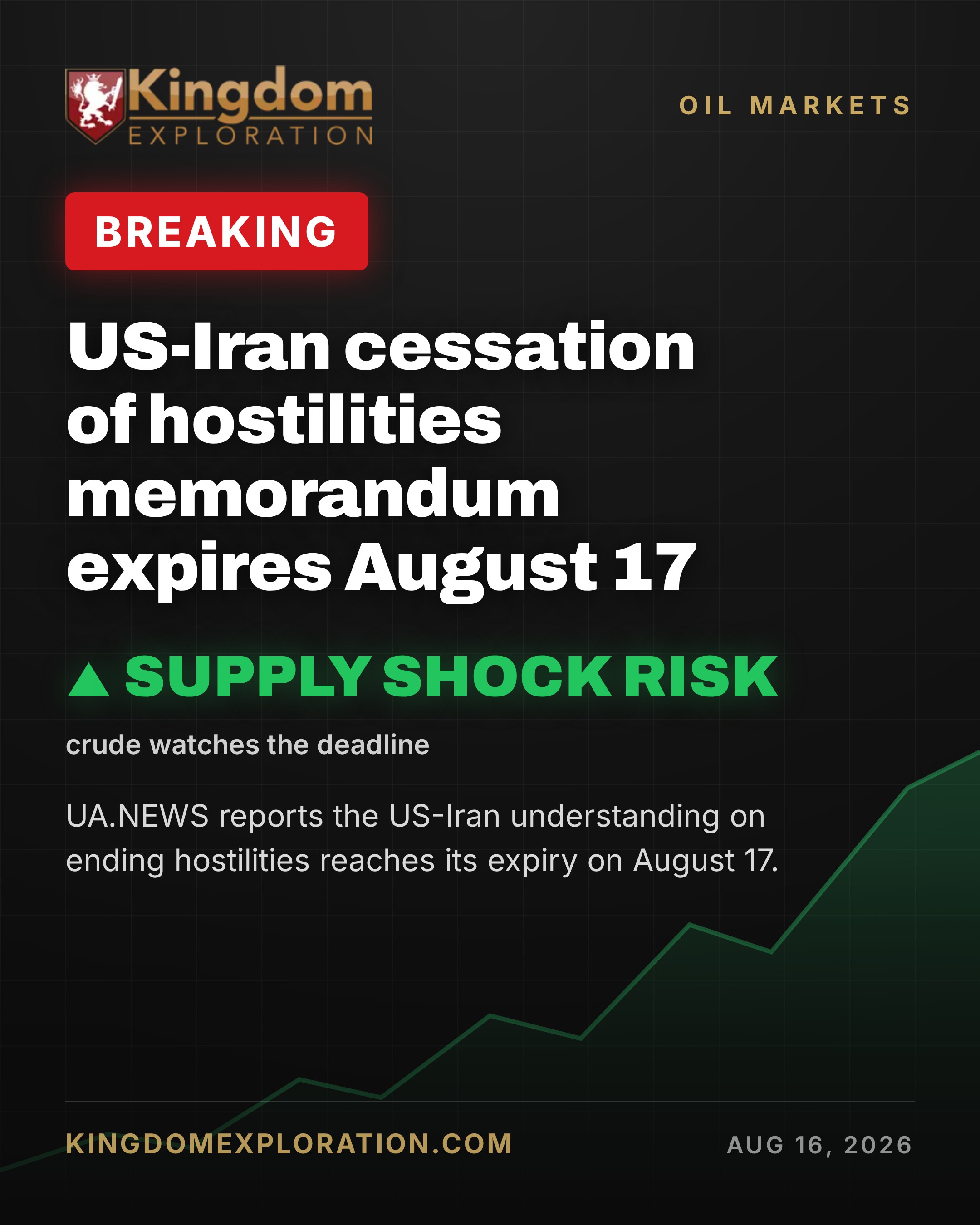
A Memorandum of Understanding between the United States and Iran on the Cessation of Hostilities is set to expire on August 17, according to UA.NEWS. The lapse of the arrangement puts a defined end date on a period of restraint between Washington and Tehran, and it lands squarely on the radar of an oil market that watches every twist in the U.S.-Iran relationship for supply implications.
What Just Happened
Per UA.NEWS, the U.S.-Iran Memorandum of Understanding on the Cessation of Hostilities carries an expiration date of August 17. Once the understanding expires, the framework that has governed restraint between the two sides is no longer in force unless it is renewed or replaced.
For energy watchers, the calendar matters. A firm expiry date creates a clear inflection point: either the two governments extend the arrangement, negotiate a new one, or allow the pause to end with no successor in place. Each path carries a different risk profile for the market.
The Numbers
The single concrete figure attached to this story is the date itself: August 17, the day UA.NEWS reports the memorandum expires. No dollar figures, barrel-per-day estimates, or price moves were cited in the source. What the market is pricing, if anything, is the calendar risk of that deadline rather than a confirmed supply disruption.
- Expiry date: August 17
- Parties: United States and Iran
- Instrument: Memorandum of Understanding on the Cessation of Hostilities
Why Oil Prices Could Rise
Kingdom Exploration's read: crude markets are sensitive to anything that raises the probability of renewed friction between Washington and Tehran. Iran is a significant player in global energy and sits along one of the most important maritime chokepoints for crude flows. When a period of formal restraint approaches an expiry with no announced replacement, traders often add a geopolitical risk premium to the barrel to compensate for the possibility of escalation.
The mechanism is straightforward: if the pause lapses and tensions climb, the market begins to price the potential for interruptions to shipping, exports, or regional stability. Even the perception of elevated risk can lift prices before any physical barrel is affected, because buyers move early to secure supply. A calm renewal, by contrast, would remove that overhang.
What to Watch Next
The clearest signal is whether Washington and Tehran announce an extension, a new framework, or say nothing at all as August 17 approaches. Watch for official statements from either government, any change in tone, and how energy benchmarks trade into and through the deadline. Absent renewal, the market's attention will shift to whether restraint holds informally or whether friction returns.
- Any renewal, extension, or replacement of the memorandum
- Official U.S. or Iranian statements around the August 17 date
- Movement in crude benchmarks as the deadline nears
Reporting sourced from UA.NEWS. Developing story.
About Kingdom Exploration
Kingdom Exploration LLC is an Oklahoma-based oil and gas exploration company. Learn more at kingdomexploration.com.