Live Updates
UPDATE — Sep 2, 5:13 PM CT: Saudi Bahri confirms two dead after Monday tanker attack in Strait of Hormuz
Saudi shipping company Bahri has confirmed that two people were killed in Monday's attack on an oil tanker transiting the Strait of Hormuz, per arabnews.com. It marks the first reported fatalities since the strikes on tankers in the waterway.
Kingdom Exploration's read: confirmed casualties raise the stakes considerably. The Strait of Hormuz carries roughly a fifth of global oil supply, and any escalation in violence against shipping there can push crude prices higher on fears of disrupted transit and rising insurance costs.
UPDATE — Sep 1, 8:41 AM CT: News18: Rockets hit engine room as two oil tankers attacked transiting Strait of Hormuz
Two oil tankers were attacked while transiting the Strait of Hormuz, with rockets impacting one vessel's engine room, News18 reports. The outlet's headline states "Rockets Impacted Vessel's Engine Room" as the ships moved through the world's most critical oil chokepoint.
Details on casualties, the operators involved and the exact location within the strait were not immediately available in the report.
Kingdom Exploration's read: any confirmed strike on tankers inside Hormuz — through which a large share of seaborne crude passes — raises the risk of higher insurance premiums, rerouting and a supply-driven jump in prices until the situation is clarified.
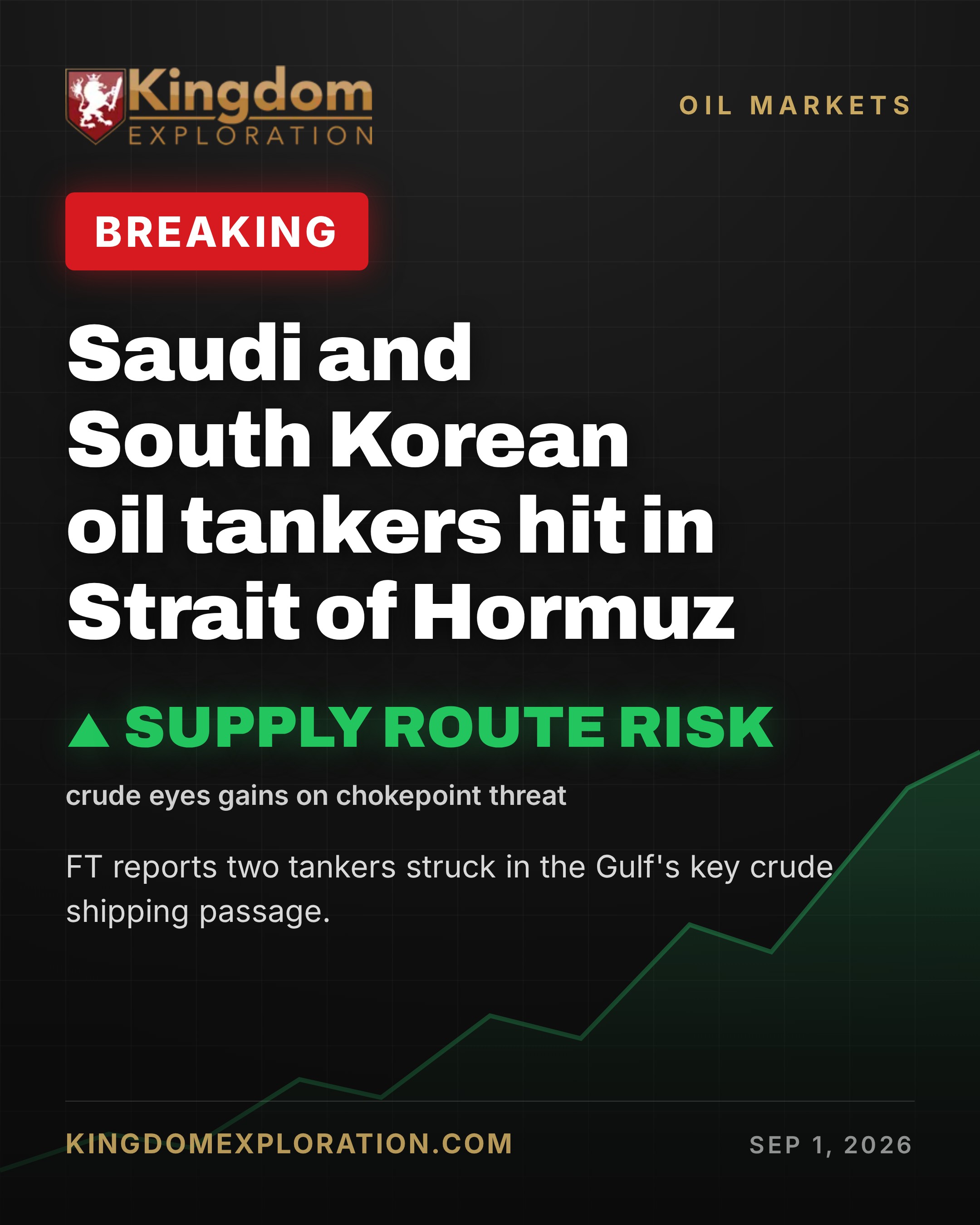
Saudi and South Korean oil tankers were hit in the Strait of Hormuz, the Financial Times reported, in an incident that instantly puts one of the world's most critical crude shipping arteries in the spotlight. The report emerged within the last hour and remains a developing story.
What Just Happened
According to the Financial Times, two oil tankers — one Saudi and one South Korean — were struck in the Strait of Hormuz, the narrow chokepoint between the Persian Gulf and the Gulf of Oman through which a large share of the world's seaborne crude passes. The outlet has not, in the initial report, detailed the nature of the strikes, the extent of the damage, or casualties.
The Strait of Hormuz is one of the most closely watched waterways in global energy trade. Any incident involving tankers there tends to reverberate quickly through freight, insurance and crude markets, because vessels have no easy alternative route out of the Gulf.
The Numbers
The initial Financial Times report does not disclose specific figures — no barrels-per-day of disrupted flow, no vessel tonnage, and no confirmed price move at the time of writing. What is known:
- Two oil tankers reported hit.
- One vessel Saudi, one South Korean.
- Location: the Strait of Hormuz.
As concrete numbers on damage, disruption and market reaction become available, they will be reported here.
Why Oil Prices Could Rise
Strikes on tankers in the Strait of Hormuz strike at the heart of the risk-premium calculation traders build into crude prices. The mechanism is straightforward:
- Supply at risk: The Strait is the only sea exit for crude loaded across the Persian Gulf. Threats to vessels there raise the possibility of slowed, rerouted or halted shipments.
- Insurance and freight: War-risk premiums for tankers transiting the region typically climb after such incidents, lifting the delivered cost of every barrel that moves through.
- Risk premium: Markets price the probability of escalation, not just current barrels lost. Even without a confirmed volume disruption, the perceived threat to the chokepoint can push crude higher.
Kingdom Exploration's read: Hormuz is the single most sensitive pressure point in the oil map. When tankers are hit there, the market moves first and asks for details second — the fear of a wider disruption is itself a price driver.
What to Watch Next
- Official confirmation of the vessels, operators and flag states involved.
- Any claim of responsibility and the response from Gulf and international authorities.
- Whether shipping companies pause or reroute transits through the Strait.
- Movement in Brent and WTI benchmarks and in tanker war-risk insurance rates.
- Statements from Saudi Arabia, South Korea and regional naval forces.
Reporting sourced from Financial Times. Developing story.
About Kingdom Exploration
Kingdom Exploration LLC is an Oklahoma-based oil and gas exploration company. Learn more at kingdomexploration.com.

