Live Updates
UPDATE — Oct 10, 7:47 PM CT: US strikes cargo vessel attempting to breach Iran naval blockade, per Roya News
The US military has struck a cargo vessel that attempted to breach the naval blockade on Iran, Roya News reports. The strike marks the first reported use of force to enforce the blockade that Washington has imposed with a reported fleet of rerouted ships.
Kingdom Exploration's read: an actual kinetic strike at sea is a sharp escalation from blockade posturing. Any armed incident around Iranian waters raises the risk of disruption to tanker traffic through the Persian Gulf and the Strait of Hormuz, the chokepoint for roughly a fifth of global oil flows. With Brent already above $105, traders are pricing in a widening conflict and further supply risk.
UPDATE — Oct 9, 9:57 PM CT: US reportedly reroutes 133 ships to enforce blockade on Iran
The US military has rerouted 133 ships to enforce a blockade on Iran, per جريدة القدس. The report marks a sharp escalation from preparation to active naval deployment in the region.
A blockade of this scale would directly threaten shipping lanes around Iran, including traffic through the Strait of Hormuz, through which a significant share of global seaborne crude transits. Any disruption to tanker movement raises the risk of supply bottlenecks.
Kingdom Exploration's read: with Brent already above $105 on strike fears, a naval blockade adds a tangible chokepoint risk on top of the threatened air campaign — the market is now pricing physical supply interruption, not just geopolitical anxiety.
UPDATE — Oct 8, 6:16 PM CT: NYT: Pentagon has drawn up a three-day Iran strike plan, nearing final preparations
The Pentagon has drawn up a three-day strike plan against Iran and is nearing final preparations, the New York Times reports, per bloomingbit. The detail sharpens the picture of escalation after earlier signals that CENTCOM had been ordered to prepare for combat operations.
The report points to a specific, time-bound military option rather than open-ended planning, suggesting decision-makers are moving closer to a potential launch window.
Kingdom Exploration's read: markets are already pricing conflict risk, with Brent above $105. A confirmed, near-ready strike plan raises the odds of disruption to Iranian output and Gulf shipping lanes, keeping upward pressure on crude until the situation clarifies.
UPDATE — Oct 8, 8:02 AM CT: Brent crude tops $105 as Trump weighs resuming 'major combat operations' in Iran
Brent crude has surged past $105 a barrel as President Trump weighs resuming "major combat operations" in Iran, per AOL.co.uk. The move marks a sharp jump for the global benchmark as traders price in the risk of a wider conflict after the Pentagon ordered CENTCOM to prepare for combat.
Kingdom Exploration's read: the $105 handle reflects a mounting war-risk premium rather than any confirmed supply loss so far. Any direct strikes on Iranian energy infrastructure or disruption to shipping through the Strait of Hormuz - the chokepoint for roughly a fifth of global oil flows - would be the next trigger for prices. For now, the market is reacting to the threat of escalation itself.
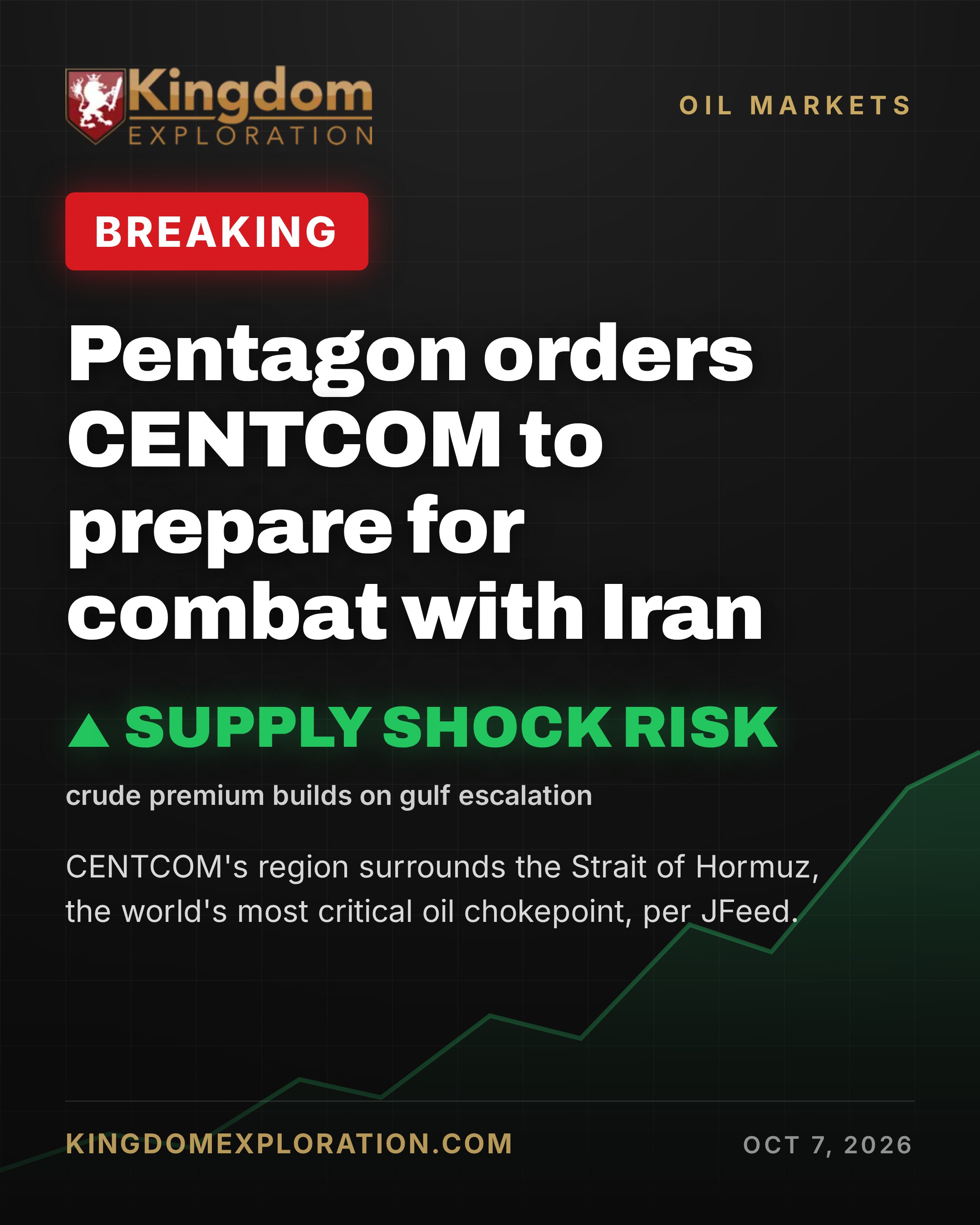
The Pentagon has directed U.S. Central Command (CENTCOM) to prepare for potential combat operations involving Iran, according to a report published by JFeed. The order signals a sharp escalation in U.S.-Iran military posture and immediately raises the stakes for one of the world's most sensitive oil-producing and oil-transiting regions.
What Just Happened
Per JFeed, the Pentagon has instructed CENTCOM — the U.S. military command responsible for the Middle East, including the Persian Gulf — to prepare for the possibility of combat with Iran. CENTCOM's area of responsibility spans the waters and littoral states surrounding the Strait of Hormuz, the single most important chokepoint in the global oil trade.
Beyond that reported directive, specific operational details, timelines, and troop movements have not been disclosed in the available reporting. The core fact driving the market reaction is the posture itself: the U.S. military's regional command has been told to ready for conflict with a major oil exporter.
The Numbers
The available source does not provide specific figures on troop deployments, oil-price moves, or production volumes tied to this order. What matters for energy markets is the geography involved. Iran sits on the northern shore of the Strait of Hormuz, through which a large share of the world's seaborne crude and condensate passes. Any military confrontation in or near that corridor directly threatens the physical flow of oil.
We are not attaching a price figure the source did not report. As concrete numbers on market reaction emerge, they will be reflected here.
Why Oil Prices Could Rise
Oil is priced on risk as much as on current barrels. When the U.S. military's regional command is ordered to prepare for combat with Iran, traders must price in the probability of supply disruption before a single barrel is actually lost. The mechanisms that feed into higher prices include:
- Chokepoint exposure: The Strait of Hormuz is the chokepoint for a huge volume of global oil shipments. Any threat to transit there can lift prices quickly.
- Risk premium: Escalation adds a geopolitical premium to crude as insurance, shipping, and financing costs rise and buyers scramble to secure supply.
- Supply at risk: Iran is a significant oil producer and exporter. A direct confrontation puts both its output and neighboring Gulf flows in play.
- Spare capacity strain: If Gulf supply is interrupted, the world leans on limited spare production capacity, tightening the global balance.
Kingdom Exploration's read: markets don't wait for the first shot — a prepare-for-combat order against a major Gulf producer is exactly the kind of headline that pulls a risk premium into crude before any physical disruption occurs.
What to Watch Next
- Official confirmation and scope of the CENTCOM directive from the Pentagon.
- Naval activity near the Strait of Hormuz and any shipping advisories or insurance-rate changes.
- Iran's response and any statements regarding Gulf shipping.
- Crude benchmarks for how quickly the market prices a geopolitical premium.
- Regional allies' postures and any changes to Gulf export routing.
Reporting sourced from JFeed. Developing story.
About Kingdom Exploration
Kingdom Exploration LLC is an Oklahoma-based oil and gas exploration company. Learn more at kingdomexploration.com.

