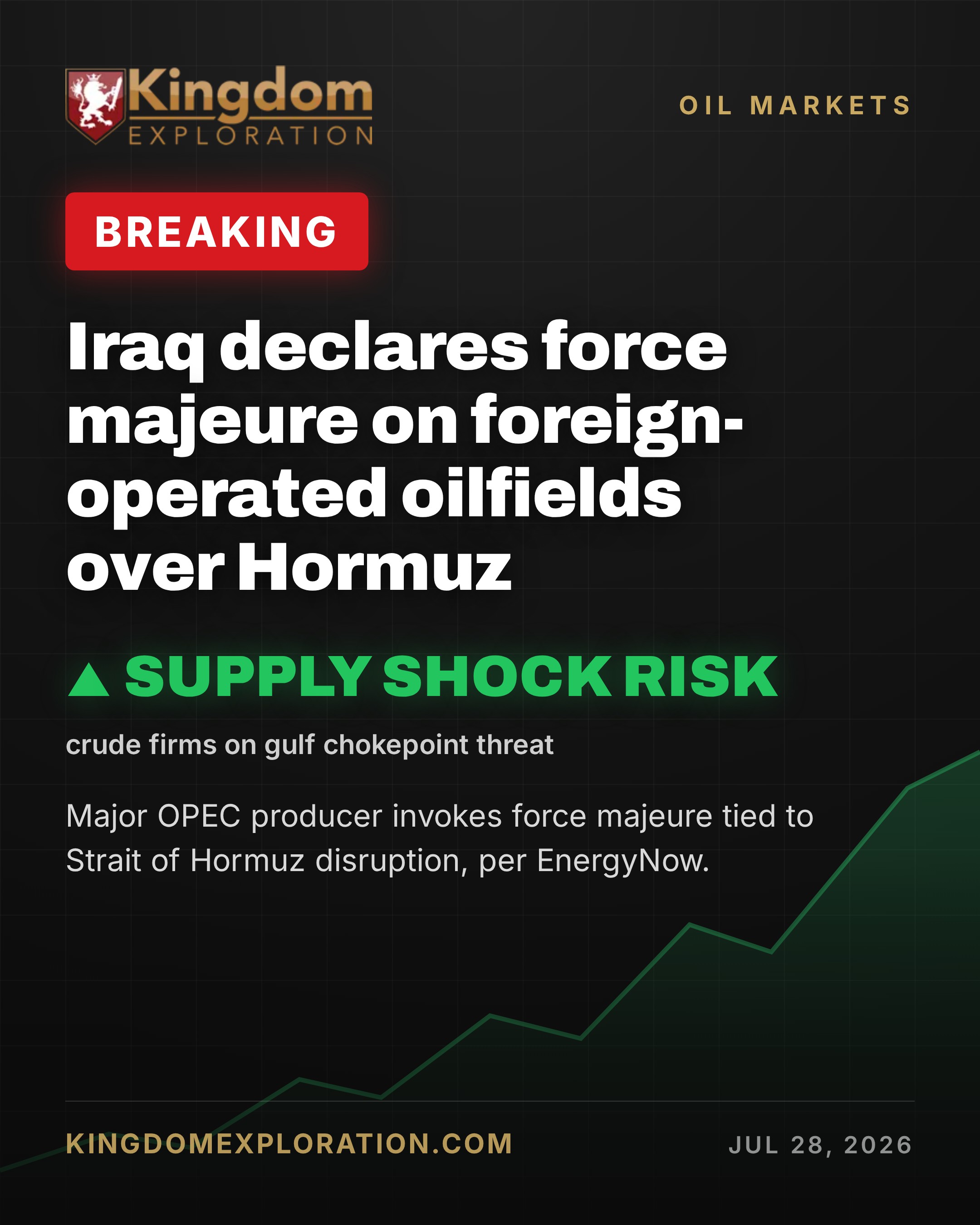
Iraq has declared force majeure on its foreign-operated oilfields in response to disruption at the Strait of Hormuz, according to sources cited by EnergyNow in a report published roughly an hour ago. The declaration signals that one of the world's largest crude producers may be unable to meet contractual delivery obligations while the key export chokepoint faces disruption.
What Just Happened
Per EnergyNow, sources say Iraq has invoked force majeure covering oilfields operated by foreign companies, tying the move directly to disruption at the Strait of Hormuz. Force majeure is a legal declaration that allows a producer or exporter to suspend contractual commitments due to circumstances beyond its control — in this case, the reported disruption affecting the Gulf's primary maritime export route.
The Strait of Hormuz is the single most critical passage for seaborne crude leaving the Persian Gulf. Any disruption there directly threatens the ability of regional producers, including Iraq, to move barrels to global markets. The declaration on foreign-operated fields suggests the impact is being felt at the level of physical production and export logistics, not just shipping lanes.
The Numbers
The EnergyNow report, as summarized, does not specify a volume of barrels affected, a price move, or a timeline for the disruption. Kingdom Exploration will update this story as concrete figures on affected output, export volumes, and market reaction become available.
- Producer: Iraq — a major OPEC member and one of the largest crude exporters in the Middle East
- Action: Force majeure declared on foreign-operated oilfields
- Trigger: Disruption at the Strait of Hormuz
- Source: EnergyNow, citing sources; report published approximately 74 minutes ago
Why Oil Prices Could Rise
A force majeure declaration by a producer of Iraq's scale is a supply-side event, and supply-side events tend to put upward pressure on crude prices through several mechanisms.
First, if barrels that markets were counting on cannot be delivered, the physical market tightens. Buyers scramble for alternative cargoes, and near-term prices can firm quickly. Second, the involvement of the Strait of Hormuz raises the geopolitical risk premium baked into oil. Traders price in not only the barrels immediately at risk but also the probability of wider or prolonged disruption to the Gulf's export artery. Third, when supply from a key chokepoint is called into question, the market's attention turns to spare capacity — how much production can be brought online elsewhere, and how fast. Any doubt about the ability to backfill lost barrels amplifies price sensitivity.
Kingdom Exploration's read: A force majeure on foreign-operated fields tied to Hormuz is the kind of headline that puts a bid under crude fast, because it hits both real barrels and the Gulf's most important export route at the same time. The key question is scale and duration — until those are clear, the market will lean toward pricing in risk.
What to Watch Next
- Volume confirmation: How many barrels per day of production or exports are actually affected by the declaration.
- Hormuz status: The nature, cause, and expected duration of the disruption at the strait.
- Operator statements: Confirmation and detail from the foreign companies operating the affected fields.
- Official Iraqi and OPEC response: Any statement clarifying the scope of force majeure or coordinated action.
- Price reaction: Movement in Brent and WTI benchmarks as the market digests the news.
This remains an unfolding situation based on sourced reporting. Details on scope and market impact may change as officials and operators comment.
Reporting sourced from EnergyNow. Developing story.
About Kingdom Exploration
Kingdom Exploration LLC is an Oklahoma-based oil and gas exploration company. Learn more at kingdomexploration.com.