Live Updates
UPDATE — Aug 7, 5:11 AM CT: Saudi Arabia on high alert over coordinated Iran-backed attack warnings
Saudi Arabia is on high alert over warnings of a coordinated attack by Iran-backed forces, Ynetnews reports. The alert follows Tehran's threats to strike Gulf states if the US carries out further attacks.
Details on the timing, targets or scale of any threatened action were not specified in the report. Kingdom Exploration's read: elevated readiness across Saudi Arabia signals rising fears for critical energy infrastructure in the world's top crude exporter.
Why it matters: any disruption to Saudi oil facilities or Gulf shipping could tighten global supply and put upward pressure on crude prices.
UPDATE — Aug 6, 9:02 AM CT: Iran threatened to 'black out' Gulf if US struck power plants, officials tell AFP
Iranian officials warned that Tehran was prepared to "black out" the Gulf if the United States targeted Iran's power plants, according to AFP reporting cited by Ahram Online. The threat sharpens Iran's earlier warnings that it would strike Gulf states in response to any renewed US attack.
No specific timeline or targets were detailed in the report, and the source text beyond the headline remains unavailable. Kingdom Exploration's read: threats aimed at the Gulf's energy and power infrastructure keep a risk premium under crude, given that the region handles a large share of global oil exports and any disruption to power or export facilities could tighten supply quickly.
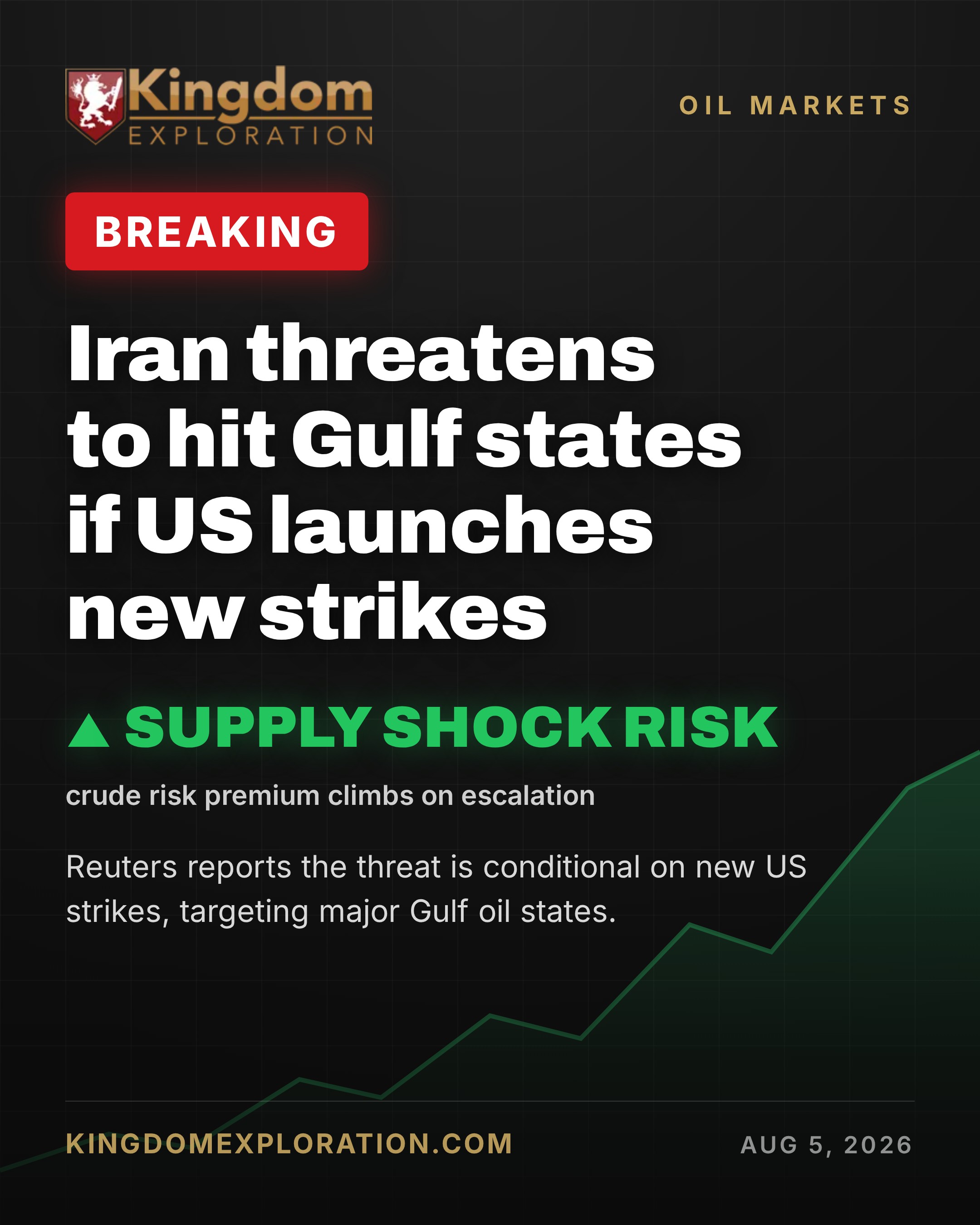
Iran has threatened to strike Gulf states if the United States launches new strikes, Reuters reported in an exclusive published minutes ago. The warning sharpens an already tense standoff and puts some of the world's most concentrated oil infrastructure directly in the frame of a potential retaliation.
Related coverage: Iran Renews Gulf Oil Target List: Ghawar, Ruwais, Burgan
What Just Happened
According to Reuters, Iran has issued a direct threat to hit Gulf states in the event of new US strikes. The exclusive report frames the threat as conditional retaliation — a response tied explicitly to further American military action rather than an immediate first move.
The threat lands against the backdrop of Iran's previously reported target list, which has named major Gulf oil facilities. Taken together, the latest warning signals that Tehran is prepared to widen any conflict beyond a bilateral exchange with the United States and into the territory of neighboring oil-producing states.
The Numbers
Reuters' exclusive, as summarized, does not attach specific figures, casualty counts, or barrel-per-day estimates to the threat. What is concrete is the conditional nature of the warning: Gulf states would be targeted if the US launches new strikes.
The stakes are defined less by any single published number and more by the geography involved. The Gulf region hosts some of the largest crude production and export capacity on the planet, and its export corridors funnel a substantial share of the world's seaborne oil. Any credible threat against that infrastructure carries outsized weight for global supply.
Why Oil Prices Could Rise
Threats of this kind feed directly into the geopolitical risk premium embedded in crude prices. When a major producer publicly warns that neighboring exporters could be hit, traders must price the possibility — however uncertain — that barrels could come offline quickly.
- Supply concentration: Gulf oil facilities represent a dense cluster of production and export capacity. A strike on any of them would remove volumes that are difficult to replace at short notice.
- Risk premium: Even without a shot fired, escalating rhetoric widens the range of outcomes traders must hedge against, tending to lift prices.
- Spare capacity: The world's cushion of readily available spare production is finite. The more of it that sits inside the threatened region, the less reassuring it becomes as a backstop.
Kingdom Exploration's read: a conditional threat is not an attack, but it compresses the market's margin for error. The closer the rhetoric moves toward the Gulf's export chokepoints, the more sensitive crude becomes to every subsequent headline.
What to Watch Next
- Whether the United States signals any new strike plans — the trigger Iran has named.
- Responses from Gulf governments and any moves to raise readiness at oil facilities.
- Ship-tracking and insurance data for signs of caution in Gulf export lanes.
- Any shift from conditional threat to specific, named targets, echoing Iran's earlier reported list.
For now, the market is trading on words, not damage. But in a region this central to global supply, words alone can move the risk premium.
Reporting sourced from Reuters. Developing story.
About Kingdom Exploration
Kingdom Exploration LLC is an Oklahoma-based oil and gas exploration company. Learn more at kingdomexploration.com.