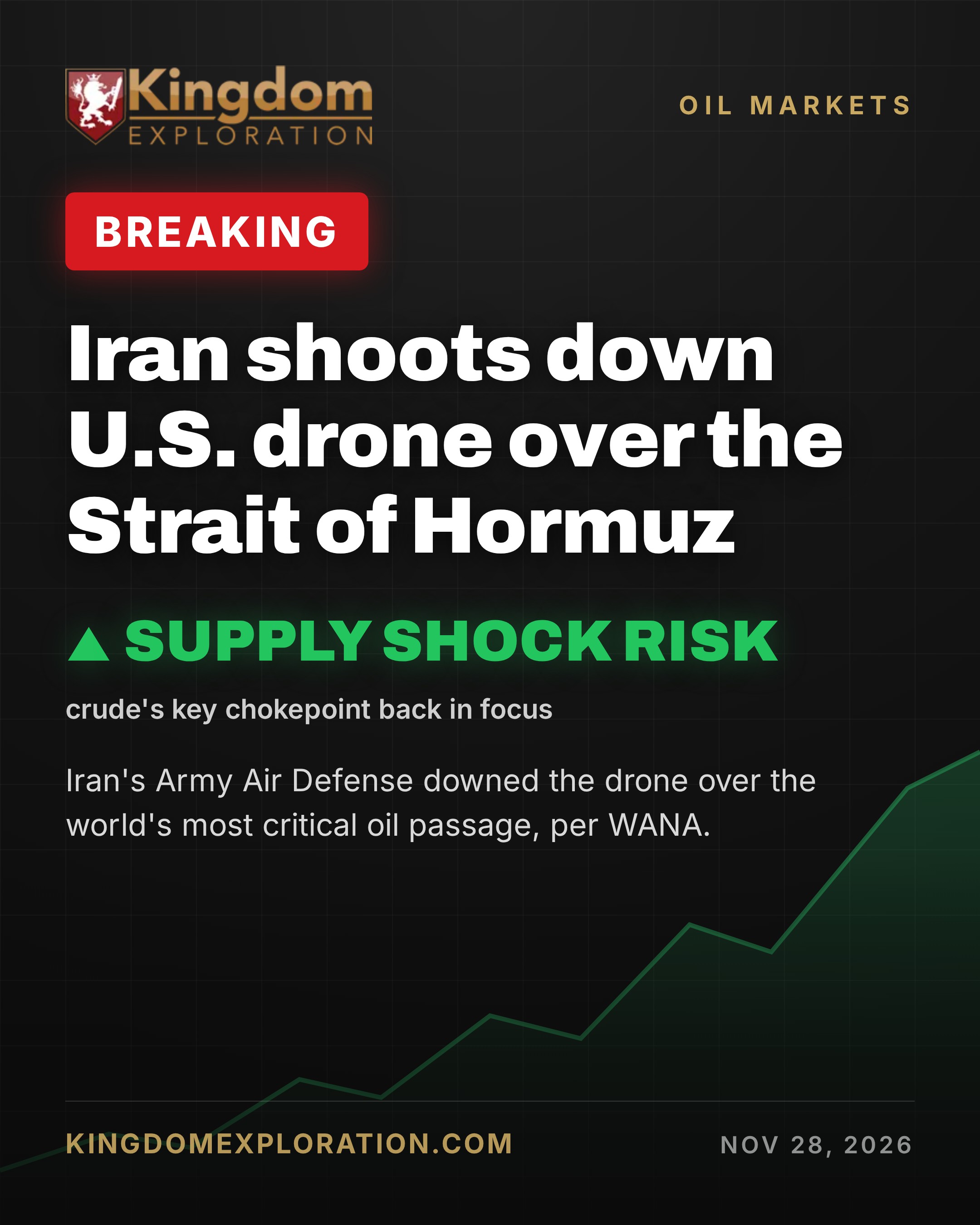
Iran's Army Air Defense shot down a U.S. drone over the Strait of Hormuz, the WANA News Agency reported, a fresh flashpoint directly above the world's most important oil shipping lane. The incident, reported within the last hour, raises the temperature in a waterway through which a large share of global seaborne crude moves every day.
What Just Happened
According to WANA, Iran's Army Air Defense engaged and brought down a U.S. drone operating over the Strait of Hormuz. The strait is the narrow passage between Iran and Oman connecting the Persian Gulf to the open ocean, and it is the single most sensitive chokepoint in the global oil trade.
Details beyond the downing itself - including the drone type, the exact location, and any U.S. response - were not specified in the initial report. The event underscores how quickly military activity around Hormuz can escalate and how closely energy markets watch any confrontation there.
The Numbers
The initial WANA report did not attach specific figures to the incident - no price moves, barrel counts, or casualty data were provided. What matters to oil markets is the location: the Strait of Hormuz is a chokepoint through which a very large volume of the world's crude and condensate transits daily, with no equivalent alternate route for most of those barrels.
Any disruption to transit - or even the perception that transit could be threatened - tends to be priced into crude quickly. Traders typically respond to escalation around Hormuz before any physical supply is actually lost.
Why Oil Prices Could Rise
The mechanism is straightforward. The Strait of Hormuz carries a concentration of global oil exports that cannot easily be rerouted. When a military incident occurs directly over or near the strait, markets add a risk premium to crude to account for the possibility of shipping disruptions, insurance-cost spikes, or a broader confrontation that could interrupt tanker traffic.
- Supply at risk: A meaningful share of seaborne crude depends on this single passage.
- Risk premium: Escalation raises the probability markets assign to a supply shock, lifting prices even without a physical cutoff.
- Thin alternatives: Limited pipeline bypass capacity means much of the flow has no quick substitute route.
Kingdom Exploration's read: A downed drone over Hormuz is the kind of headline that moves the risk premium first and asks questions later. The market does not need barrels to actually stop flowing - it only needs a credible reason to fear they might.
What to Watch Next
Key questions now: whether the United States confirms or disputes the account, whether there is any retaliatory or de-escalatory signal from either side, and - most importantly for oil - whether tanker traffic through the strait shows any sign of disruption or rising war-risk insurance costs. Watch for official statements from U.S. Central Command and for any change in shipping advisories through the Gulf.
If the incident stays isolated, any price reaction may fade. If it signals a wider pattern of confrontation around Hormuz, the risk premium could prove more durable.
A single drone over the Strait of Hormuz can move oil more than a routine production report - because the market is pricing the one scenario it can't easily hedge: a closed chokepoint.
Reporting sourced from WANA News Agency. Developing story.
About Kingdom Exploration
Kingdom Exploration LLC is an Oklahoma-based oil and gas exploration company. Learn more at kingdomexploration.com.