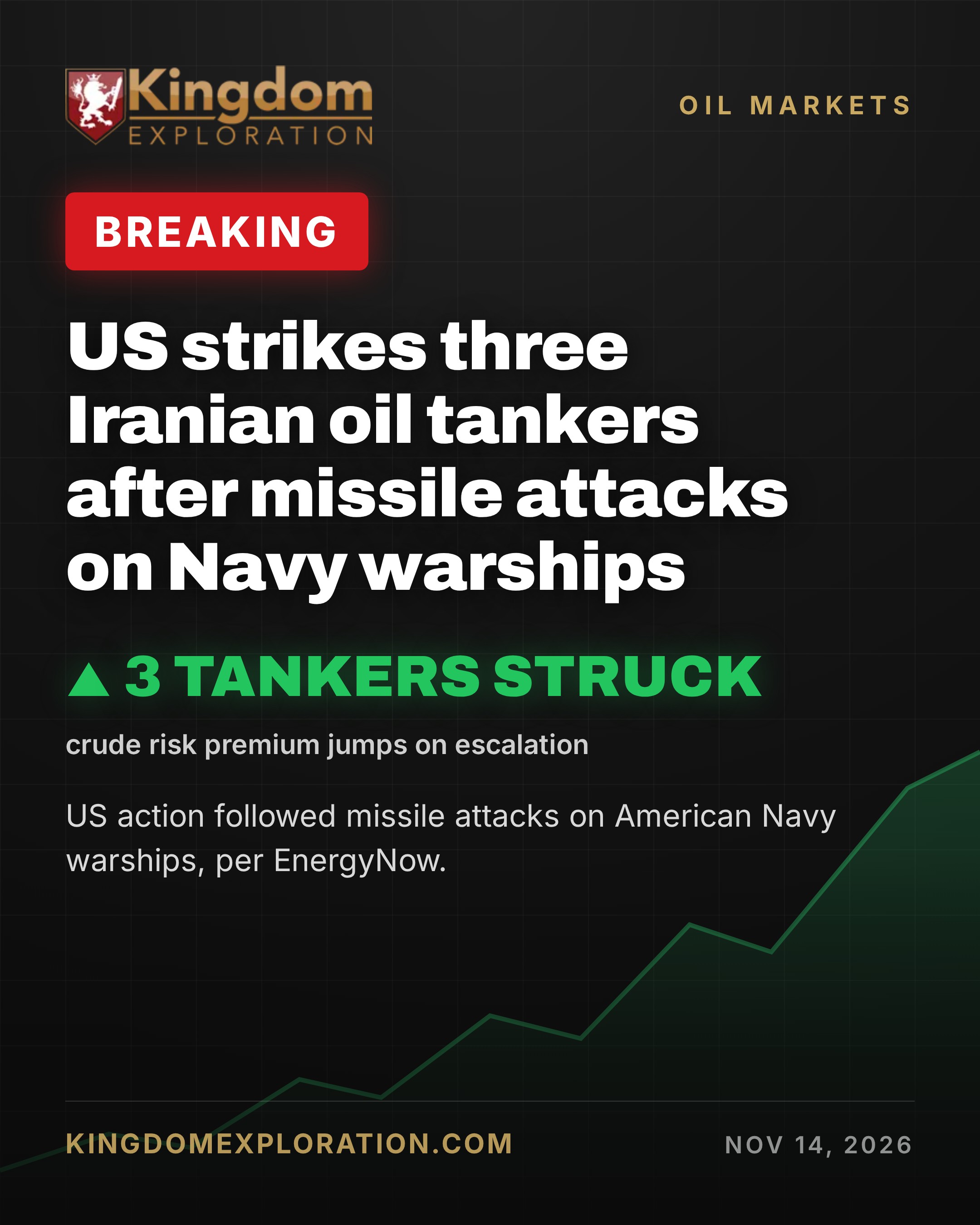
U.S. forces struck three Iranian oil tankers following missile attacks on American Navy warships, EnergyNow reported in a story published roughly 80 minutes ago. The strikes mark a sharp military escalation directly involving crude-carrying vessels, raising immediate concern across energy markets over Gulf supply security.
What Just Happened
According to EnergyNow, the United States targeted three Iranian oil tankers in response to missile attacks directed at U.S. Navy warships. The report frames the action as a retaliatory strike, placing oil infrastructure squarely in the center of a live military confrontation.
While the full operational details were not available at the time of reporting, the core facts are significant on their own: a direct U.S. military action against Iranian tankers tied to an exchange of fire with American naval assets. When crude-carrying vessels become targets, the market's attention turns instantly from barrels produced to barrels that may never reach port.
The Numbers
The confirmed figure from the source is three Iranian oil tankers struck. No casualty counts, barrel volumes, or price moves were provided in the initial EnergyNow report. We are deliberately not attaching numbers the source did not state.
- Tankers struck: 3 (Iranian oil tankers, per EnergyNow)
- Trigger: Missile attacks on U.S. Navy warships
- Status: Developing, published ~80 minutes ago
Why Oil Prices Could Rise
Direct strikes on oil tankers hit the market where it is most sensitive: the physical movement of crude. The Gulf region and its shipping lanes handle a large share of the world's seaborne oil, and any sign that vessels are now fair game injects a fresh risk premium into every barrel.
Three mechanisms tend to push prices higher in a scenario like this:
- Supply at risk: Tankers carry millions of barrels; damaged or diverted vessels remove supply from the market in real time.
- Risk premium: Traders price in the probability of wider conflict, insurance costs rise, and shippers may demand hazard pricing to transit the region.
- Spare capacity pressure: If Gulf flows are disrupted, the world leans on limited spare production capacity, leaving less cushion to absorb further shocks.
Kingdom Exploration's read: markets do not need a confirmed barrel count to move on a story like this. The moment tankers become military targets, the question shifts from "how much oil is flowing" to "how safe is the route it flows through" - and that uncertainty alone can lift crude.
What to Watch Next
Key signals in the coming hours and days include any Iranian response, whether shipping traffic through regional chokepoints slows or reroutes, and how insurers and tanker operators price the new risk. Watch for official statements from U.S. and Iranian authorities, confirmation of the tankers' cargo and status, and any indication the confrontation widens beyond this exchange.
For oil watchers, the near-term tell is the tape itself: how Brent and WTI open and trade as the market digests whether this is a contained incident or the start of a broader disruption to Gulf oil flows.
Reporting sourced from EnergyNow. Developing story.
About Kingdom Exploration
Kingdom Exploration LLC is an Oklahoma-based oil and gas exploration company. Learn more at kingdomexploration.com.

