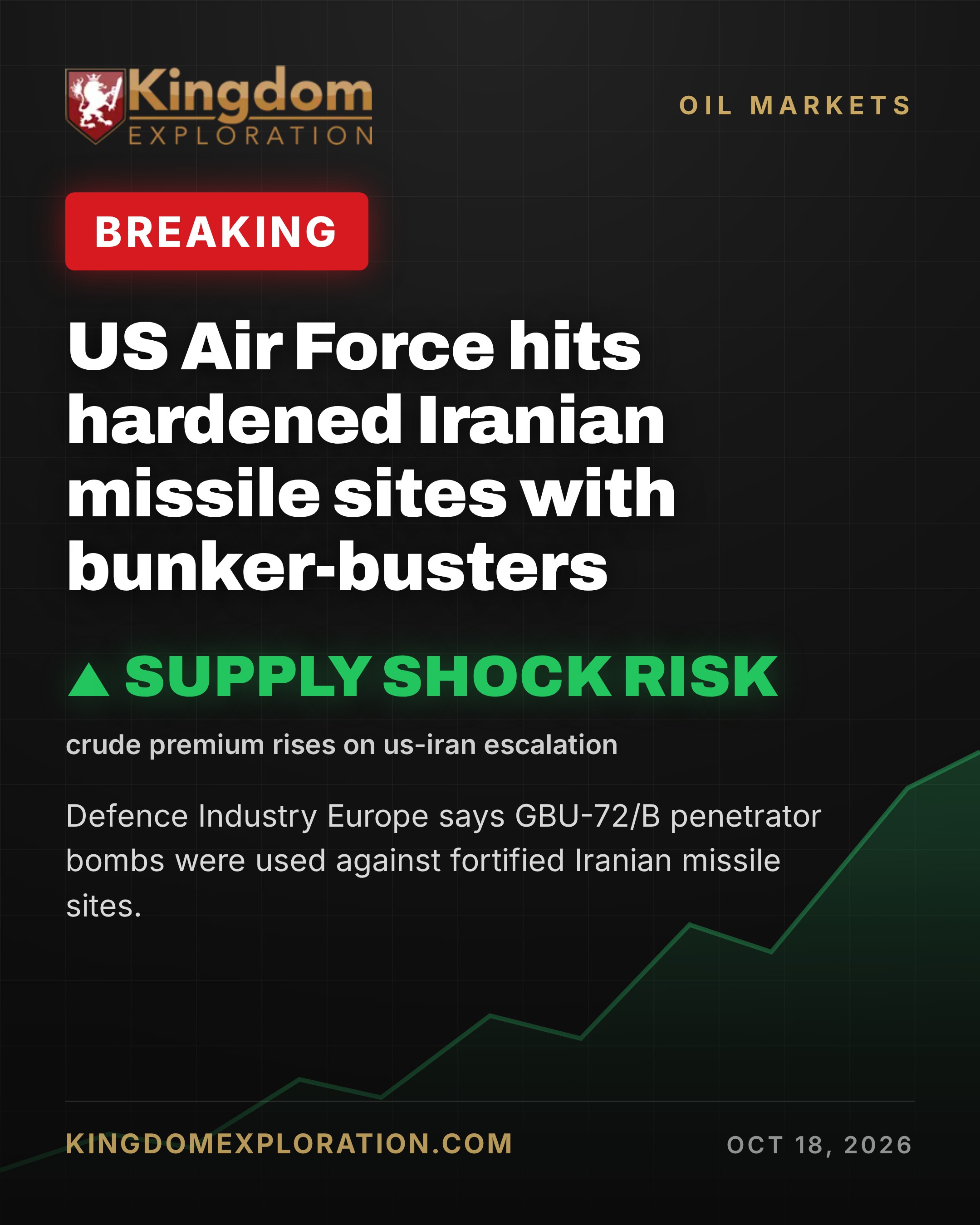
The U.S. Air Force deployed GBU-72/B bunker-buster bombs against hardened Iranian missile sites, Defence Industry Europe reported in the last hour. The strikes mark a sharp escalation in the U.S.-Iran confrontation and put one of the world's most sensitive oil corridors squarely back in the market's crosshairs.
Related coverage: Pentagon Orders CENTCOM to PREPARE for Iran Combat
What Just Happened
According to Defence Industry Europe, U.S. forces used GBU-72/B Advanced 5K Penetrator bombs - heavy, precision bunker-buster weapons designed to destroy deeply buried, fortified targets - against hardened Iranian missile sites. The GBU-72/B is purpose-built to reach reinforced underground facilities that lighter munitions cannot penetrate, signaling that the targets were high-value, hardened installations.
This follows earlier reporting that the Pentagon had ordered U.S. Central Command (CENTCOM) to prepare for combat operations against Iran. The confirmed use of penetrator weapons moves the situation from preparation to active strikes.
The Numbers
Defence Industry Europe's report centers on the munition itself - the GBU-72/B - and the nature of the targets (hardened Iranian missile sites). The outlet did not publish casualty figures, the number of sites hit, or specific barrel-per-day volumes at risk. We are not adding figures that were not reported.
What is undisputed in the market context: Iran is a major OPEC producer, and roughly one-fifth of the world's seaborne oil transits the nearby Strait of Hormuz. Any direct military exchange in the region raises the probability of supply disruption.
Why Oil Prices Could Rise
Direct U.S. strikes on Iranian military infrastructure introduce a textbook geopolitical risk premium into crude pricing. The mechanism is straightforward:
- Supply at risk: Iranian production and export terminals, plus the broader Gulf shipping lanes, sit within potential retaliation range.
- Chokepoint exposure: The Strait of Hormuz is the single most important oil transit point on earth; any threat to its security forces traders to price in disruption.
- Spare-capacity math: If barrels come offline, the market leans on OPEC spare capacity - and the thinner that cushion looks, the sharper the price reaction.
- Retaliation uncertainty: Markets hate the unknown. An Iranian response - against shipping, regional bases, or energy assets - would keep a bid under crude until the situation stabilizes.
Kingdom Exploration's read: a confirmed bunker-buster strike on hardened Iranian sites is the kind of headline that moves risk premium first and asks questions later. Watch whether Iran signals restraint or retaliation - that single variable will drive the near-term crude tape more than any inventory report.
What to Watch Next
- Iran's response: Any move against Gulf shipping or the Strait of Hormuz would be the clearest escalation trigger.
- Damage confirmation: Whether the strikes hit missile-launch capability or oil-related infrastructure.
- OPEC signaling: Any statement on spare capacity or willingness to add barrels.
- Shipping and insurance: Rising war-risk premiums on Gulf tanker traffic are an early tell of market stress.
- Official confirmation: Pentagon or Iranian government statements that corroborate or expand on the initial report.
Reporting sourced from Defence Industry Europe. Developing story.
About Kingdom Exploration
Kingdom Exploration LLC is an Oklahoma-based oil and gas exploration company. Learn more at kingdomexploration.com.

