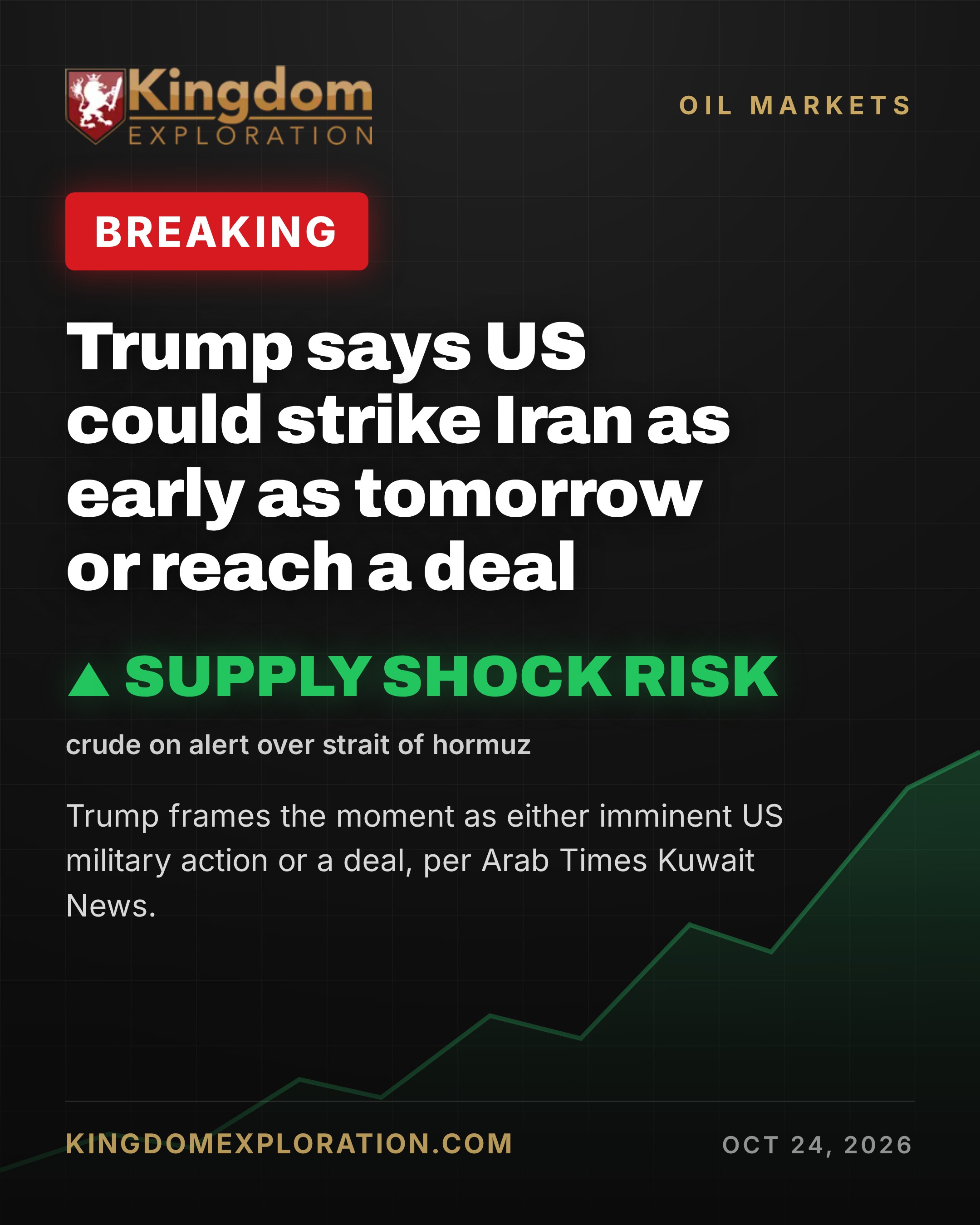
President Donald Trump said the United States could launch a military strike on Iran as early as “tomorrow” — or alternatively reach a deal — according to Arab Times Kuwait News, in comments published within the hour. The remark injects fresh uncertainty into an already tense standoff and puts energy markets on alert for a possible supply shock in the world’s most important oil-producing region.
Related coverage: US Bunker-Busters HIT Iranian Missile Sites
What Just Happened
Per Arab Times Kuwait News, Trump signaled that American military action against Iran could come imminently, framing the moment as a binary: a strike as soon as the next day, or a negotiated agreement. The dual framing underscores how fluid the situation remains, with both escalation and de-escalation openly on the table.
The comments follow earlier US military action against Iranian missile sites, which Kingdom Exploration has covered separately. The latest remarks raise the prospect of a further, broader confrontation rather than a single contained operation.
The Numbers
No specific figures — troop movements, targets, or timelines beyond “tomorrow” — were provided in the source. What markets weigh instead is geography: Iran sits on the Strait of Hormuz, the chokepoint through which a large share of the world’s seaborne crude transits. Any disruption there is the single largest tail risk in global oil supply, which is why even a verbal threat can move sentiment.
Why Oil Prices Could Rise
The mechanism is straightforward. A direct US-Iran military exchange threatens physical oil flows and raises the risk of retaliation against tankers, export terminals, or shipping lanes in the Gulf. Traders respond by pricing in a geopolitical risk premium — paying up for crude before any barrels are actually lost, simply to hedge against the possibility.
- Supply at risk: Iran is a major producer and sits astride the Strait of Hormuz, a critical export corridor.
- Risk premium: Open talk of an imminent strike pulls forward hedging and speculative buying.
- Spare capacity: A sustained outage would test how quickly other producers could backfill lost barrels.
Kingdom Exploration’s read: markets rarely wait for confirmation of an attack. When a head of state openly floats a strike “tomorrow,” the risk premium tends to build first and verify later — and it can unwind just as fast if the “deal” path gains traction.
What to Watch Next
Three things matter most in the hours ahead. First, whether the rhetoric translates into actual military movement or a diplomatic opening. Second, any signal from Iran on how it would respond, particularly regarding Gulf shipping and the Strait of Hormuz. Third, the reaction in benchmark crude prices and freight insurance rates, which often move before official confirmation of any event.
For energy watchers, the key distinction is between words and barrels: threats raise premiums, but only a confirmed disruption to flows changes the physical supply balance.
Reporting sourced from Arab Times Kuwait News. Developing story.
About Kingdom Exploration
Kingdom Exploration LLC is an Oklahoma-based oil and gas exploration company. Learn more at kingdomexploration.com.

