Live Updates
UPDATE — Sep 16, 8:56 AM CT: Only four ships transit Strait of Hormuz in a single day, UA.NEWS reports
Traffic through the Strait of Hormuz has collapsed to just four ships in a single day, according to UA.NEWS. The figure marks a dramatic deepening of the shipping paralysis that began after the supertanker mine strike, far below the strait's normal daily throughput of dozens of vessels.
Kingdom Exploration's read: a near-total halt in transits chokes off the roughly fifth of global seaborne oil that moves through the strait. With owners refusing to send tankers into a mined, IRGC-declared blockade zone, the physical supply crunch is now measured in ships, not rhetoric - a direct upward pressure on crude prices.
UPDATE — Sep 15, 7:26 AM CT: Reuters: Strait of Hormuz traffic halved as Middle East escalation deepens
Shipping traffic through the Strait of Hormuz has been cut in half amid the escalating conflict, according to Reuters cited by UA.NEWS. The drop follows the reported supertanker mine strike and Iran's IRGC declaring the waterway blockaded.
Roughly a fifth of the world's oil supply moves through the strait, so a sustained halving of transits would sharply tighten global crude flows and raise the risk of supply shortfalls.
Kingdom Exploration's read: even without a full closure, a 50% reduction in traffic signals shippers are already avoiding the chokepoint, which typically pushes freight and insurance costs higher and feeds directly into oil prices.
UPDATE — Sep 14, 6:27 PM CT: IRGC declares Strait of Hormuz 'fully blockaded' after supertanker mine strike
Iran's Revolutionary Guard has declared the Strait of Hormuz "fully blockaded," according to mbiz.heraldcorp.com, marking a sharp escalation hours after a supertanker struck naval mines in the waterway. The IRGC reiterated its claim that the vessel detonated a mine while transiting the strait.
The Strait of Hormuz is the world's most critical oil chokepoint, carrying roughly a fifth of global crude and condensate shipments. A declared blockade — if enforced — would threaten to choke off exports from Saudi Arabia, Iraq, Kuwait, the UAE and Iran itself.
Kingdom Exploration's read: a stated "full blockade" moves this from a single-vessel incident toward a systemic supply shock, and crude markets typically price a heavy risk premium the moment passage through Hormuz is called into question.
UPDATE — Sep 14, 4:21 PM CT: IRGC confirms oil tanker exploded after striking naval mines in Strait of Hormuz
Iran's Islamic Revolutionary Guard Corps (IRGC) says an oil tanker exploded after hitting naval mines in the Strait of Hormuz, per english.news.cn. The IRGC confirmation follows earlier reports of a supertanker striking two mines in the waterway.
No casualty figures, vessel identification or cargo details have been released in this report. Kingdom Exploration's read: an official IRGC acknowledgment of mines in the strait raises the stakes for the roughly one-fifth of global oil that transits Hormuz daily, and any perception of a mining threat can push insurance and freight costs sharply higher.
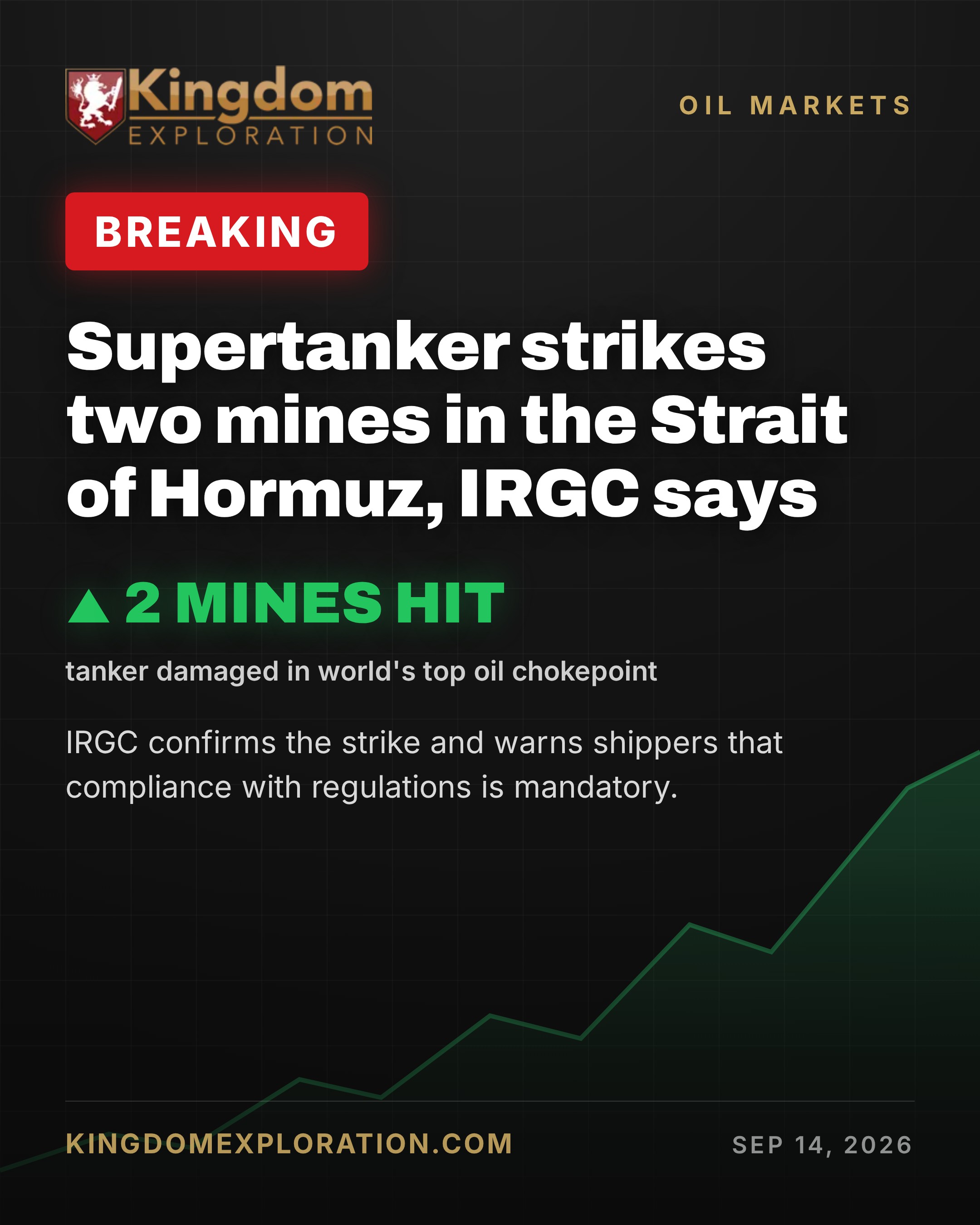
A supertanker struck two mines in the Strait of Hormuz, Iran's Islamic Revolutionary Guard Corps (IRGC) said, in an incident reported by The Sunday Guardian as part of its live coverage of the US-Israel-Iran conflict. The IRGC paired the announcement with a blunt warning to vessels transiting the waterway: "Compliance with regulations is mandatory." The report also noted that Saudi Arabia has lifted an emergency alert in its southern Najran region.
What Just Happened
According to The Sunday Guardian, the IRGC stated that a supertanker hit two mines while moving through the Strait of Hormuz, the narrow chokepoint that connects the Persian Gulf to the open ocean and carries a large share of the world's seaborne crude. The Guard's accompanying warning that adherence to regulations is "mandatory" signals Tehran's intent to assert control over shipping in the strait amid the wider regional conflict.
Separately, Saudi Arabia lifting its emergency alert in Najran, near the Yemeni border, suggests an easing of one localized threat even as the maritime situation in the Gulf draws fresh attention. The two developments together underscore how quickly conditions across the region can shift.
The Numbers
The source provides limited hard figures. The confirmed detail is that one supertanker struck two mines in the Strait of Hormuz, per the IRGC as reported by The Sunday Guardian. No casualty count, vessel name, cargo volume, or price move was specified in the available report.
- Vessels involved: one supertanker
- Mines struck: two
- Location: Strait of Hormuz
- Saudi Arabia: emergency alert lifted in Najran
Why Oil Prices Could Rise
The Strait of Hormuz is the single most important oil transit chokepoint on earth. Any incident that damages a tanker or raises the threat of mines in these waters injects immediate risk into the market. When shippers face the prospect of hitting mines, insurance and freight costs climb, some cargoes divert or delay, and traders price in a risk premium for barrels that must pass through the strait.
The mechanism is straightforward: even without a single barrel being physically removed from the market, the perceived threat to supply through a chokepoint of this size can lift crude prices. If Tehran follows through on enforcing shipping "regulations" through the strait, the volume of oil exposed to disruption is enormous.
"Compliance with regulations is mandatory."
— IRGC, as reported by The Sunday Guardian
Kingdom Exploration's read: a mine strike on a supertanker in the world's busiest oil corridor is exactly the kind of event that puts a floor of risk premium under crude until traders have clarity on whether transit remains safe.
What to Watch Next
- Whether shipping through the Strait of Hormuz slows or reroutes in response to the mine threat
- War-risk insurance premiums for Gulf-bound tankers
- Any independent confirmation of the vessel, its condition, and cargo
- Follow-up statements from the IRGC on enforcement of transit "regulations"
- Whether Saudi Arabia's lifted alert in Najran signals broader de-escalation on land
Reporting sourced from The Sunday Guardian. Developing story.
About Kingdom Exploration
Kingdom Exploration LLC is an Oklahoma-based oil and gas exploration company. Learn more at kingdomexploration.com.

