Live Updates
UPDATE — Aug 11, 7:06 PM CT: Death toll hits 6 in Houthi "double-tap" strike at Bab al-Mandeb Strait
Yemen now claims six people were killed in a Houthi "double-tap" strike on a vessel in the Red Sea's Bab al-Mandeb Strait, per ANI News. The report raises the toll from the four previously confirmed and points to a repeat-strike tactic, in which a second hit targets the same ship after the first.
Bab al-Mandeb is one of the world's most critical oil chokepoints, funneling crude and product tankers between the Red Sea and the Gulf of Aden. Kingdom Exploration's read: escalating casualties and a strait-focused strike pattern deepen shipping-risk fears, a bullish pressure point for crude as carriers weigh avoiding the corridor.
UPDATE — Aug 11, 9:08 AM CT: Death toll rises to 4 as Houthis strike another Red Sea vessel
The Iranian-backed Houthis killed four people in an attack on a vessel in the Red Sea, Newsmax reports. The updated toll marks an increase from the three deaths reported after the earlier strike on a Saudi ship, underscoring the widening scale of the maritime assault.
Newsmax attributes the attack to the Iranian-backed Houthi movement. Details on the targeted vessel's flag and cargo were not immediately available in the report.
Kingdom Exploration's read: sustained deadly attacks on Red Sea shipping keep a risk premium under crude, as owners weigh rerouting away from one of the world's busiest oil-transit corridors.
UPDATE — Aug 11, 7:52 AM CT: Houthi missile strike kills 3 on Saudi ship; 8 vessels targeted in Red Sea
A Houthi missile attack has killed three people aboard a Saudi ship, including two Pakistani nationals, per Bhaskar English. The report says a total of eight vessels were targeted in the Red Sea, marking a sharp escalation in maritime attacks on the vital shipping corridor.
Kingdom Exploration's read: multi-vessel strikes with confirmed fatalities raise the risk premium across the Red Sea and Bab el-Mandeb chokepoint. Any sustained targeting of shipping there can force carriers to reroute around Africa, tightening supply timelines and adding upward pressure to crude prices.
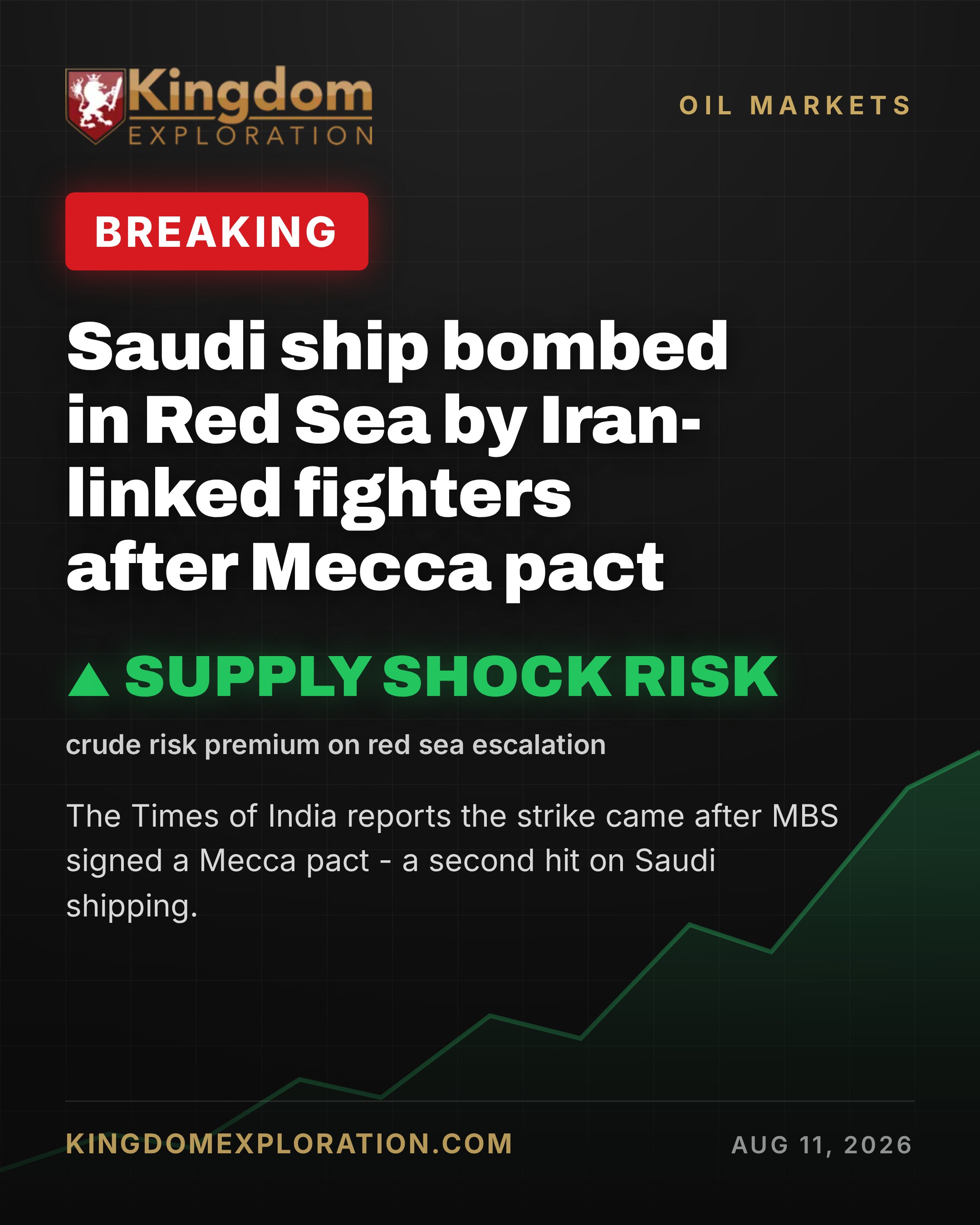
A Saudi ship was bombed in the Red Sea by Iran-linked fighters, striking shortly after Saudi Crown Prince Mohammed bin Salman signed a Mecca pact, The Times of India reported. The attack, reported roughly 12 minutes before publication, marks a fresh escalation along one of the world's most sensitive energy shipping corridors.
Related coverage: Houthis STRIKE Saudi Oil Tanker in Red Sea
What Just Happened
Per The Times of India, a Saudi ship was bombed in the Red Sea in an attack attributed to Iran-linked fighters. The outlet frames the strike as coming after MBS signed a Mecca pact, tying the incident directly to the broader regional tensions playing out across the Arabian Peninsula and the maritime approaches to the Suez Canal.
This development follows earlier reporting of a Houthi strike on a Saudi oil tanker in the same waters, indicating a pattern of attacks on Saudi-linked vessels transiting the Red Sea. The latest reporting centers on a new vessel being hit, though the full scope of damage and casualties was not detailed in the available report.
The Numbers
The Times of India report does not provide specific figures for the volume of cargo affected, the type of vessel, or any casualties. No barrels-per-day disruption total, tonnage, or price move was cited in the available summary. Kingdom Exploration will update this page as concrete figures are confirmed.
What is established: the Red Sea and its southern chokepoint, the Bab el-Mandeb strait, is a critical passage for crude and refined products moving between the Middle East, Europe, and beyond. Any credible threat to Saudi-flagged or Saudi-linked shipping in this corridor raises the cost and risk of transit.
Why Oil Prices Could Rise
Attacks on shipping in the Red Sea feed directly into crude pricing through the risk premium. When vessels tied to a major producer like Saudi Arabia are targeted, several mechanisms can push prices higher:
- Rerouting risk: Tankers may divert around the Cape of Good Hope, adding days and cost to voyages and tightening near-term available supply.
- Insurance and freight costs: War-risk premiums on hulls and cargo transiting the corridor tend to climb after each strike, raising the delivered cost of crude.
- Escalation premium: A strike tied to Iran-linked fighters against Saudi assets amplifies fears of a wider confrontation between regional heavyweights, and markets price in the possibility of supply loss before it materializes.
Kingdom Exploration's read: the market rarely waits for damage tallies. A second reported strike on Saudi-linked shipping in the Red Sea signals a sustained campaign rather than a one-off, and that is exactly the kind of pattern that keeps a risk premium embedded in crude.
What to Watch Next
Key signals in the coming hours and days include official confirmation from Saudi authorities on the vessel and its cargo, any claim of responsibility, and whether shipping firms announce fresh diversions away from the Bab el-Mandeb strait. Watch also for insurer responses on war-risk rates and any comment from OPEC members on supply assurances. The reference to a Mecca pact suggests a fast-moving diplomatic backdrop that could shape whether this incident de-escalates or widens.
Reporting sourced from The Times of India. Developing story.
About Kingdom Exploration
Kingdom Exploration LLC is an Oklahoma-based oil and gas exploration company. Learn more at kingdomexploration.com.

