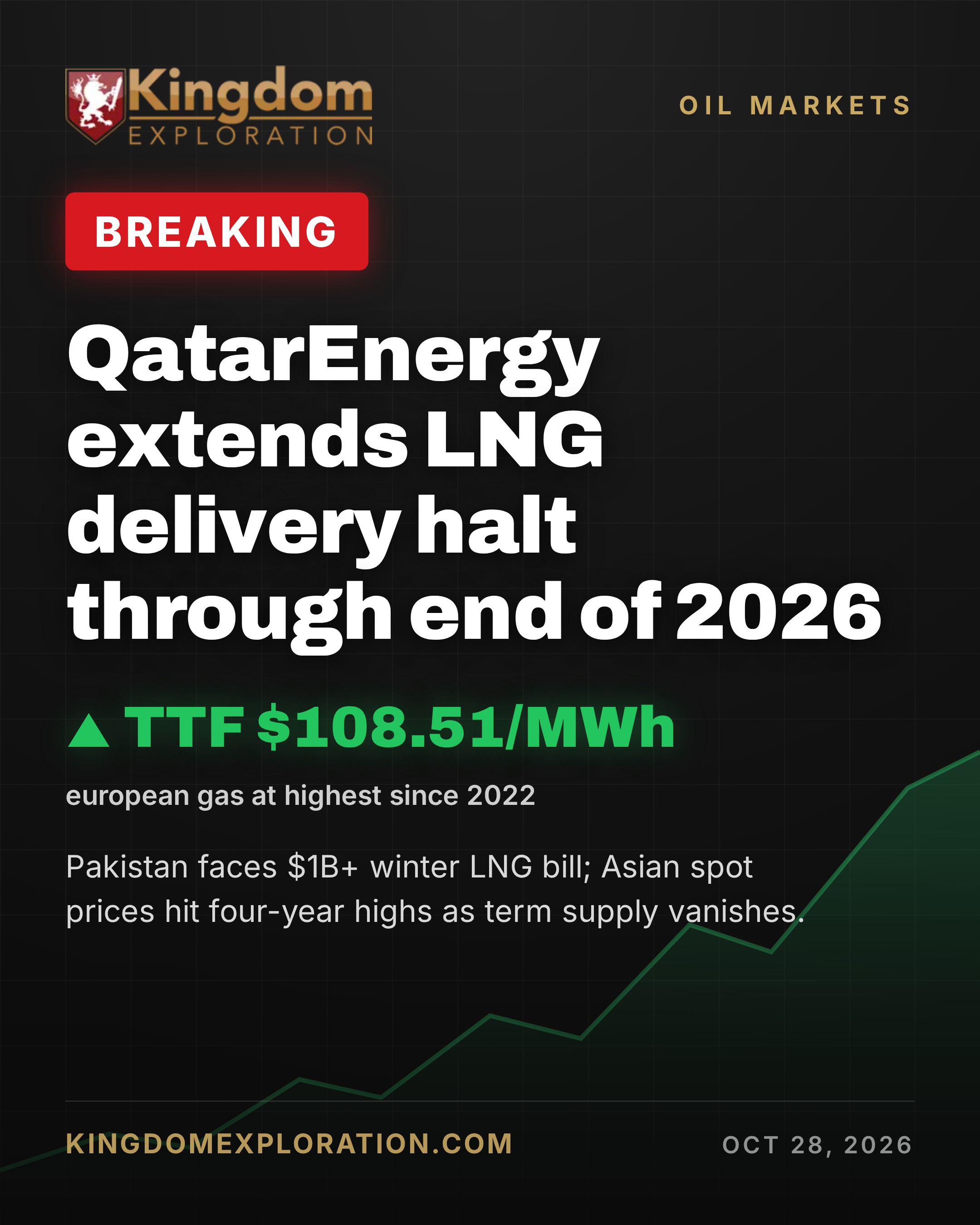
QatarEnergy has extended its force majeure on LNG deliveries through the end of December 2026, stripping Europe and Asia of certain term supply as they head into winter, oilprice.com reported Wednesday. The move pushed European natural gas prices to their highest level since the autumn of 2022.
What Just Happened
State-owned QatarEnergy notified buyers it cannot meet contracted LNG deliveries, extending a force majeure that has been in force since April 2026 until the end of the year. Italy's gas importer Edison confirmed it received notice that QatarEnergy would be unable to deliver three further LNG cargoes at the Adriatic LNG terminal in Italy.
The disruption is not limited to Europe. A source at Bangladesh's Petrobangla told Reuters that the force majeure on Qatari LNG deliveries to price-sensitive South Asian markets — Pakistan and Bangladesh — has also been extended until the end of the year. Per oilprice.com, LNG flows at the Strait of Hormuz have not recovered in any meaningful way, even as oil exports from the Middle East have, hiking European and Asian prices to the highest level since 2022.
The Numbers
- Force majeure extended to the end of December 2026 (in force since April 2026).
- Three further LNG cargoes to Italy's Adriatic LNG terminal will not be delivered.
- European front-month TTF price rose 1.5% to $108.51 (97.53 euros) per MWh — the highest since the 2022 energy crisis.
- Pakistan faces paying in excess of $1 billion to secure LNG for the winter, planning to import 10 spot cargoes at double its long-term Qatari contract price.
- Asian spot LNG prices have surged to four-year highs.
Why Oil Prices Could Rise
When term LNG supply is yanked offline, buyers are forced into the spot market to keep homes heated and factories running through winter. That scramble — visible in Pakistan's plan to pay double for 10 spot cargoes — tightens global energy supply broadly and lifts the risk premium across the entire fuel complex.
Natural gas and crude are substitutes in power generation and industry. As gas prices spike to 2022 crisis highs, some demand migrates to oil-based fuels, and the same geopolitical choke point behind the disruption — the Strait of Hormuz — is the world's most critical oil transit route. Any lingering stress on flows there keeps a bid under crude even as Middle East oil exports continue.
"We are trying to secure additional spot cargoes to bridge the supply gap, but at a significant cost, driving our import bill sharply higher and putting considerable pressure on our finances." — Abdul Mannan, chairman, Petrobangla
What to Watch Next
- Whether LNG flows at the Strait of Hormuz show any recovery in the coming weeks.
- How high European TTF and Asian spot LNG prices climb as winter demand builds.
- Further force majeure notices to other Qatari term buyers beyond Edison and South Asia.
- Spillover into crude as gas-to-oil switching and the Hormuz risk premium feed through to prices.
Reporting sourced from oilprice.com. Developing story.
About Kingdom Exploration
Kingdom Exploration LLC is an Oklahoma-based oil and gas exploration company. Learn more at kingdomexploration.com.

