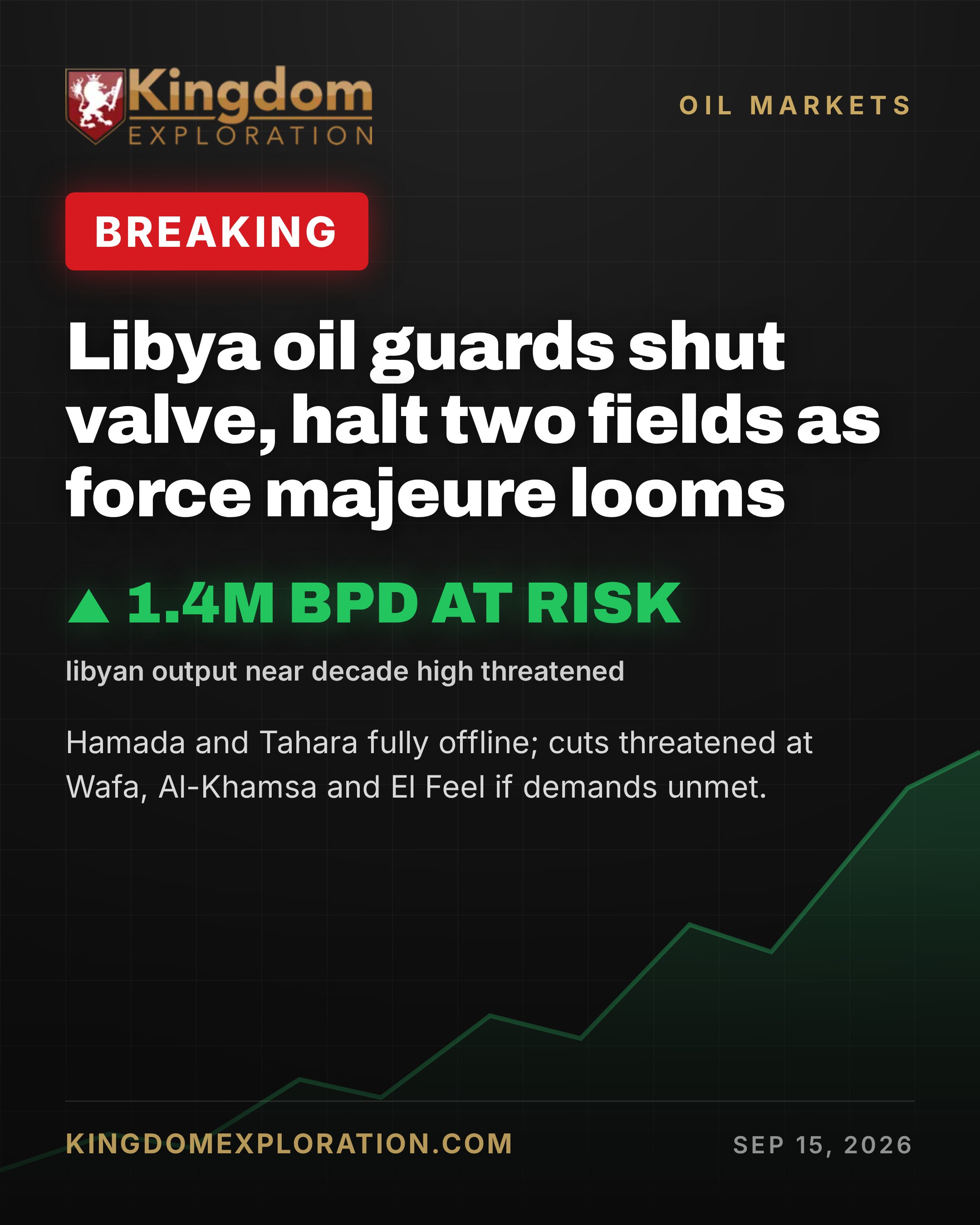
Libya's National Oil Corporation is threatening to declare force majeure after members of the security force assigned to protect the country's oil infrastructure shut a pipeline valve and halted production at two oilfields, oilprice.com reported Tuesday. Production has stopped completely at the Hamada and Tahara oilfields and at a pumping station after members of the Petroleum Facilities Guard closed a valve on the main Hamada-Zawiya crude pipeline.
What Just Happened
The Petroleum Facilities Guard, the very force tasked with protecting Libya's oil assets, closed a valve on the main Hamada-Zawiya crude pipeline, bringing production at the Hamada and Tahara fields and a pumping station to a complete stop. The Guard is demanding to be transferred financially and administratively from Libya's defense ministry to the National Oil Corporation, and wants a firm timetable to complete that move.
The disruption may not stop there. The Guard said it would impose partial production cuts for one week at several additional fields, including Wafa, Al-Khamsa and El Feel, with a full shutdown to follow if its demands are not met. NOC responded that it could declare force majeure if the closed valve is not reopened or if similar shutdowns hit other oilfields.
Libya has been here before. Political groups, armed factions and workers have repeatedly used oilfields, pipelines and terminals as leverage since the 2011 uprising that toppled Muammar Gaddafi. The recurring vulnerability is structural: fields capable of producing more oil remain exposed to whoever controls the valve.
The Numbers
- Complete production halt at the Hamada and Tahara oilfields plus a pumping station.
- Partial cuts threatened for one week at Wafa, Al-Khamsa and El Feel, with a full shutdown to follow.
- Libyan output has climbed to roughly 1.4 million barrels per day, its highest level in more than a decade.
- NOC targets 1.6 million bpd by end of 2026 and 2 million bpd by the early 2030s.
- Reaching those targets could require $36 billion to $40 billion in foreign investment, per NOC Chairman Masoud Suleman.
- NOC received a $2 billion allocation under Libya's 2026 budget to support its production plans.
Why Oil Prices Could Rise
Libya sits close to the top of its production range in over a decade, and any barrels pulled offline tighten an already-watched global balance. A full field shutdown removes physical supply while a force majeure declaration would formally suspend contractual delivery obligations, signaling to the market that Libyan barrels are not reliably available.
The mechanism is straightforward: when a producer at 1.4 million bpd faces cascading shutdowns across multiple fields, traders price in a risk premium against the possibility that more valves close. With the Guard threatening to widen the action from two fields to Wafa, Al-Khamsa and El Feel, the perceived supply risk grows even before additional barrels are lost.
Libya's history of using infrastructure as political leverage amplifies the uncertainty. Each closure raises the question of how quickly output can be restored, and repeated stoppages erode confidence in Libyan supply just as international majors like Repsol, Eni, QatarEnergy, TPAO and MOL are moving back in.
Kingdom Exploration's read
The story here is not just the two fields already down, it is the credible threat to close the valve at several more. Markets tend to price the threatened barrels, not only the lost ones. Watch whether NOC actually declares force majeure, because that word converts a local dispute into a global supply signal.
What to Watch Next
- Whether NOC formally declares force majeure on the affected fields.
- Whether the Guard follows through on partial cuts at Wafa, Al-Khamsa and El Feel, and whether those escalate to full shutdowns.
- Any resolution of the Guard's demand to shift oversight from the defense ministry to NOC.
- How much of Libya's roughly 1.4 million bpd is ultimately taken offline and for how long.
- Whether the standoff affects Libya's ability to attract the $36 billion to $40 billion in investment tied to its expansion plans.
Reporting sourced from oilprice.com. Developing story.
About Kingdom Exploration
Kingdom Exploration LLC is an Oklahoma-based oil and gas exploration company. Learn more at kingdomexploration.com.

