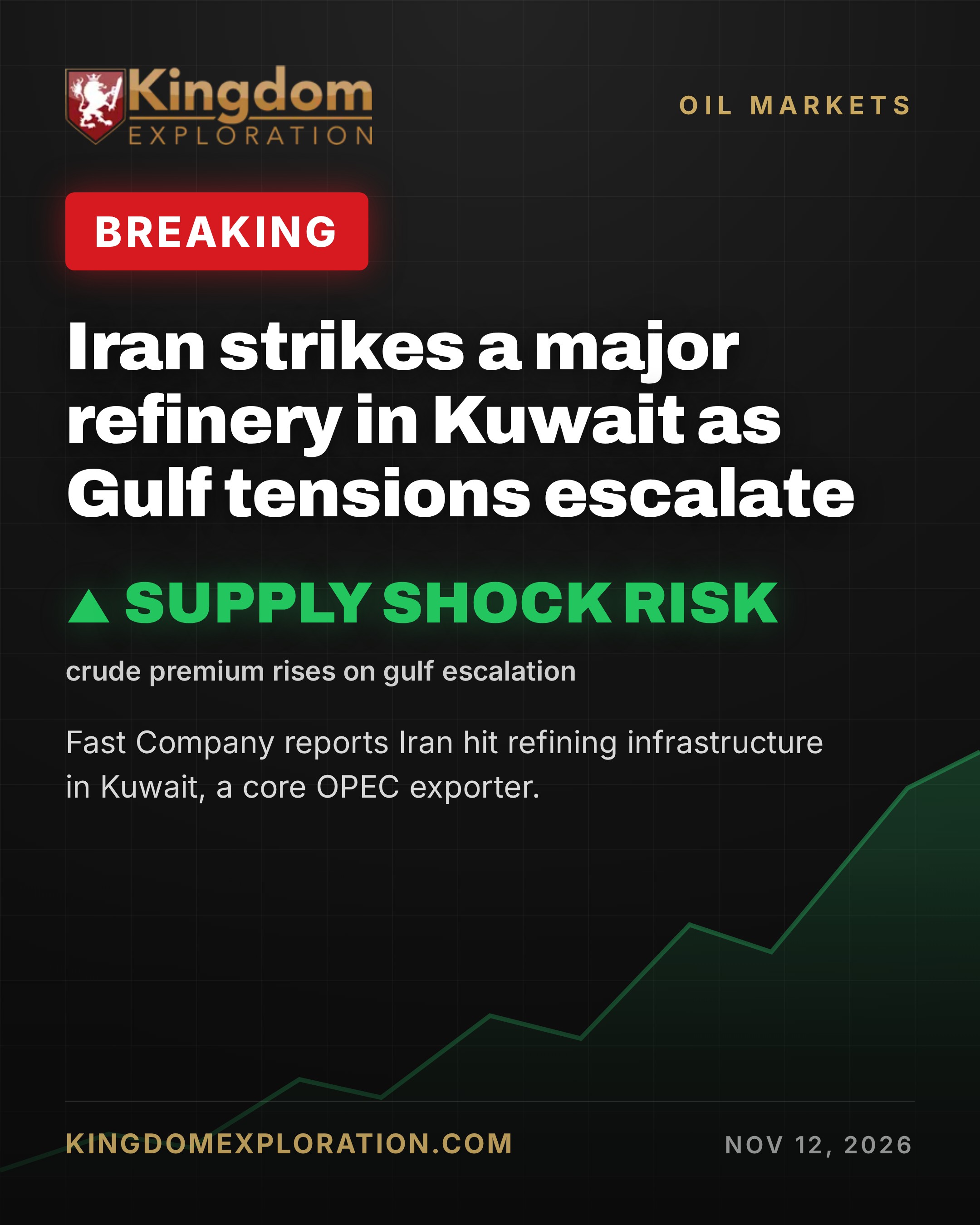
Iran has escalated its attacks in the Gulf, striking one of the region's major refineries in Kuwait, Fast Company reports. The strike marks a sharp intensification of hostilities in one of the world's most critical energy corridors and immediately raises the specter of disrupted crude and refined-product flows from the Persian Gulf.
What Just Happened
According to Fast Company, Iran escalated its campaign of attacks across the Gulf, hitting a major Kuwaiti refinery. Kuwait is a core OPEC producer and a significant exporter of both crude oil and refined products, making any direct strike on its refining infrastructure a serious concern for global energy markets.
An attack on refining assets differs from a strike on an oilfield or pipeline: refineries are complex, hard-to-replace facilities, and damage can take weeks or months to repair. A hit on a major Gulf refinery can ripple through fuel supply chains well beyond Kuwait's borders.
The Numbers
At this early stage, Fast Company's report does not specify casualty figures, the volume of refining capacity affected, or the scale of any production outage. Kingdom Exploration is not attaching numbers that have not been confirmed by the source.
What is clear is the location: the Gulf region, through which a large share of the world's seaborne crude moves daily. Markets price risk to that corridor aggressively, even before hard damage assessments are available.
Why Oil Prices Could Rise
The oil market runs on risk premium, and a direct strike on major Gulf refining infrastructure is exactly the kind of event that can push prices higher. The mechanism is straightforward:
- Supply at risk: A damaged refinery can curb refined-product output and, depending on severity, back up crude handling in the region.
- Escalation fear: An attack on Kuwait signals a widening conflict that could threaten tankers, terminals, and the broader Gulf shipping lanes.
- Spare capacity questions: Traders weigh how quickly other producers could offset lost volumes, and refining capacity is harder to replace than crude barrels.
Even without confirmed outage figures, the headline alone tends to inject a geopolitical premium into crude benchmarks as the market braces for the worst-case scenario.
Kingdom Exploration's read: A direct hit on a major Gulf refinery is the kind of headline that moves the risk premium first and asks for the damage report later. The market will watch for any sign the conflict spreads to tankers or export terminals.
What to Watch Next
- Damage assessment: Confirmed figures on refining capacity offline and repair timelines.
- Kuwaiti and regional response: Official statements on the attack and any defensive posture changes across the Gulf.
- Shipping and insurance: War-risk premiums for tankers transiting Gulf waters, a leading indicator of market stress.
- Crude benchmarks: How Brent and WTI react as the session develops and whether the premium holds or fades.
- Further escalation: Any additional strikes on energy infrastructure or signs the conflict is broadening.
This is a fast-moving situation and details remain limited. Kingdom Exploration will track confirmed figures as they emerge.
Reporting sourced from Fast Company. Developing story.
About Kingdom Exploration
Kingdom Exploration LLC is an Oklahoma-based oil and gas exploration company. Learn more at kingdomexploration.com.

