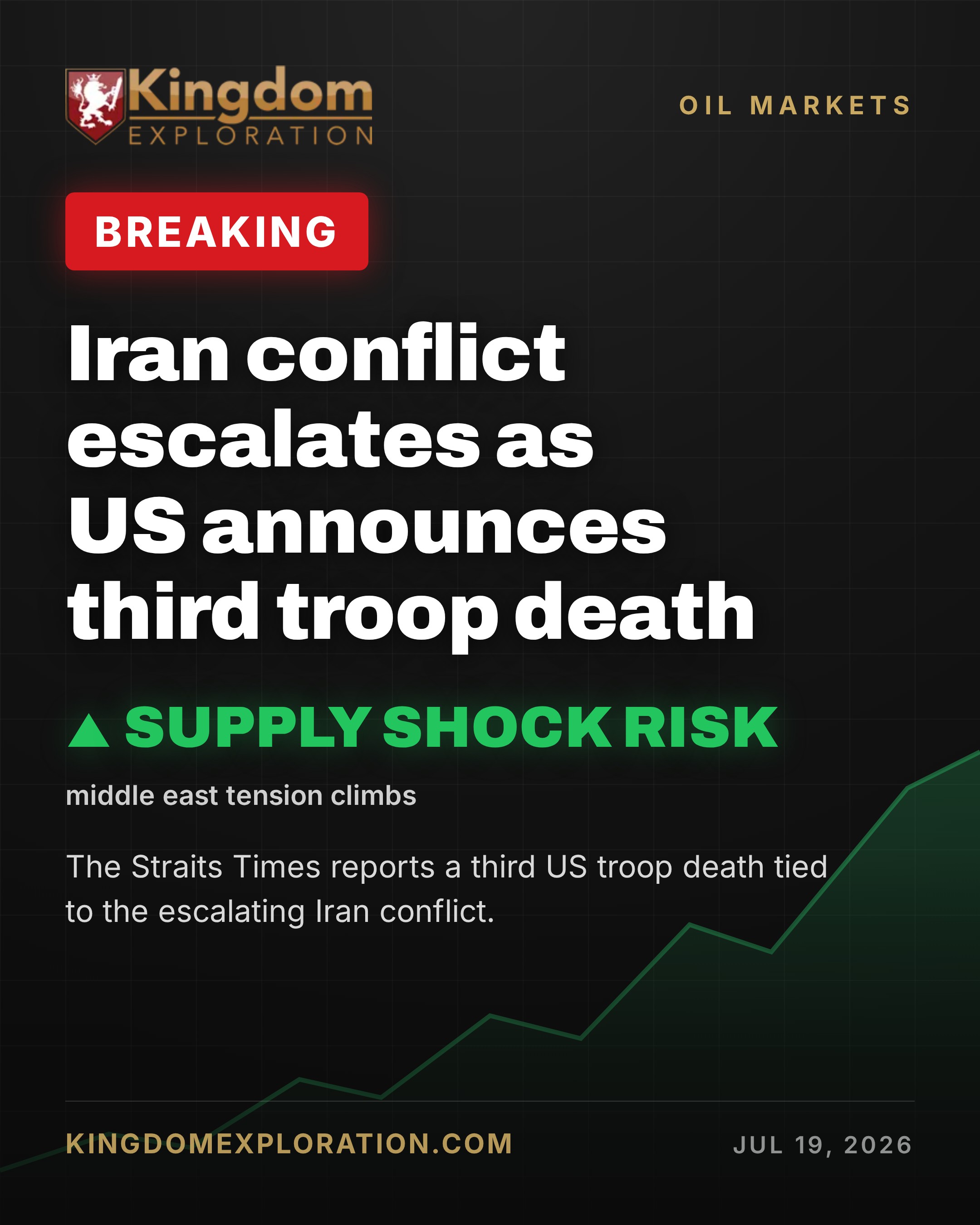
Tensions surrounding Iran escalated further after the United States announced a third troop death tied to the ongoing conflict, according to The Straits Times. The report, published minutes ago, points to a deepening confrontation in one of the world's most strategically important energy regions.
What Just Happened
Per The Straits Times, the Iran conflict has intensified as the US confirmed a third troop fatality connected to the escalation. The report frames the development as a marker of a worsening security situation. With the story still developing, details beyond the announced troop death remain limited, but any escalation involving US personnel and Iran carries immediate implications for global energy markets.
The Numbers
The confirmed figure available in the reporting is stark in its simplicity: a third US troop death. The Straits Times report does not provide additional casualty counts, production figures, or price data at this time. As with any developing story, further numbers may emerge as the situation unfolds.
- US troop deaths announced: three, per The Straits Times
- Time since report: published within the hour
- Additional confirmed figures: none provided in the source
Why Oil Prices Could Rise
The Middle East sits at the center of global crude supply, and Iran in particular borders the Strait of Hormuz, the chokepoint through which a large share of the world's seaborne oil passes daily. When conflict involving Iran escalates, markets typically price in a risk premium - not because supply has necessarily been cut, but because the probability of disruption rises.
The mechanism is straightforward. Traders weigh the possibility that escalation could threaten regional production, shipping lanes, or infrastructure. Even the perception of heightened risk can pull spare capacity assumptions tighter and push barrels higher as buyers seek to secure supply ahead of any potential interruption. A confirmed US troop death signals a more direct confrontation, which can amplify that premium.
Kingdom Exploration's read: escalation involving US forces and Iran is exactly the kind of headline that reintroduces a geopolitical risk premium into crude. Markets tend to react first to the risk of disruption and confirm the fundamentals later.
What to Watch Next
Watch for official statements clarifying the scope of the escalation and any indication of impact on regional oil infrastructure or shipping through the Strait of Hormuz. Additional casualty details, any Iranian response, and diplomatic signaling will shape how durable any risk premium becomes. Traders will also monitor whether energy exports from the region show any measurable disruption versus a purely sentiment-driven move.
For now, the situation remains fluid. The key questions are how far the confrontation extends and whether it moves from a security event into a genuine supply-side concern.
Reporting sourced from The Straits Times. Developing story.
About Kingdom Exploration
Kingdom Exploration LLC is an Oklahoma-based oil and gas exploration company. Learn more at kingdomexploration.com.

