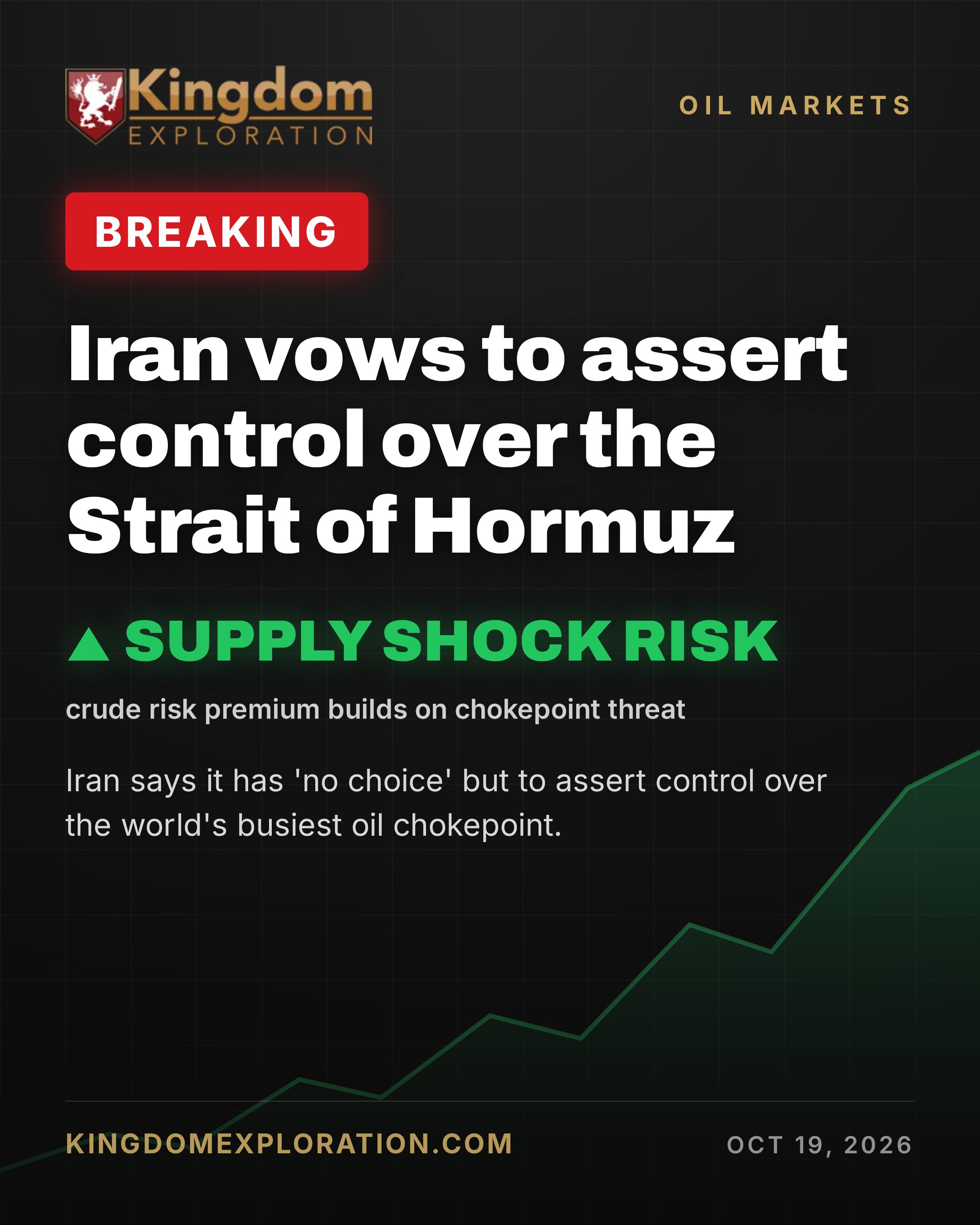
Iran has declared it has "no choice" but to assert control over the Strait of Hormuz, the narrow waterway that funnels a large share of the world's seaborne crude, according to Business Upturn. The statement, reported within the past hour, immediately raises the specter of disruption at the single most sensitive chokepoint in global energy.
What Just Happened
Per Business Upturn, Iran framed its posture toward the Strait of Hormuz as a necessity rather than a choice, signaling an intent to assert control over the passage. The Strait of Hormuz separates the Persian Gulf from the Gulf of Oman and is the maritime corridor through which tankers carrying crude from Saudi Arabia, Iraq, Kuwait, the United Arab Emirates and Iran itself must pass to reach global markets.
Any move by a single actor to assert control over that waterway is treated by oil markets as a direct threat to the free flow of barrels. Even absent a physical blockade, rhetoric of this kind tends to inject a risk premium into crude prices as traders price in the possibility of interruption.
The Numbers
The source did not provide specific figures on barrels affected, price moves, or vessel traffic tied to this statement. What is not in dispute among energy watchers is the strategic weight of the Strait of Hormuz as the busiest oil transit chokepoint on the planet — a position that makes even verbal escalation market-moving.
Kingdom Exploration will update this report with concrete figures on crude benchmarks and shipping volumes as they are confirmed.
Why Oil Prices Could Rise
The mechanism is straightforward. The Strait of Hormuz is a narrow passage with no easy substitute for the volume of crude that moves through it. When the flow through a chokepoint like this is called into question, three things happen:
- Supply at risk: A meaningful share of globally traded crude could be delayed, rerouted, or halted if the strait is contested.
- Risk premium: Traders add a premium to crude futures to account for the probability of disruption, pushing prices up before any barrel is actually lost.
- Spare capacity strain: Much of the world's spare production capacity sits inside the Gulf — behind the very chokepoint now in question — limiting the ability to offset a shortfall.
Kingdom Exploration's read: markets do not wait for a strait to actually close. The mere assertion of control over Hormuz is enough to move the risk premium, because the downside scenario is so severe and the alternatives so limited.
What to Watch Next
- Official responses from Gulf states, the United States, and major importers in Asia.
- Any change in tanker traffic, insurance rates, or rerouting around the strait.
- Movement in Brent and WTI benchmarks as traders reprice the risk.
- Clarification from Iran on what "assert control" means in practice — rhetorical, regulatory, or physical.
For now, the headline fact is clear: the custodian of one side of the world's most important oil chokepoint is signaling it intends to assert control over it. That alone is enough to put energy markets on alert.
Reporting sourced from Business Upturn. Developing story.
About Kingdom Exploration
Kingdom Exploration LLC is an Oklahoma-based oil and gas exploration company. Learn more at kingdomexploration.com.

