Live Updates
UPDATE — Aug 24, 12:57 PM CT: Houthis escalate Saudi campaign with VLCC strike, gCaptain reports
The Houthis have escalated their campaign against Saudi shipping with a strike on a VLCC (Very Large Crude Carrier), gCaptain reports. VLCCs are the workhorses of the crude trade, each typically capable of carrying roughly 2 million barrels, making them prime targets in any effort to disrupt Saudi oil exports.
Kingdom Exploration's read: an attack aimed at a supertanker rather than a smaller vessel raises the stakes for Red Sea and Saudi export routes. Any threat to VLCC traffic near the Kingdom's loading terminals could pressure freight and insurance costs and inject fresh risk premium into crude prices if the campaign persists.
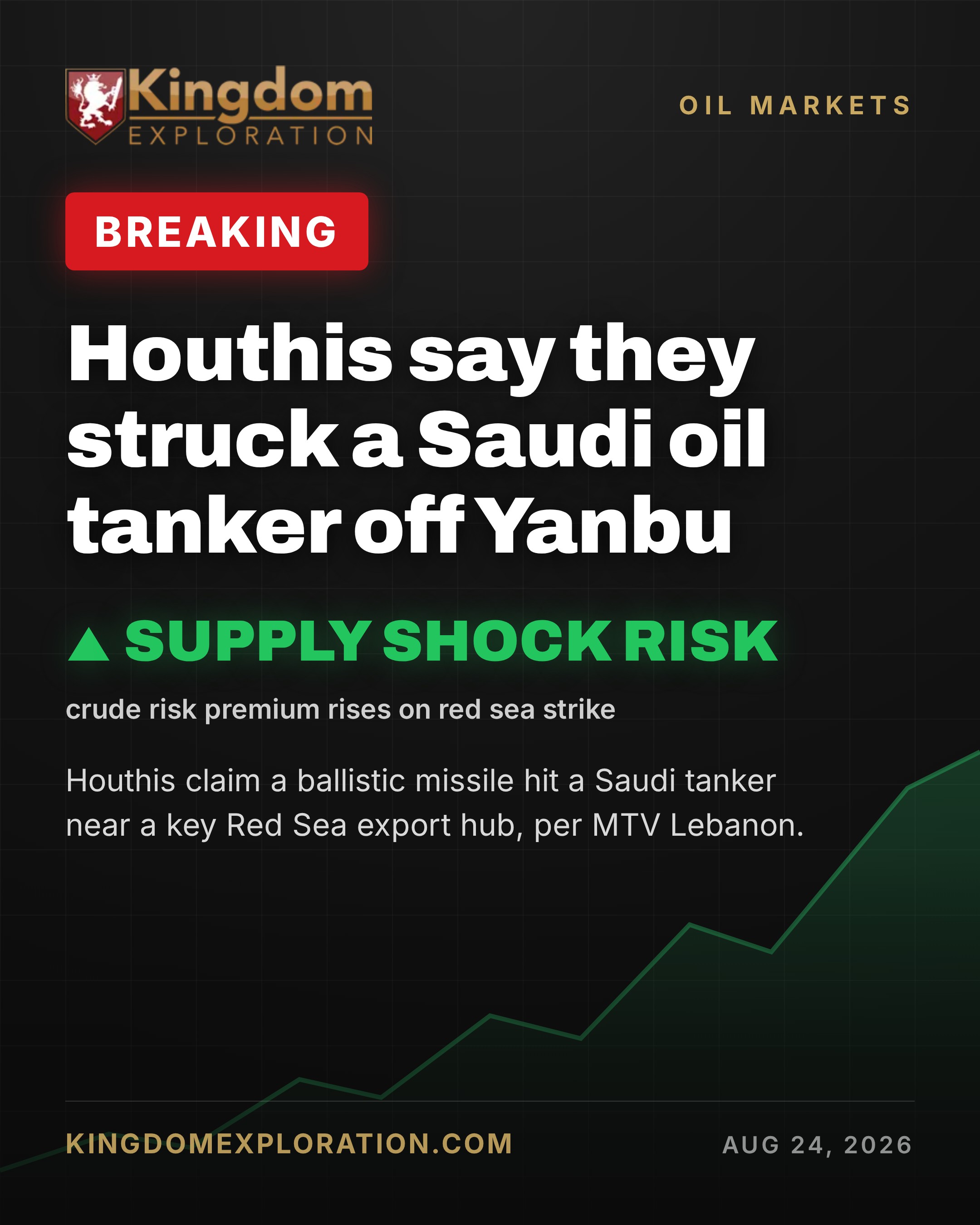
Yemen's Houthi movement said it targeted a Saudi oil tanker with a ballistic missile off the coast of Yanbu, according to MTV Lebanon, in a fresh escalation of maritime attacks near one of Saudi Arabia's most important Red Sea oil-export gateways. The claim surfaced within the past hour.
Related coverage: Saudi Ship BOMBED in Red Sea After MBS Signs Mecca Pact
What Just Happened
The Houthis stated that they struck a Saudi oil tanker using a ballistic missile in waters off Yanbu, MTV Lebanon reported. Yanbu sits on Saudi Arabia's Red Sea coast and hosts major crude-export terminals and refining capacity, making any credible threat to shipping in the area a direct concern for global oil flows.
The claim marks a further extension of Houthi maritime targeting, which has repeatedly disrupted commercial traffic through the Red Sea corridor. As of this report, independent details on damage, casualties, or the vessel's status were not provided in the source material.
The Numbers
No casualty figures, cargo volumes, or vessel specifications were disclosed in the initial report from MTV Lebanon. The only concrete details available are the claimed weapon (a ballistic missile), the stated target (a Saudi oil tanker), and the location (off the coast of Yanbu). We will update as verified figures emerge.
Why Oil Prices Could Rise
Attacks near Yanbu strike at the heart of a critical oil-logistics zone. The port is a western outlet for Saudi crude and refined products, offering an alternative to the Strait of Hormuz for shipments heading toward Europe and beyond. A missile threat to tankers in this area raises the risk premium embedded in crude prices for several reasons:
- Supply-route risk: Rerouting or delaying tankers away from the Red Sea adds cost and time, tightening effective supply.
- Insurance and freight: War-risk premiums and shipping rates tend to climb when vessels are attacked, feeding into delivered oil costs.
- Escalation potential: Repeated strikes on Saudi assets raise the possibility of a broader regional response, keeping a geopolitical bid under the market.
Kingdom Exploration's read: even a single claimed strike near a hub like Yanbu can move sentiment, because the market prices the threat to barrels long before any physical shortfall shows up. Traders watch these headlines closely for signs the disruption could widen.
What to Watch Next
- Independent confirmation of the strike and the tanker's condition.
- Any statement from Saudi authorities or the vessel's operator.
- Shipping-company decisions to pause, reroute, or continue Red Sea transits.
- Movements in war-risk insurance premiums for Red Sea voyages.
- Whether attacks near Yanbu become a recurring pattern rather than an isolated event.
Reporting sourced from MTV Lebanon. Developing story.
About Kingdom Exploration
Kingdom Exploration LLC is an Oklahoma-based oil and gas exploration company. Learn more at kingdomexploration.com.