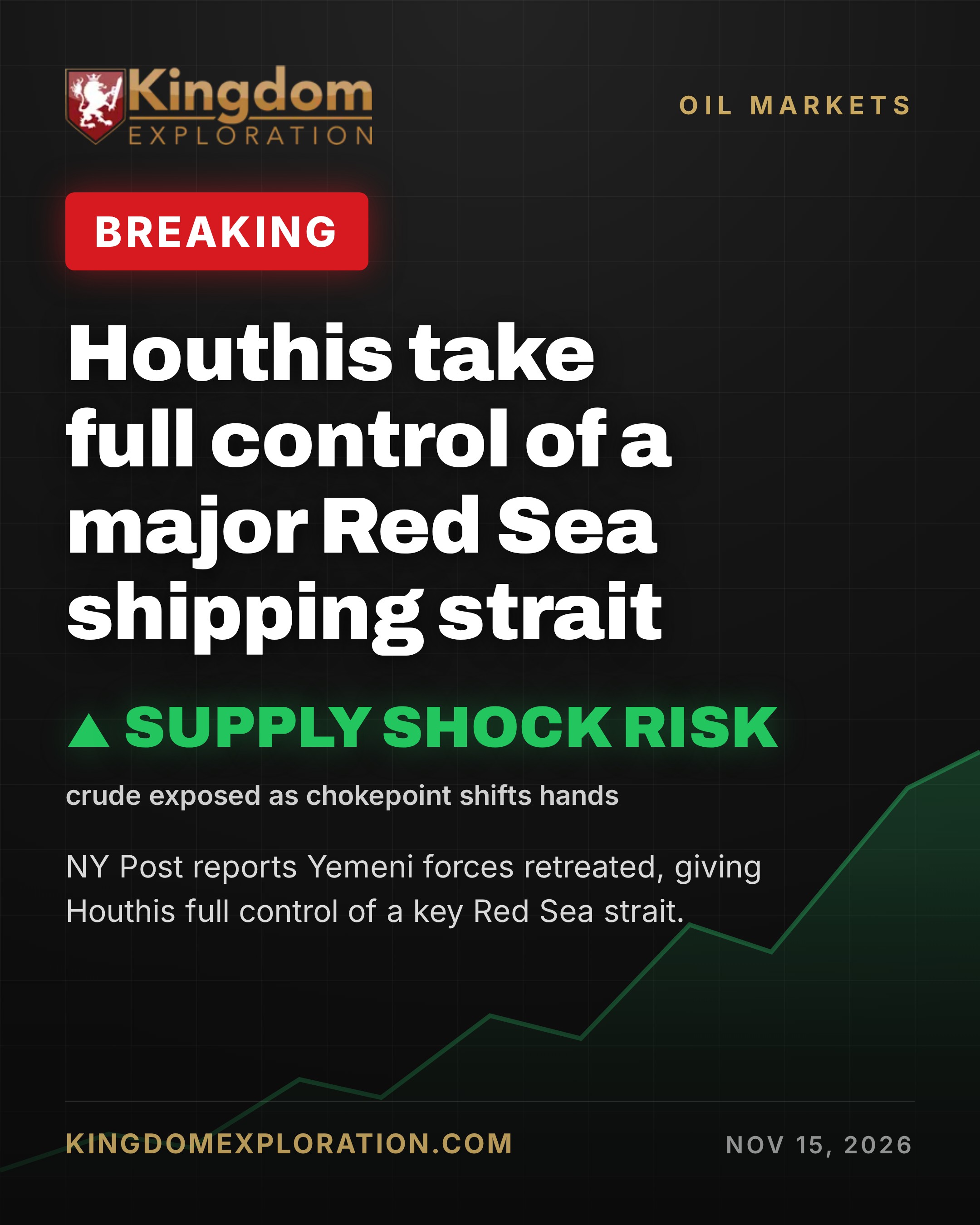
A major Red Sea strait has fallen under full Houthi control after Yemeni forces retreated from the area, the New York Post reported in a story published minutes ago. The shift hands one of the world's most sensitive maritime passages to the Yemeni militant group, raising immediate questions about the safety of oil and commodity shipments that transit the corridor.
What Just Happened
According to the New York Post, Yemeni forces pulled back from positions along the strait, allowing Houthi fighters to assert full control over the waterway. The Red Sea connects to the Gulf of Aden and the broader Indian Ocean through narrow chokepoints, making the region a critical artery for global energy and container traffic moving between Europe, the Middle East and Asia.
Control of a strait of this importance by an armed non-state actor is a material escalation for maritime security. Vessels passing through confined waters have little room to maneuver and become far more exposed to interdiction, targeting or disruption when a single party dominates the surrounding territory.
The Numbers
The New York Post report did not provide specific figures on troop movements, vessel traffic or oil volumes at the time of publication. What is established is the physical fact: a major Red Sea strait is now described as being under full Houthi control following the retreat of Yemeni forces.
Kingdom Exploration will update this story with concrete shipping and barrel figures as verified numbers become available.
Why Oil Prices Could Rise
Red Sea chokepoints are among the busiest energy transit routes on earth. When control of such a passage shifts to a group that has previously threatened or struck commercial shipping, insurers, tanker operators and traders price in the added danger almost immediately.
- Supply at risk: Crude and refined-product cargoes that normally transit the Red Sea may be delayed, rerouted around southern Africa, or halted entirely if operators judge the strait unsafe.
- Risk premium: Even without a single barrel being lost, the mere threat to a key passage tends to add a geopolitical premium to global benchmarks as the market hedges against disruption.
- Longer voyages: Diversions add thousands of miles, tying up tankers, tightening available shipping capacity and raising the delivered cost of oil.
Kingdom Exploration's read: Whoever controls a Red Sea strait controls the risk calculus for every tanker that approaches it. Full Houthi control turns a shipping lane into a potential pressure point, and energy markets historically respond to that kind of uncertainty before the first cargo is ever touched.
What to Watch Next
- Official confirmation of which strait is affected and the extent of control.
- Any response from naval coalitions operating in the Red Sea and Gulf of Aden.
- Whether major shipping lines announce suspensions or reroutes around the Cape of Good Hope.
- War-risk insurance rates for vessels in the region.
- Movement in Brent and WTI crude as traders assess supply exposure.
Reporting sourced from New York Post. Developing story.
About Kingdom Exploration
Kingdom Exploration LLC is an Oklahoma-based oil and gas exploration company. Learn more at kingdomexploration.com.

