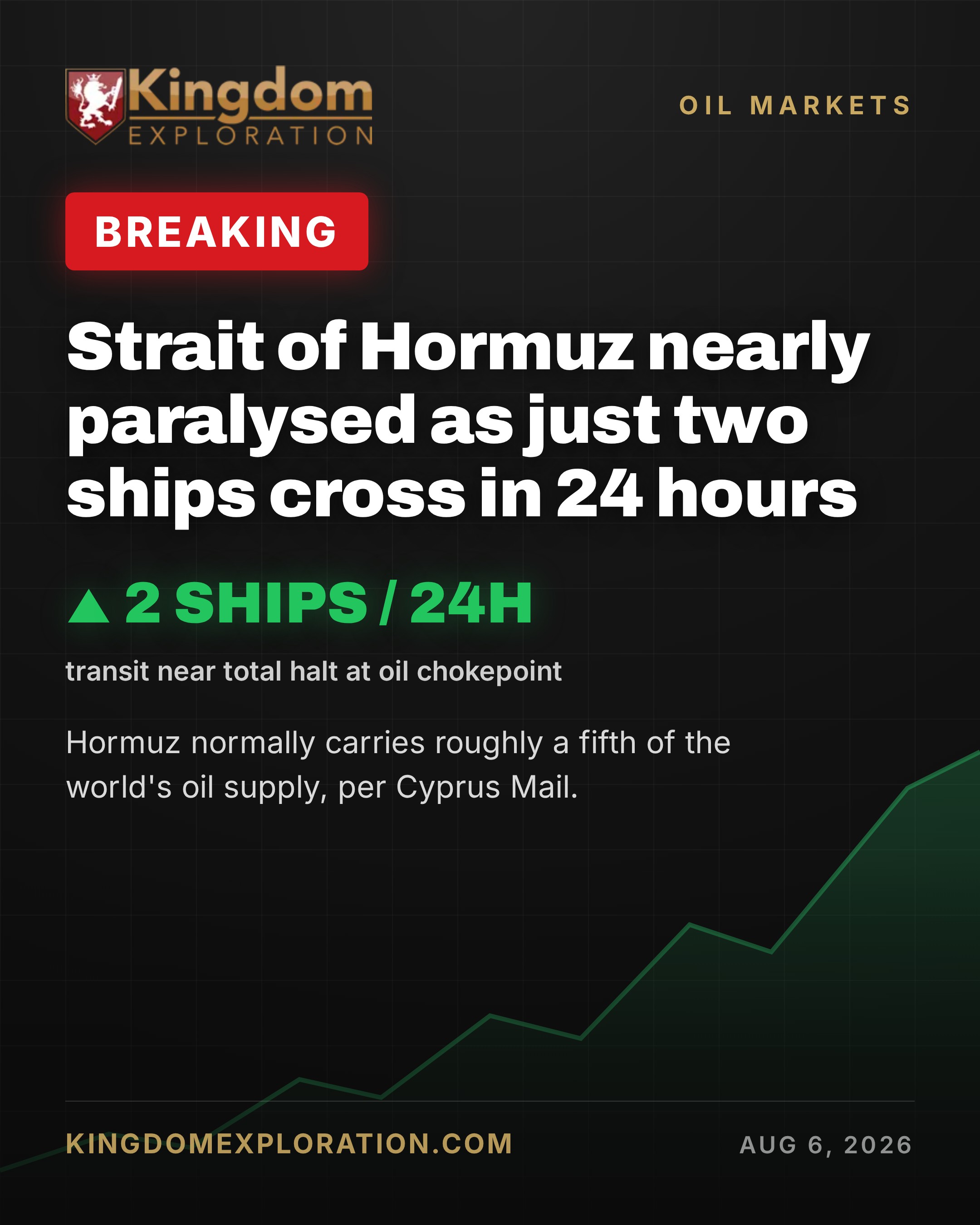
Traffic through the Strait of Hormuz has collapsed to a near standstill, with just two ships transiting the world's most critical oil chokepoint in a 24-hour window, according to the Cyprus Mail. The report, published minutes ago, points to a deepening disruption at the narrow waterway that funnels roughly a fifth of global crude to market.
Related coverage: Only One Tanker Crosses Hormuz in 24 Hours Amid Disruption
What Just Happened
The Cyprus Mail reports that the Strait of Hormuz is "nearly paralysed," with only two ships passing through in the last 24 hours. That figure marks a continued freeze in the flow of vessels through the strait, which under normal conditions sees dozens of tankers and cargo ships move through daily.
This update follows our earlier coverage, when only a single tanker was recorded crossing in a 24-hour period. The latest count of two ships confirms that transit through the passage remains at a fraction of typical volumes, signaling that whatever is choking movement through Hormuz has not eased.
The Numbers
- 2 ships transited the Strait of Hormuz in 24 hours, per the Cyprus Mail.
- The strait normally carries roughly a fifth of the world's oil supply, making it the single most important maritime chokepoint for crude and refined products.
The Cyprus Mail's report does not attach specific price moves or barrel-per-day loss figures to the disruption, but a transit count this low speaks for itself: the flow of energy through Hormuz has effectively stopped.
Why Oil Prices Could Rise
Hormuz is the pressure point of the global oil trade. Crude loaded from major Gulf producers must pass through the narrow strait to reach buyers in Asia, Europe and beyond. When traffic falls to a trickle, barrels that markets expect simply do not arrive on schedule.
Two mechanisms drive prices higher in this scenario. First, physical supply at risk: every day of paralysed transit means cargoes that cannot be delivered, tightening availability for refiners who must scramble for alternatives. Second, the risk premium: traders price in the danger of a prolonged or worsening blockage, bidding crude up on the fear of what comes next rather than waiting for confirmed shortages.
There is limited slack to absorb a Hormuz stoppage. Pipelines that bypass the strait carry only a portion of Gulf output, and spare capacity elsewhere cannot fully replace the volumes that normally move through this single waterway.
Kingdom Exploration's read: a transit count of two ships in 24 hours is not a slowdown - it is a near-total halt at the one point the oil market can least afford to lose. Markets tend to price the chokepoint, not the calendar.
What to Watch Next
- Daily transit counts: whether the number recovers toward normal or stays near zero over the coming days.
- Official statements: any confirmation of the cause and expected duration of the disruption.
- Tanker rerouting and insurance: shifts in war-risk premiums and vessels diverting or waiting outside the strait.
- Crude benchmarks: how Brent and WTI respond as the market weighs the length of the freeze.
Reporting sourced from Cyprus Mail. Developing story.
About Kingdom Exploration
Kingdom Exploration LLC is an Oklahoma-based oil and gas exploration company. Learn more at kingdomexploration.com.