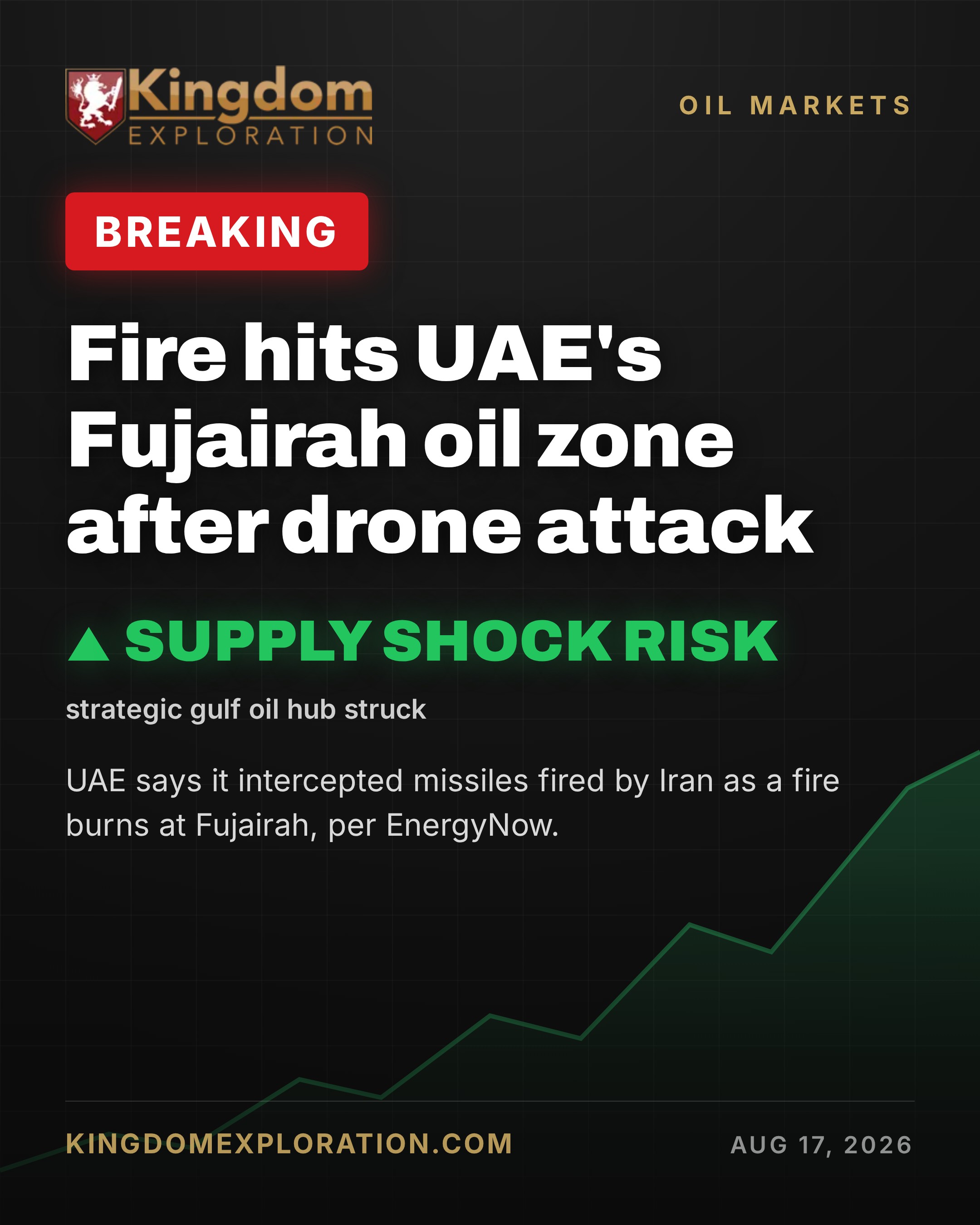
A fire broke out at the Fujairah Oil Zone following a drone attack, while the UAE said it intercepted missiles fired by Iran, according to EnergyNow. The incident targets one of the world's most important fuel storage and bunkering hubs, immediately raising fresh concern over Gulf energy infrastructure.
What Just Happened
Per EnergyNow, the Fujairah Oil Zone was struck by a drone attack that sparked a fire at the facility. Separately, UAE authorities said they intercepted missiles launched by Iran. Fujairah sits on the UAE's east coast, just outside the Strait of Hormuz, making it a strategic node for storing and loading crude and refined products that bypass the chokepoint.
As a developing story, details on the scale of the fire, damage to storage tanks, and any impact on loading operations remain limited to what the outlet has reported.
The Numbers
No casualty figures, volumes offline, or price moves have been confirmed in the source reporting at this stage. What is clear is the strategic weight of the location: Fujairah is one of the largest bunkering and oil storage hubs in the world, serving as a key alternative outlet for Gulf barrels that avoids transiting the Strait of Hormuz.
Any confirmed damage to storage capacity or a disruption to loading schedules would be the first hard numbers to watch.
Why Oil Prices Could Rise
Attacks on Gulf energy infrastructure tend to inject an immediate risk premium into crude prices, even before physical supply losses are confirmed. The mechanism is straightforward:
- Supply at risk: Fujairah handles vast volumes of stored and transiting fuel. A fire at the zone threatens both storage and the reliability of a key non-Hormuz export outlet.
- Escalation premium: A drone strike paired with reported missile interceptions points to widening regional conflict, the kind of tension that historically pushes traders to price in worst-case supply outcomes.
- Chokepoint proximity: Fujairah's role as an alternative to the Strait of Hormuz means any threat here undermines the region's main insurance policy against a Hormuz disruption.
Kingdom Exploration's read: markets don't wait for a full damage assessment when a strategic oil hub is on fire. The initial move is usually driven by the risk premium, with fundamentals catching up as loading and storage impacts become clear.
What to Watch Next
- Confirmation of damage to storage tanks and any volumes taken offline at Fujairah.
- Whether crude and product loading operations at the port are suspended or continue.
- Official statements from the UAE and Iran, and any signs of further strikes or retaliation.
- Insurance and shipping responses, including war-risk premiums for vessels calling at the UAE east coast.
- Any spillover concern for the nearby Strait of Hormuz.
Reporting sourced from EnergyNow. Developing story.
About Kingdom Exploration
Kingdom Exploration LLC is an Oklahoma-based oil and gas exploration company. Learn more at kingdomexploration.com.

