Live Updates
UPDATE — Jul 21, 3:43 PM CT: Report: New UK PM Andy Burnham approves British bases for US strikes on Iran
New UK Prime Minister Andy Burnham has approved the use of British bases for US strikes on Iran, according to a report circulated by @insiderpaper on Telegram.
The move would formalize British support for the ongoing US air campaign, potentially expanding the launch points available to CENTCOM as strikes continue for a straight run of nights. Earlier reporting noted US B-1 bombers departing the UK for the Middle East.
Kingdom Exploration's read: deeper UK involvement raises the risk of a wider and more prolonged confrontation with Iran, keeping a fresh war-risk premium on crude given the threat to Strait of Hormuz shipping. Details remain unconfirmed and the report should be treated with caution.
UPDATE — Jul 21, 12:53 PM CT: US B-1 bombers depart UK for Middle East, reportedly targeting Iran's Pickaxe Mountain
Multiple US B-1 bombers have taken off from the United Kingdom and are heading to the Middle East for a strike on Iran's Pickaxe Mountain, per @GWarMonitor on X. The report marks a potential escalation beyond the six waves of CENTCOM strikes already carried out during the ongoing Hormuz conflict.
Details on the target and timing remain unconfirmed, and Kingdom Exploration has not independently verified the account. The B-1 is a long-range heavy bomber capable of carrying large conventional payloads.
Kingdom Exploration's read: the deployment of strategic bombers signals a widening campaign that keeps a heavy risk premium on crude, given roughly a fifth of global oil flows through the Strait of Hormuz.
UPDATE — Jul 18, 8:41 PM CT: US strikes Iran for eighth straight night after two US soldiers killed
The United States carried out strikes on Iran for an eighth consecutive night, following the deaths of two US soldiers, Haaretz reports. The escalation marks the first reported US military fatalities in the current conflict tied to the Strait of Hormuz.
With American casualties now confirmed, the campaign risks deepening beyond the earlier stated goal of degrading Iranian threats to Hormuz shipping. Kingdom Exploration's read: the loss of US personnel raises the political stakes for further escalation, keeping a heavy risk premium on crude as roughly a fifth of global oil flows through the strait.
UPDATE — Jul 18, 5:41 PM CT: CENTCOM launches new strikes to degrade Iranian threats to Hormuz shipping
US Central Command says it has launched fresh airstrikes on Iran aimed at degrading threats to commercial shipping in the Strait of Hormuz, per a post on CENTCOM's official X account published about 24 minutes ago.
The strikes mark the latest phase of the ongoing US air campaign against Iran, this round explicitly framed around protecting the flow of vessels through the world's most important oil chokepoint.
Kingdom Exploration's read: with roughly a fifth of global oil consumption passing through Hormuz, any operation tied directly to shipping threats keeps a war-risk premium in crude markets. No new casualty or damage figures were provided by CENTCOM.
UPDATE — Jul 17, 4:01 PM CT: US launches seventh night of strikes on Iran as Hormuz conflict escalates
The United States has launched a seventh consecutive night of strikes on Iran, The Guardian reports, as the confrontation centered on the Strait of Hormuz continues to escalate. The development follows the sixth wave of CENTCOM strikes already covered on this page.
The Guardian frames the situation as an escalating Hormuz conflict, though detailed figures on targets and munitions were not immediately available in the report.
Kingdom Exploration's read: any sustained military activity around the Strait of Hormuz keeps a persistent risk premium on crude, given that roughly a fifth of global oil flows transit the waterway. Traders will watch closely for any disruption to tanker traffic as the strikes enter a second week.
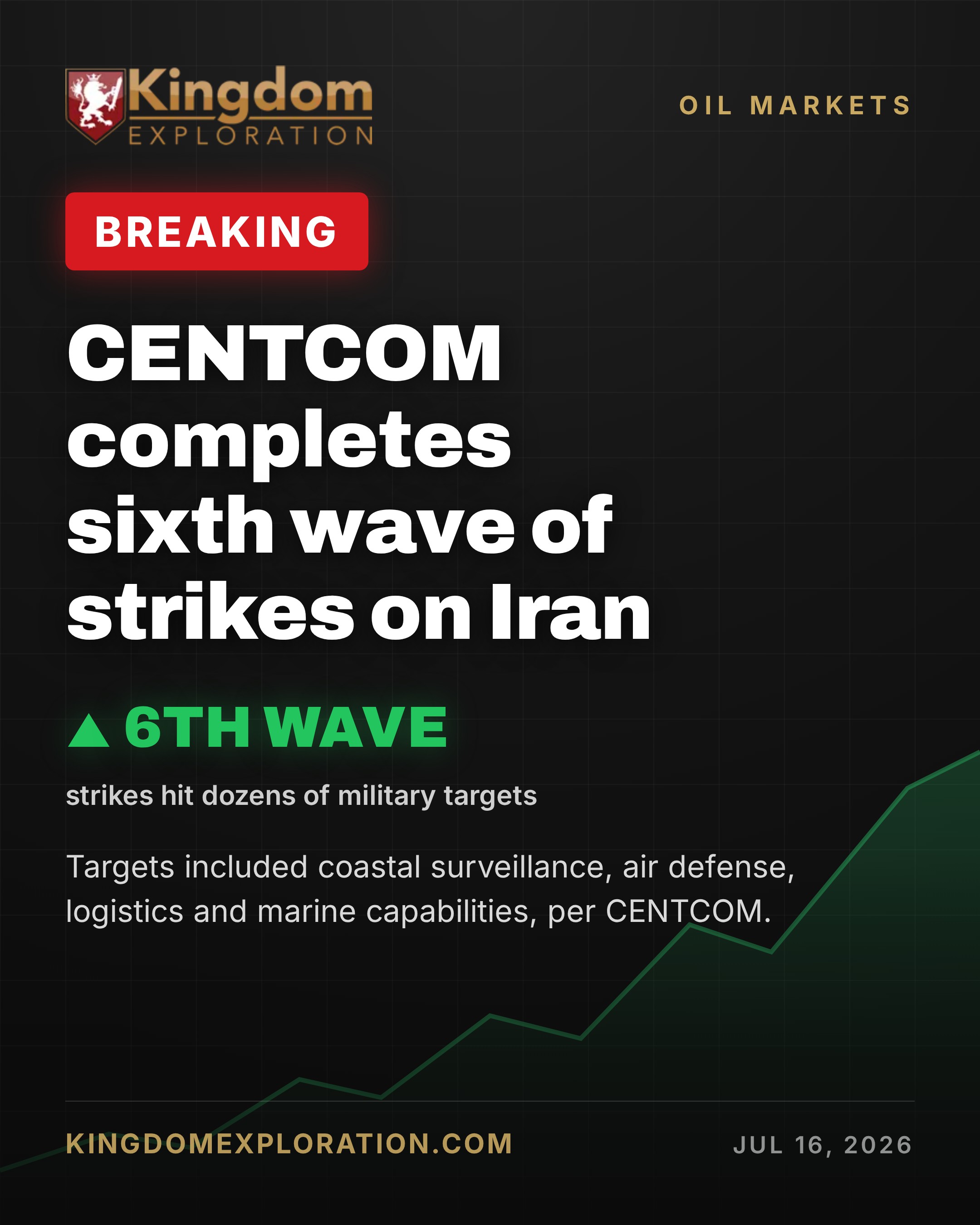
U.S. Central Command (CENTCOM) says it has completed a sixth wave of strikes on Iran, hitting dozens of Iranian military targets, according to a post carried by Telegram channel @disclosetv citing CENTCOM. The reported strikes targeted coastal surveillance and air defense sites, military logistics infrastructure, and marine capabilities.
What Just Happened
Per @disclosetv, CENTCOM announced the completion of its sixth wave of strikes against Iran. The command described the targets as "Iranian military targets such as coastal surveillance and air defense sites, military logistics infrastructure and marine capabilities."
The reference to a "sixth wave" indicates an ongoing, sustained military campaign rather than an isolated exchange. The mention of coastal surveillance and marine capabilities is particularly notable for energy markets, given Iran's position along the Strait of Hormuz and the Persian Gulf, through which a substantial share of global seaborne crude and LNG transits.
The Numbers
The source provides limited hard figures. Confirmed details from the report include:
- Sixth wave of strikes reported as completed by CENTCOM.
- Dozens of Iranian military targets struck.
- Target categories: coastal surveillance, air defense sites, military logistics infrastructure, and marine capabilities.
No casualty counts, no barrel-per-day figures, and no confirmed damage to energy infrastructure were included in the reporting available at this time.
Why Oil Prices Could Rise
Escalating direct military action involving Iran typically injects a geopolitical risk premium into crude prices. The mechanism is straightforward: markets price in the probability of supply disruption before any actual barrels are lost.
Several factors are relevant here. Iran is a significant crude producer and OPEC member, and its coastline flanks the Strait of Hormuz, the world's most critical oil chokepoint. Strikes on "coastal surveillance" and "marine capabilities" raise the specter of a wider maritime confrontation in the Gulf, where any interference with tanker traffic could threaten flows well beyond Iran's own exports.
When supply is perceived to be at risk and global spare capacity is limited, even the threat of disruption can move prices. Traders tend to buy risk premium first and ask questions later during active military campaigns.
Kingdom Exploration's read
A sixth consecutive wave of strikes signals a campaign that is broadening rather than winding down. The targeting of marine and coastal assets is the detail energy watchers should focus on, because it moves the conflict closer to the shipping lanes that actually price crude. Until there is clarity on whether Gulf tanker traffic is affected, expect volatility to stay elevated.
What to Watch Next
- Strait of Hormuz traffic: Any reports of tanker delays, rerouting, or insurance-rate spikes would be the clearest signal of real supply impact.
- Iranian response: The scale and nature of any retaliation, especially anything touching Gulf shipping or energy infrastructure.
- Official confirmation: Independent verification of the strike details and any damage assessments from additional outlets.
- Physical export data: Whether Iranian or regional crude loadings are disrupted in the days ahead.
This is a fast-moving situation with limited confirmed detail. Figures and specifics may be revised as more reporting emerges.
Reporting sourced from Telegram @disclosetv, citing CENTCOM. Developing story.
About Kingdom Exploration
Kingdom Exploration LLC is an Oklahoma-based oil and gas exploration company. Learn more at kingdomexploration.com.

