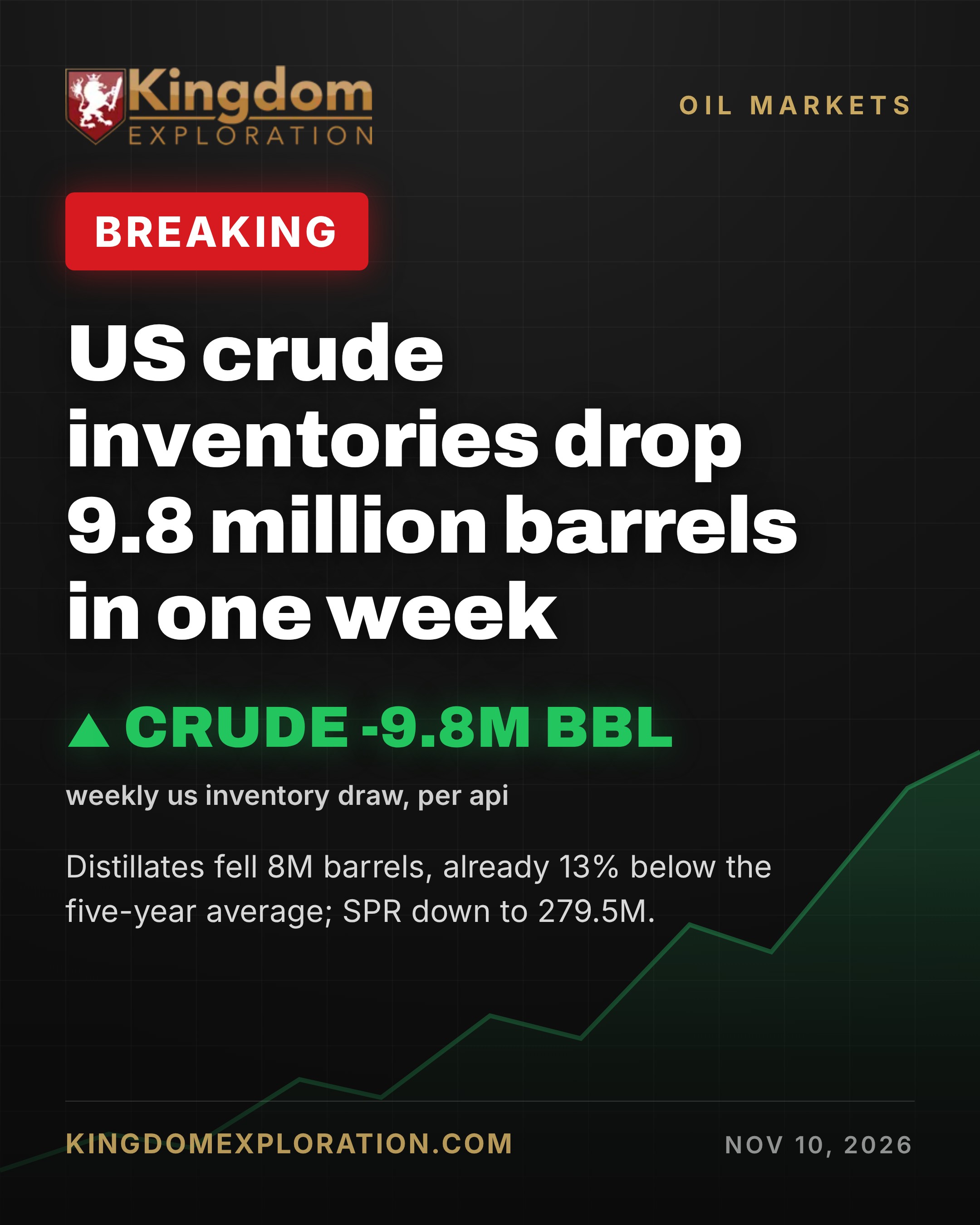
US commercial crude oil inventories plunged by 9.8 million barrels in the week ending November 6, according to estimates released by the American Petroleum Institute (API). The sharp draw more than doubled the prior week's 5.267-million-barrel decline and landed alongside an 8-million-barrel drop in distillate stocks that were already running well below seasonal norms.
What Just Happened
The API's weekly snapshot pointed to accelerating tightness across US petroleum balances. Crude inventories fell by 9.8 million barrels, building on a string of draws that have steadily pulled barrels out of commercial tanks over the course of the year. On the products side, distillate inventories — diesel and heating oil — fell by 8 million barrels, following a 270,000-barrel decline the week before.
The draws were partly cushioned by the Strategic Petroleum Reserve (SPR). For the week ending November 6, 2.7 million barrels left the SPR to aid commercial inventories, bringing the total held in the reserve down to 279.5 million barrels.
The Numbers
- Crude draw: -9.8 million barrels (week ending Nov 6), vs. -5.267 million the prior week
- Commercial crude: down more than 73 million barrels over the last 30 weeks, and 22 million so far this year
- Distillates: -8 million barrels, already 13% below the five-year average heading into the period
- Gasoline: +2.7 million barrels, following a 1.427-million-barrel build; stocks were 2% below the five-year average
- SPR: 2.7 million barrels drawn, total down to 279.5 million barrels — 434 million shy of maximum capacity
- Cushing hub: +5.1 million barrels, after a 511,000-barrel gain the prior week
- US production: record 14.003 million bpd (week ending Oct 30), up from 13.992 million and up 352,000 bpd year-on-year
- Prices: Brent $91.96 (-0.66%), WTI $86.37 (-0.55%) at 4:24 pm ET Wednesday
Why Oil Prices Could Rise
Back-to-back crude draws of this size signal that US demand and exports are outpacing supply to commercial tanks. A 9.8-million-barrel weekly draw is a large move, and the 8-million-barrel distillate draw is especially notable given inventories were already 13% below the five-year average — a thin cushion heading into the winter heating season when diesel and heating oil demand typically climbs.
The buffer being used to offset these draws is the SPR, which has now fallen to 279.5 million barrels. That sits near the upper edge of the generally accepted operational minimum of 250–300 million barrels, below which the reserve may struggle to pump and process oil efficiently. As that policy lever narrows, the market loses one of the tools that has kept commercial inventories

