Live Updates
UPDATE — Aug 14, 6:17 PM CT: Two more tankers attacked in Strait of Hormuz, per The Maritime Executive
Two additional tankers have been attacked in the Strait of Hormuz, according to The Maritime Executive, widening a string of maritime strikes in the world's most critical oil chokepoint.
The report gives no immediate details on casualties, vessel names or the extent of damage. It follows earlier incidents in the strait, including a tanker struck by a UAV whose crew was reported safe.
Kingdom Exploration's read: repeated attacks on shipping in Hormuz raise the risk of higher insurance costs, rerouting and supply disruption. Roughly a fifth of global oil flows through the strait, so any escalation keeps upward pressure on crude prices.
UPDATE — Aug 14, 1:36 PM CT: Oil spill in Strait of Hormuz spreads to size of 40,000 football fields
A massive oil spill is now spreading across the Strait of Hormuz following the tanker attacks, per en.haberler.com. The outlet reports the slick has reached the size of roughly 40,000 football fields, marking a significant escalation in the environmental and shipping fallout from the strikes.
Kingdom Exploration's read: a spill of this scale in the world's most critical oil chokepoint could complicate transit, cleanup, and insurance in a corridor that carries a large share of seaborne crude. Any disruption to Hormuz traffic tends to put upward pressure on oil prices as markets price in supply risk.
UPDATE — Aug 14, 8:52 AM CT: UKMTO: tanker struck by UAV transiting Strait of Hormuz, crew reported safe
A tanker was hit by an unmanned aerial vehicle (UAV) while transiting the Strait of Hormuz, with the crew reported safe, per News Mobile citing the UK Maritime Trade Operations (UKMTO). The report points to a drone strike rather than the earlier-described attack on two vessels flagged by the Abu Dhabi oil firm.
No casualties were reported and details on the vessel, cargo, or resulting damage remain limited. UKMTO typically issues advisories to commercial shipping when incidents occur in the waterway.
Kingdom Exploration's read: even a single confirmed UAV strike on a tanker inside Hormuz — the chokepoint for roughly a fifth of global oil flows — raises the risk premium on crude and could push insurers to widen war-risk cover for transiting ships.
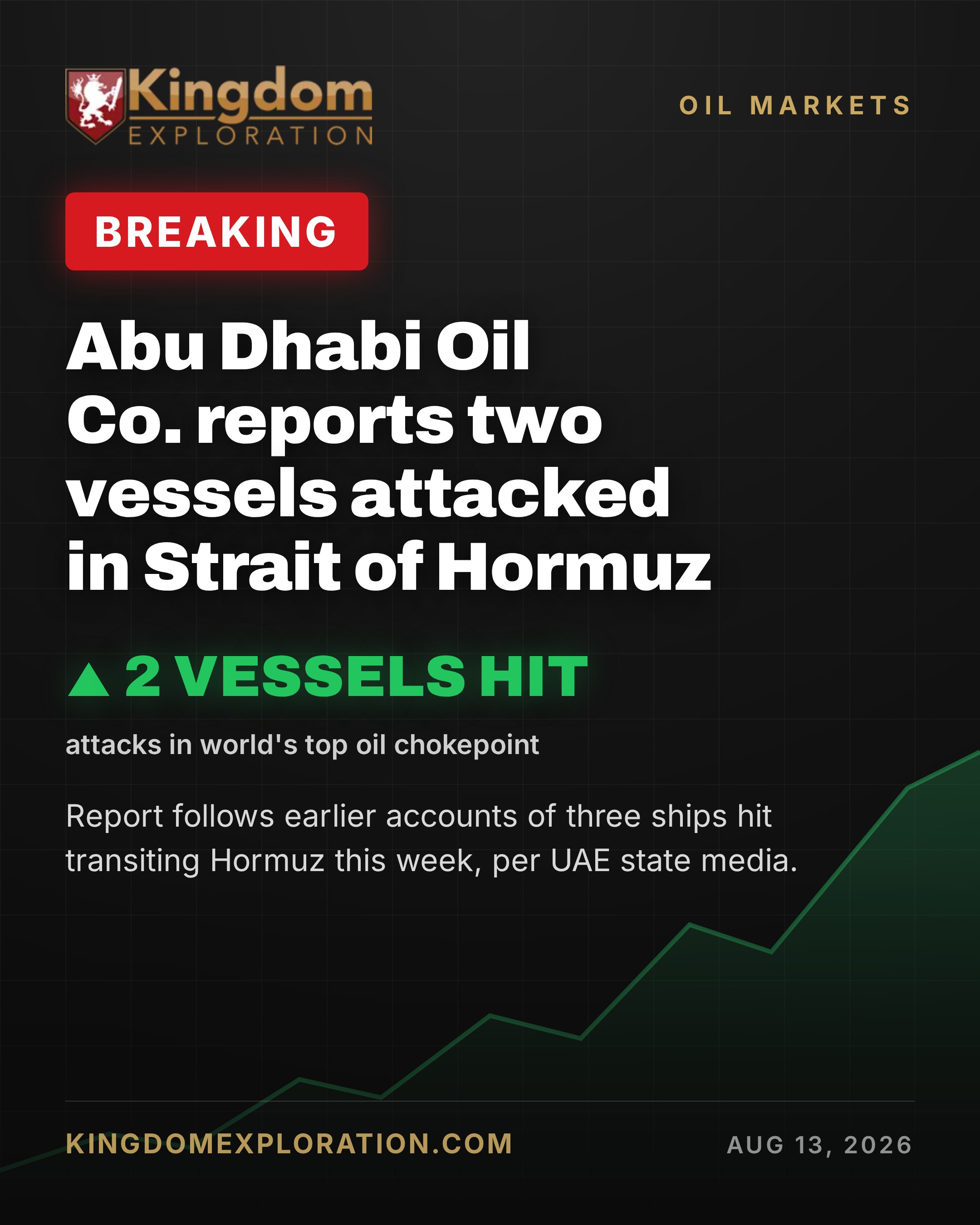
Abu Dhabi Oil Co. said two vessels were attacked in the Strait of Hormuz, according to the UAE state news agency, in a fresh incident targeting shipping through the world's most critical oil chokepoint, timesofisrael.com reported. The report emerged within the past hour and marks the latest in a string of attacks on vessels transiting the strait this week.
Related coverage: Adnoc: THREE Vessels Hit Transiting Hormuz This Week
What Just Happened
Per the UAE state news agency, Abu Dhabi Oil Co. reported that two vessels came under attack in the Strait of Hormuz. The disclosure adds to earlier reports this week of multiple ships being hit while transiting the same waterway, pointing to a sustained pattern of maritime disruption in the Gulf.
The Strait of Hormuz is the narrow passage between the Persian Gulf and the Gulf of Oman through which a large share of the world's seaborne crude and liquefied natural gas moves. Any attack on shipping there immediately raises concerns about the safety of tanker traffic and the reliability of exports from the region's major producers.
The Numbers
Abu Dhabi Oil Co. reported two vessels attacked in this incident. Earlier coverage this week cited three vessels hit while transiting Hormuz. The source did not specify the type of vessels, the nature of the damage, casualties, or the party responsible. No barrel-per-day figures or price moves were provided in the report.
Why Oil Prices Could Rise
The Strait of Hormuz is the single most important artery for global oil flows. When vessels are attacked there, several pressures build on crude prices at once:
- Supply at risk: A meaningful portion of global crude and LNG passes through the strait daily. Even the threat of disruption to that flow can tighten expected supply.
- Risk premium: Traders price in the danger of escalation, adding a security premium to every barrel regardless of whether physical volumes are lost.
- Insurance and rerouting costs: Repeated attacks push up war-risk insurance and can force shippers to slow, reroute, or pause transits, raising the effective cost of delivered crude.
- Spare capacity in question: Much of the world's spare production capacity sits inside the Gulf, and it can only reach global markets by moving through Hormuz. If the strait itself is contested, that cushion is harder to deploy.
Kingdom Exploration's read: back-to-back attacks on tankers in the same waterway are exactly the kind of pattern that turns a one-off headline into a durable risk premium. The market tends to respond first to the possibility of disruption, well before any barrels are actually lost.
What to Watch Next
Key signals in the hours and days ahead include official confirmation of the vessels' identities and cargoes, any claim of responsibility, statements from naval forces operating in the region, and whether shipping companies adjust transit schedules through the strait. Also watch for updates from regional oil authorities on whether export loadings and terminal operations are affected. Each of these will shape how much of a lasting premium crude carries.
Kingdom Exploration's read: with multiple vessels reported hit in a single week, the story to track is no longer one incident but whether traffic through Hormuz stays fully open.
Reporting sourced from timesofisrael.com. Developing story.
About Kingdom Exploration
Kingdom Exploration LLC is an Oklahoma-based oil and gas exploration company. Learn more at kingdomexploration.com.

