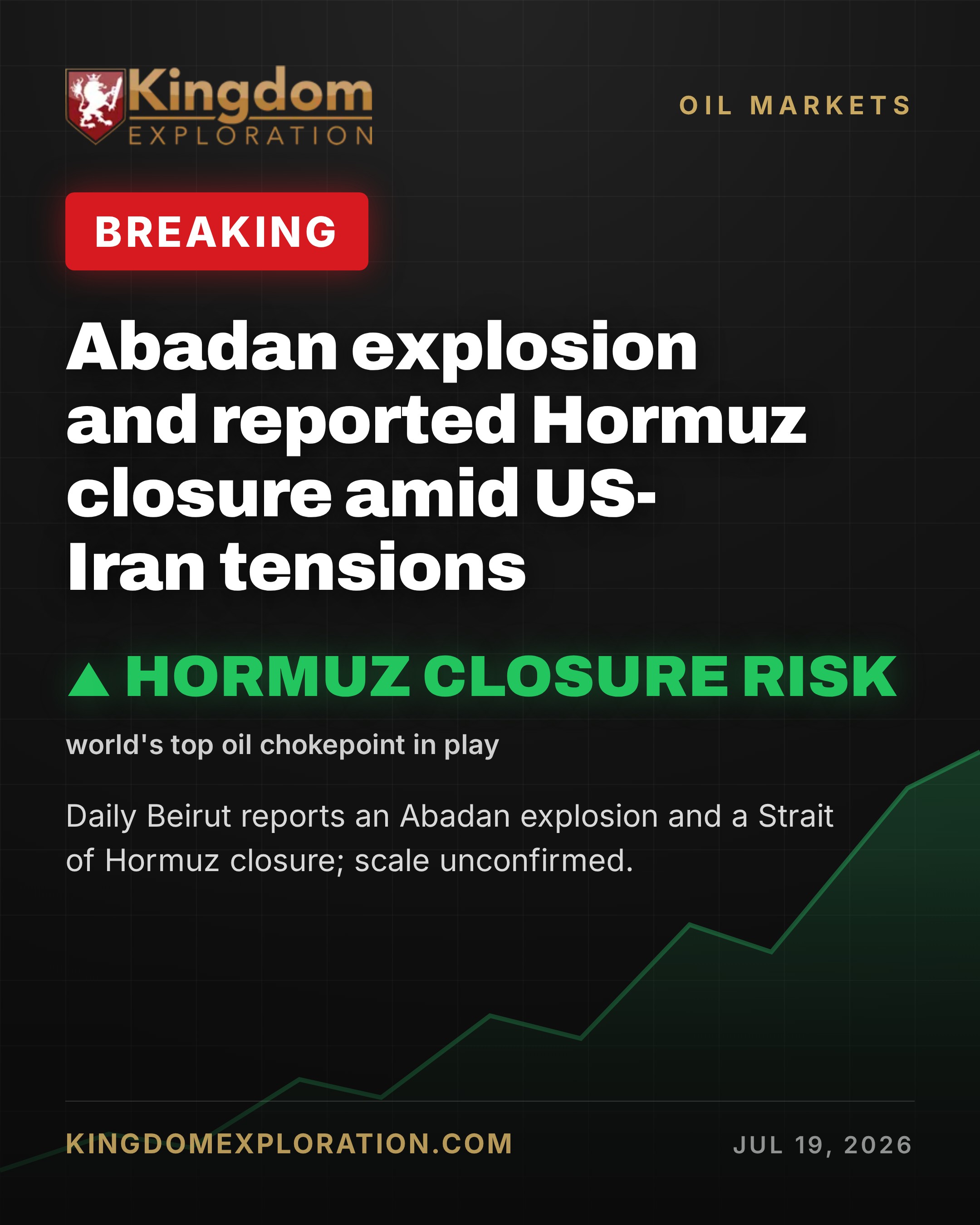
Reports emerging in the past hour point to an explosion at Abadan and a closure of the Strait of Hormuz amid escalating US-Iran tensions, per Daily Beirut. The situation is developing and details remain limited, but both events strike at the most sensitive nerve of the global oil market.
What Just Happened
According to Daily Beirut, an explosion has been reported at Abadan — a city on Iran's southwest coast long associated with one of the country's oldest and largest refining complexes — alongside a reported closure of the Strait of Hormuz. The developments are unfolding against the backdrop of heightened tensions between the United States and Iran.
As of this writing, independent confirmation of the scale of the Abadan incident and the status of Hormuz shipping traffic was not available in the source reporting. Kingdom Exploration is monitoring the story as it develops.
The Numbers
The source reporting did not provide specific figures on barrels affected, casualties, price moves, or the duration of any Hormuz disruption. What matters for oil markets is the strategic weight of the locations involved rather than any single confirmed statistic at this early stage.
- Abadan: Home to major Iranian refining capacity on the Persian Gulf coast.
- Strait of Hormuz: The world's single most important oil transit chokepoint, through which a large share of seaborne crude and condensate moves daily.
Why Oil Prices Could Rise
The Strait of Hormuz is the mechanism that makes any incident in this region a global concern. It is the narrow waterway connecting the Persian Gulf to open ocean, and the primary export route for producers including Saudi Arabia, Iraq, the UAE, Kuwait and Iran. Even the credible threat of a closure — let alone an actual one — forces traders to price in a risk premium, because tankers that cannot pass mean barrels that cannot reach refiners.
An explosion at a major refining hub like Abadan compounds the picture by putting physical infrastructure and processing capacity at risk. When supply routes and supply points are simultaneously in question, the market's spare-capacity cushion becomes far less reassuring: the volumes that would need to be replaced are large, and the alternative routes around Hormuz are limited.
Kingdom Exploration's read: Hormuz is the one headline that can move crude on its own. Confirmation of the scale here is everything — but markets tend to price the risk premium first and verify later.
What to Watch Next
- Confirmation of the Hormuz status — whether transit is actually halted, restricted, or merely threatened.
- The extent of the Abadan damage and any impact on refining throughput.
- Official statements from Iran, the United States, and Gulf producers.
- Tanker and insurance signals — rerouting, war-risk premiums, and freight rates often move before official confirmations.
- Crude benchmark reaction once liquid trading digests the reports.
This remains an early, unverified picture. Kingdom Exploration will update as confirmed details emerge.
Reporting sourced from Daily Beirut. Developing story.
About Kingdom Exploration
Kingdom Exploration LLC is an Oklahoma-based oil and gas exploration company. Learn more at kingdomexploration.com.

