Live Updates
UPDATE — Sep 18, 8:06 AM CT: Aramco tells European buyers no contracted Saudi crude in October after pipeline hit
Saudi Aramco has informed European buyers that no contracted crude will be delivered in October following the pipeline strike, per Iran International (@IranIntl_En). The notice extends earlier disruptions that had already hit September loadings and Indian refiners.
The move signals the supply crunch is stretching well beyond initial estimates, with an entire contracted delivery month now off the table for European customers as repairs continue with no firm restart timeline.
Kingdom Exploration's read: a full month of cancelled contracted barrels to Europe forces refiners toward alternative grades and spot cargoes, tightening an already stressed market and keeping upward pressure on crude.
UPDATE — Sep 17, 12:51 PM CT: Saudi Aramco halts crude oil supply to Indian refiners after pipeline outage
Saudi Aramco has halted crude oil supply to Indian refiners, Inshorts reports, widening the fallout from the East-West pipeline shutdown that has already forced the cancellation of September loadings to European buyers.
India is one of the world's largest crude importers and a major destination for Saudi barrels. Cutting supply to Indian refiners deepens the strain first felt in Europe and signals Aramco is now rationing exports across multiple markets as pipeline repairs remain without a restart timeline.
Kingdom Exploration's read: with Saudi export stocks reportedly thin and roughly 4% of global supply already at risk, extending cutoffs from Europe to Asia points to a tightening global crude balance and adds fresh upward pressure on prices.
UPDATE — Sep 15, 9:57 AM CT: Oil loadings suspended at Saudi Yanbu port after pipeline attack
Oil loadings have been suspended at Saudi Arabia's Red Sea port of Yanbu following the East-West pipeline attack, Reuters reports, per @clashreport. Yanbu is the western terminus of the pipeline that carries crude from eastern oil fields to the Red Sea, so a suspension there directly severs a key export route to European and other westbound buyers.
The halt compounds the earlier cancellation of September crude loadings to European refiners and the warning that Saudi export stocks could run out within days without a pipeline restart. Kingdom Exploration's read: with roughly 4% of global supply already flagged at risk and no restart timeline, a Yanbu shutdown tightens the physical crude picture further and keeps upward pressure on prices.
UPDATE — Sep 15, 8:42 AM CT: Saudi Arabia cancels September crude loadings to European refiners after pipeline closure
Saudi Arabia has cancelled September crude oil loadings destined for European refiners following the shutdown of its East-West pipeline, per @zerohedge on X. It is the first concrete sign that the pipeline outage is now disrupting physical exports rather than just threatening them.
The East-West line carries crude from eastern oilfields to Red Sea terminals for shipment to Europe. With that route offline and no restart timeline confirmed, cargoes to European buyers can no longer be fulfilled on schedule.
Kingdom Exploration's read: cancelled loadings turn a supply threat into a supply loss. European refiners forced to seek alternative barrels could tighten the market quickly and add upward pressure on crude prices.
UPDATE — Sep 13, 8:16 AM CT: Roughly 4% of global oil supply at risk, pipeline repairs may take 5-6 weeks
Roughly 4% of global oil supply is now at risk as the Saudi pipeline outage continues, with repairs potentially taking up to five to six weeks, per the Jerusalem Post.
The extended timeline signals the disruption is far from a quick fix. With no restart in sight and the East-West line still offline, the volume at stake underscores how tight the market could become in the weeks ahead.
Kingdom Exploration's read: a multi-week outage removing that share of global supply is the kind of prolonged squeeze that keeps upward pressure on crude, especially with Hormuz-area vessel strikes already rattling nerves.
UPDATE — Sep 13, 7:36 AM CT: Saudi export stocks may run out within days without pipeline restart, Cyprus Inform reports
Saudi oil export stocks could run out within days unless the Red Sea pipeline is brought back online, according to Cyprus Inform. The warning follows the confirmed shutdown of the East-West pipeline system after the recent projectile and drone attacks, with no restart timeline yet given.
Kingdom Exploration's read: the pipeline is a key route for moving crude westward to Red Sea terminals, bypassing the Strait of Hormuz. If exportable stocks draw down as described, the market could face a tangible supply squeeze in the coming days, adding fresh upward pressure to crude prices already jittery from the Hormuz-area vessel strikes.
UPDATE — Sep 11, 6:17 PM CT: Saudi Arabia says drones fired from Iraq struck oil pipeline; Baghdad orders probe
Saudi Arabia says the drones that struck its oil pipeline were fired from Iraq, per TRT World. Baghdad has ordered an investigation into the claim, expanding the incident beyond Saudi borders and pointing to a cross-border attack path.
The attribution follows Riyadh's confirmation that its East-West pipeline was shut after being hit, with no restart timeline given. TRT World reports Iraqi authorities are now probing whether their territory was used to launch the strike.
Kingdom Exploration's read: naming Iraq as the launch point widens the geography of the threat to Gulf oil infrastructure. If drones can reach the East-West line — a key route bypassing the Strait of Hormuz — the market's supply-security premium has more reasons to build.
UPDATE — Sep 11, 1:49 PM CT: Saudi confirms East-West oil pipeline shutdown after attacks, no restart timeline
Saudi Arabia has confirmed the shutdown of its East-West oil pipeline following Thursday's attacks, with no timeline given for a restart, per journalist Javier Blas on X.
The East-West line is the kingdom's key artery for moving crude from eastern oilfields to Red Sea export terminals, offering a route that bypasses the Strait of Hormuz. Its suspension removes that alternative just as vessels have been struck near Hormuz itself.
Kingdom Exploration's read: losing the pipeline's bypass capacity concentrates more Saudi barrels through the contested Gulf chokepoint, tightening the effective supply cushion and adding a fresh risk premium to crude while the outage persists.
UPDATE — Sep 11, 11:36 AM CT: CNN: Saudi oil pipeline system struck by projectiles, triggering fires
Saudi Arabia's oil pipeline system has been hit by projectiles, triggering fires, CNN reported minutes ago. The report adds a major new front to the escalating security crisis near the Strait of Hormuz, where vessels were already struck.
No casualty figures, volume impact, or damage assessment have been released, and details remain limited. The full scope of any disruption to Saudi crude flows is not yet confirmed.
Kingdom Exploration's read: strikes on Saudi pipeline infrastructure, if they impede throughput, would compound supply fears already building around Hormuz. Any hit to the world's top exporter's transit system is exactly the trigger that puts a risk premium under crude prices.
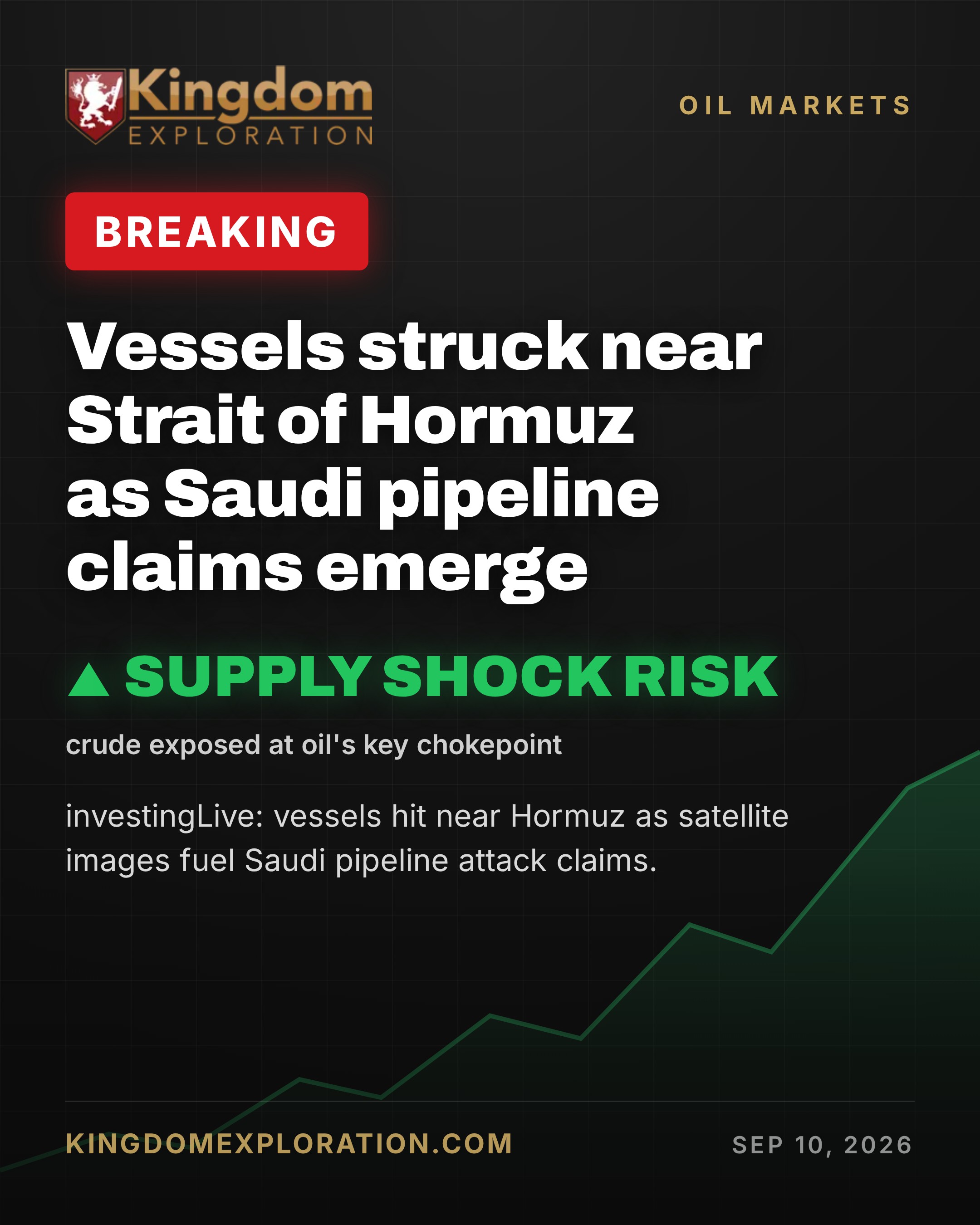
Vessels were struck near the Strait of Hormuz, one of the world's most critical oil-shipping chokepoints, while newly circulated satellite images fuel claims of an attack on Saudi pipeline infrastructure, investingLive reports. The developments, surfacing within the past hour, put two of the global oil market's most sensitive pressure points in play at the same time.
What Just Happened
According to investingLive, vessels were hit in the vicinity of the Strait of Hormuz. Separately, satellite imagery is being cited as the basis for claims of an attack on Saudi pipeline assets. Both threads center on the flow of crude and refined products out of the Gulf region \u2014 the artery through which a large share of the world's seaborne oil moves.
The Strait of Hormuz sits between the Persian Gulf and the Gulf of Oman and is the single most important transit chokepoint for global oil. Any incident involving vessels in that corridor immediately raises the specter of disrupted transit, higher insurance costs, and rerouted cargoes.
The Numbers
Specific figures on the number of vessels affected, casualties, or barrels-per-day at risk were not detailed in the initial reporting. What is established is the location \u2014 near Hormuz \u2014 and the parallel emergence of satellite-based Saudi pipeline attack claims. As the situation is confirmed, watch for hard data on tanker traffic, any halted throughput, and official statements from Gulf authorities.
Why Oil Prices Could Rise
Oil markets price risk, not just barrels. When vessels are hit near Hormuz, three mechanisms tend to push crude higher:
- Supply at risk: A meaningful portion of the world's oil exports transits Hormuz. Even the threat of interference forces traders to price in the possibility of interrupted flows.
- Risk premium: War-risk insurance and freight rates climb when a shipping lane turns hostile, raising the delivered cost of every barrel that moves through the region.
- Infrastructure exposure: Claims of a Saudi pipeline attack strike at the redundancy meant to bypass Hormuz. If overland pipeline capacity is questioned, the market's fallback option looks less secure \u2014 tightening the perceived supply cushion.
Kingdom Exploration's read: two chokepoint threats landing at once \u2014 seaborne transit and pipeline bypass \u2014 is exactly the combination that compresses the market's sense of spare capacity and can add a rapid risk premium to crude, even before any physical barrels are confirmed lost.
What to Watch Next
- Official confirmation of the vessels involved, their flags, cargoes, and condition.
- Verification of the satellite imagery and any Saudi statement on pipeline status.
- Tanker-tracking data showing whether traffic through Hormuz slows or reroutes.
- Moves in war-risk insurance premiums and Gulf freight rates.
- Any response from regional militaries or naval escorts in the strait.
Reporting sourced from investingLive. Developing story.
About Kingdom Exploration
Kingdom Exploration LLC is an Oklahoma-based oil and gas exploration company. Learn more at kingdomexploration.com.

