Live Updates
UPDATE — Sep 13, 2:41 PM CT: Oman says Iran-Gulf talks on Hormuz postponed from Monday
Oman has announced that talks between Iran and Gulf states over the Strait of Hormuz have been postponed from their scheduled Monday start, per The Times of Israel. No new date for the diplomacy was provided in the report.
Kingdom Exploration's read: the delay removes a near-term off-ramp for de-escalation, leaving the strait's disruptions - collapsed vessel traffic, mines and restricted zones - unresolved. With diplomacy stalled, the risk premium tied to the world's most critical oil chokepoint stays elevated, and supply routes remain exposed to further military escalation.
UPDATE — Sep 13, 9:02 AM CT: Report: Iran-Oman deal would place Hormuz entry route entirely in Iranian waters
A new report from The Cradle says an Iran-Oman understanding would place the Strait of Hormuz entry route entirely within Iranian territorial waters, per thecradle.co. The outlet frames it as a shift in control over one of the world's most critical maritime chokepoints.
The report follows earlier signals that an Iran-Oman understanding does not automatically reopen Hormuz to normal traffic. If confirmed, routing inbound vessels through Iranian waters would hand Tehran greater leverage over who transits and under what conditions.
Kingdom Exploration's read: with Hormuz traffic already collapsed and mines reported in the strait, any move tightening Iranian jurisdiction over the approach raises the risk premium on the roughly one-fifth of global oil supply that passes through the chokepoint.
UPDATE — Sep 12, 8:21 PM CT: Ship hit by projectile while transiting Strait of Hormuz, UK maritime agency says
A vessel has been struck by a projectile while transiting the Strait of Hormuz, the UK's maritime agency reported, per timesofisrael.com. The report did not immediately specify the ship's flag, cargo or the extent of damage.
The strike marks a direct hit on commercial shipping inside the world's most critical oil chokepoint, where traffic has already collapsed to a handful of vessels amid the escalating conflict. Kingdom Exploration's read: a confirmed projectile strike on a transiting ship raises the war-risk premium for every remaining tanker and could accelerate the exodus from Hormuz, tightening seaborne crude flows further.
UPDATE — Sep 12, 12:22 PM CT: Iran-Oman understanding does not mean Hormuz reopens, Iranian source tells Tasnim
An Iranian source has told semi-official Tasnim that a recent understanding between Iran and Oman does not signal a reopening of the Strait of Hormuz, dashing hopes that quiet diplomacy might restore normal tanker traffic through the world's most critical oil chokepoint.
The clarification suggests the waterway — where transits have already collapsed toward single digits amid mines, restricted zones and US-Iran strikes — will stay effectively shut for the near term. Roughly a fifth of global oil supply normally moves through Hormuz.
Kingdom Exploration's read: with Tehran publicly ruling out a near-term reopening, the market loses its most obvious off-ramp, keeping a heavy risk premium on crude until a broader ceasefire emerges.
UPDATE — Sep 10, 5:17 PM CT: Iranian oil loadings collapse to 0.2M bpd from 1.8M bpd amid war disruptions
Iranian crude and condensate loadings have plunged to roughly 0.2 million barrels per day, down from about 1.8 million bpd, as the widening conflict cripples Iran's export machine, per Sahi.
That represents an effective loss of around 1.6 million bpd from global supply channels — a near-total shutdown of one of OPEC's major producers. The collapse compounds the strain from crippled Strait of Hormuz traffic, where vessel transits have already thinned dramatically.
Kingdom Exploration's read: with Iranian barrels vanishing from the market at the same time Hormuz throughput is choking, the physical supply picture is tightening fast. Traders now face the prospect of a sustained shortfall that goes well beyond a shipping scare.
UPDATE — Sep 9, 7:03 AM CT: IRGC says maritime restricted zone to extend into Gulf of Oman, Arabian Sea
Iran's Islamic Revolutionary Guard Corps says its planned maritime restricted zone will extend beyond the Strait of Hormuz into the Gulf of Oman and the Arabian Sea, per Zawya. The move widens the threatened area far past the strait's chokepoint, reaching waters that vessels use to approach and leave the Gulf.
The expansion follows Iran's earlier signal that it would declare a restricted zone outside Hormuz. Extending it into the Arabian Sea would give shipping fewer safe options to route around the conflict.
Kingdom Exploration's read: pushing the danger zone into open water beyond Hormuz means tankers can't simply wait offshore for safe passage - it broadens the supply risk and adds fresh pressure on crude and freight insurance costs.
UPDATE — Sep 8, 11:27 PM CT: Hormuz traffic collapses to just 6 vessels as Iran conflict escalates
Vessel traffic through the Strait of Hormuz has cratered to just six ships, Moneycontrol.com reports, as the conflict between the US and Iran intensifies. That marks a dramatic further collapse from the 77 transits and 28% weekly drop flagged in earlier updates.
The Strait is the world's most critical oil chokepoint, carrying roughly a fifth of global crude supply. A near-total halt in transits threatens to strand tankers and choke exports from the Gulf.
Kingdom Exploration's read: with only a handful of ships still moving, the waterway is edging toward de facto closure - a scenario that would put severe upward pressure on crude prices if it persists.
UPDATE — Sep 8, 3:47 PM CT: IRGC warns tanker crews near Kuwait, Bahrain to abandon vessels after US strikes Iranian tankers
The IRGC has warned oil tanker crews operating near Kuwait and Bahrain to leave their vessels, following US strikes on Iranian tankers, per The Sunday Guardian. The warning marks a direct threat to commercial shipping crews in the northern Gulf, beyond the Strait of Hormuz itself.
Kingdom Exploration's read: an explicit call for crews to abandon ships signals Tehran is prepared to treat the wider Gulf as a combat zone. Even without a formal closure of Hormuz, a threat of this scope can freeze charter activity, spike war-risk insurance premiums, and choke the flow of crude from the region that carries roughly a fifth of the world's oil.
UPDATE — Sep 7, 9:41 PM CT: Hormuz vessel traffic falls 28% in a week as only 77 ships transit
Shipping through the Strait of Hormuz has collapsed by 28% over the past week, with just 77 vessels passing through the chokepoint, RTV News reports. The steep drop signals that commercial operators are increasingly avoiding the waterway amid the escalating US-Iran military confrontation.
Roughly a fifth of the world's oil supply normally moves through Hormuz, so a sustained decline in transits threatens to squeeze crude flows to global markets even without a formal closure of the strait.
Kingdom Exploration's read: falling ship counts are the clearest market signal yet that the conflict is already disrupting energy trade, and continued avoidance could tighten supply and add risk premium to oil prices.
UPDATE — Sep 6, 7:17 PM CT: Iran lays about a dozen mines in Strait of Hormuz, sources say
Iran has laid about a dozen naval mines in the Strait of Hormuz, sources tell EnergyNow.com in a report published roughly 95 minutes ago. The move marks a sharp physical escalation beyond the missile and drone exchanges already tracked on this page, taking the confrontation directly into the waterway itself.
The exact positions of the mines were not disclosed, and there is no confirmation yet of vessels struck. Kingdom Exploration's read: even a small number of mines can force shippers and insurers to pause transits through the world's most important oil chokepoint, since roughly a fifth of global crude and much of the world's LNG moves through Hormuz. The threat of mining—rather than any single strike—is what typically drives freight, insurance and crude prices higher.
UPDATE — Sep 6, 2:12 PM CT: Iran to declare new 'restricted zone' outside Strait of Hormuz, security official says
A top Iranian security official says Tehran will declare a new "restricted zone" in waters outside the Strait of Hormuz, according to PressTV. No coordinates, timing or enforcement details were provided in the report.
The move would extend Iran's threat posture beyond the strait's chokepoint itself, potentially complicating shipping approaches to one of the world's most critical oil arteries. Roughly a fifth of global crude flows through the Hormuz corridor.
Kingdom Exploration's read: even the announcement of a restricted zone — without firing a shot — can push up tanker insurance and reroute traffic, keeping a risk premium in crude prices while the standoff continues.
UPDATE — Sep 6, 10:13 AM CT: Iran strikes military sites in Bahrain, Kuwait and Qatar after fresh US strikes
Iran has attacked military sites across three Gulf states — Bahrain, Kuwait and Qatar — in retaliation for the latest wave of U.S. strikes, according to The Arab Weekly. The report marks a sharp widening of the conflict beyond Iranian territory and the Strait of Hormuz into the broader Gulf, home to major U.S. bases and critical energy infrastructure.
Kingdom Exploration's read: hitting targets in Bahrain (home to the U.S. Fifth Fleet), Kuwait and Qatar drags the entire Gulf into the fighting. Those three states sit alongside the world's busiest oil-export corridor, and any threat to their ports, terminals or airspace raises the risk of disrupted crude and LNG flows through Hormuz — the channel for roughly a fifth of global oil supply.
UPDATE — Sep 3, 6:06 PM CT: South Korea prepares to deploy troops to the Strait of Hormuz, per i24NEWS
South Korea is preparing to deploy troops to the Strait of Hormuz, i24NEWS reports. The move would add another national military to a waterway already crowded with U.S. and Iranian forces amid escalating strikes.
Details on the size, timing and mandate of any South Korean deployment were not provided in the report. Seoul has previously maintained anti-piracy naval assets in the region to protect commercial shipping and energy imports.
Kingdom Exploration's read: fresh foreign military involvement signals just how seriously governments are taking the threat to Hormuz traffic. Roughly a fifth of global oil flows through the strait, so any additional militarization keeps a firm risk premium under crude prices as the standoff widens.
UPDATE — Sep 1, 3:17 PM CT: NBC News confirms fresh U.S. strikes near Strait of Hormuz as Iran vows retaliation
NBC News reports that U.S. forces have struck targets inside Iran near the Strait of Hormuz, with Iran saying it is now retaliating against American positions. The report reinforces earlier CENTCOM and BBC confirmations of an expanding exchange of fire around the world's most critical oil chokepoint.
Kingdom Exploration's read: with strikes and counterstrikes now concentrated around Hormuz, the risk to tanker traffic and roughly a fifth of global seaborne oil flows keeps climbing. Any disruption to transit through the strait would tighten physical supply fast, and markets are pricing that escalation risk into crude.
UPDATE — Sep 1, 1:52 PM CT: Washington Post reports fresh wave of U.S. strikes inside Iran
The Washington Post reports that U.S. forces have carried out new military strikes inside Iran, the latest in an escalating series of American operations tied to the fighting around the Strait of Hormuz.
The outlet did not immediately detail targets, locations or casualties from this newest round. It follows earlier CENTCOM-confirmed strikes and Iranian retaliation against U.S. forces reported across the region.
Kingdom Exploration's read: each new wave of strikes keeps a war-risk premium bid into crude, with roughly a fifth of global oil flows transiting Hormuz. Traders will watch for any disruption to tanker traffic as the confrontation widens.
UPDATE — Sep 1, 1:12 PM CT: CENTCOM confirms fresh wave of U.S. strikes against Iran
The U.S. has launched a new round of strikes against Iran, U.S. Central Command said, per CBS News. The announcement extends an escalating military exchange centered on the Strait of Hormuz, through which roughly a fifth of the world's oil supply flows.
CBS News reports CENTCOM confirmed the fresh strikes; specific targets, weapons and casualty figures were not detailed in the initial report.
Kingdom Exploration's read: each new round of U.S.-Iran fire near Hormuz raises the risk of disruption to tanker traffic, keeping a war-risk premium on crude. We will update as CENTCOM and outlets provide target details.
UPDATE — Sep 1, 12:43 PM CT: BBC confirms US strikes on Iran after 'attempted attacks in Strait'
The BBC reports that U.S. forces have launched strikes on Iran following "attempted attacks in Strait," adding a further outlet's confirmation to the widening confrontation over the Strait of Hormuz.
The BBC framed the strikes as a direct response to attempted attacks in the waterway, consistent with earlier Centcom statements tying U.S. action to fresh shipping threats in the region.
Kingdom Exploration's read: the Strait of Hormuz carries roughly a fifth of global oil flows, so any escalation that threatens transit through the chokepoint keeps a firm risk premium under crude prices as markets watch for shipping disruptions.
UPDATE — Sep 1, 12:07 PM CT: Centcom says U.S. strikes Iran after fresh Hormuz shipping attacks
U.S. Central Command says American forces carried out new strikes inside Iran in response to fresh attacks on shipping in the Strait of Hormuz, CNBC reported roughly 10 minutes ago.
Centcom tied the latest round of strikes directly to renewed assaults on vessels in the strait, though details on targets and damage were not immediately available in the report.
Kingdom Exploration's read: with the world's most critical oil chokepoint now the stated trigger for U.S. military action, the risk of disruption to the roughly one-fifth of global crude that transits Hormuz keeps upward pressure on prices as the confrontation escalates.
UPDATE — Sep 1, 11:36 AM CT: US official confirms American forces struck in Iran's Bandar Abbas
A US official has confirmed that American forces were struck in Iran's Bandar Abbas, per The Jerusalem Post. The report marks a further widening of the direct US-Iran exchange after earlier strikes on Larak Island and Iranian missile launchers.
Bandar Abbas sits at the northern edge of the Strait of Hormuz and hosts key Iranian naval facilities. The absence of casualty figures or details on the scale of the strike leaves the situation fluid, with The Jerusalem Post citing only a US official's confirmation.
Kingdom Exploration's read: fighting now reaching Bandar Abbas — a hub adjacent to the world's most critical oil chokepoint — raises the risk premium on crude, as roughly a fifth of global oil supply transits Hormuz daily.
UPDATE — Aug 31, 2:36 PM CT: Trump weighing limited strikes on Iran to protect Strait of Hormuz, per Axios
President Trump is weighing limited strikes on Iran aimed at protecting the Strait of Hormuz, according to an Axios report carried by Arab Times Kuwait News. The report frames the potential action as narrowly scoped and focused on keeping the vital chokepoint open.
No timing, targets, or scale were specified in the report. Kingdom Exploration's read: any signal of further US military action tied to Hormuz keeps a risk premium under crude, given that roughly a fifth of global oil flows transit the strait. Traders will watch whether "limited" holds or the confrontation widens.
UPDATE — Aug 31, 7:02 AM CT: Iran says it targeted US forces at UAE air base with explosive drones
Iran says it launched explosive drones at US forces stationed at an air base in the United Arab Emirates, per Anadolu Ajansı. The claim marks a fresh expansion of Tehran's retaliation beyond the immediate Strait of Hormuz theatre and into the wider Gulf.
Details on damage, casualties or the specific base were not provided in the report. Kingdom Exploration's read: strikes reaching Gulf air bases raise the stakes for energy infrastructure and shipping across a region that handles a large share of the world's crude exports.
Any widening of attacks near Hormuz and the UAE keeps a persistent risk premium under oil, with traders watching for disruption to tanker traffic and export terminals.
UPDATE — Aug 30, 6:51 PM CT: Iran fires missiles at US warships in the Strait of Hormuz, per Asia Business Daily
Iran has fired missiles directly at U.S. warships in the Strait of Hormuz, according to South Korea's 아시아경제 (Asia Business Daily), which described the strike as coming within a day of the U.S. attack on Iranian targets. The report was published roughly 14 minutes ago.
The outlet characterized the launch as retaliation, escalating the confrontation from Larak Island and Jordan into the strategic waterway itself. Details on damage or casualties were not provided in the summary.
Kingdom Exploration's read: an attack on naval assets inside Hormuz raises the risk of disruption to the roughly one-fifth of global oil that transits the strait. Any threat to shipping through this chokepoint tends to put upward pressure on crude prices as traders price in supply risk.
UPDATE — Aug 30, 6:21 PM CT: Iran strikes US forces in Jordan in retaliation for Larak Island attack
Iran has struck US forces in Jordan following the American attack on Iranian missile launchers on Larak Island, per Eurasia Review. The report marks a sharp escalation, with Tehran making good on the IRGC's earlier vow of heavy retaliation.
Details on casualties and the scale of the strike were not immediately available in the report. The exchange widens the direct US-Iran confrontation beyond the initial strikes near the Strait of Hormuz.
Kingdom Exploration's read: a retaliatory Iranian strike on US positions raises the risk of a broader regional conflict around Hormuz, the chokepoint for roughly a fifth of global oil flows. Any threat to that corridor keeps upward pressure on crude prices.
UPDATE — Aug 30, 5:51 PM CT: US hits Iranian missile launchers on Larak Island as IRGC vows heavy retaliation
US forces struck Iranian missile launchers on Larak Island, an outpost near the Strait of Hormuz, according to ANI News. The Islamic Revolutionary Guard Corps (IRGC) has vowed "heavy retaliation," per the same report.
Larak Island sits close to the mouth of the Strait of Hormuz, the chokepoint through which a large share of the world's seaborne crude and LNG passes. Targeting launchers there points to an effort to degrade Iran's ability to threaten shipping in the waterway.
Kingdom Exploration's read: with the IRGC signaling escalation, traders will price in a higher risk premium on any threat to Hormuz traffic. No disruption to tanker flows has been confirmed at this stage.
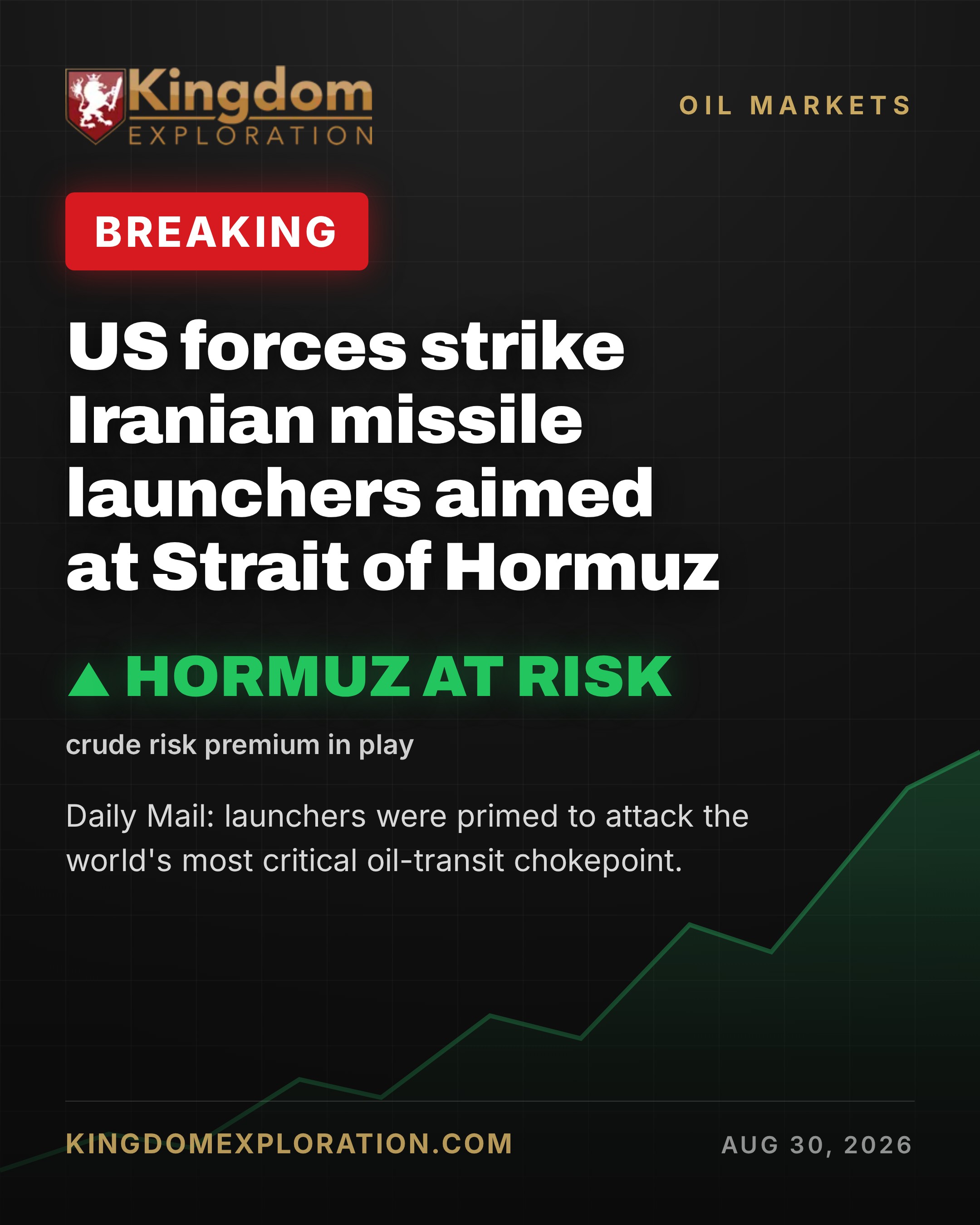
US forces struck Iranian missile launchers that were primed to attack the Strait of Hormuz, the Daily Mail reported roughly 25 minutes ago. The action targets weaponry positioned against the world's single most critical oil-transit chokepoint, instantly injecting fresh geopolitical risk into an already jittery crude market.
What Just Happened
According to the Daily Mail, US forces carried out a strike on Iranian missile launchers that were readied to fire on the Strait of Hormuz. The narrow waterway between Iran and the Arabian Peninsula is the primary export route for a large share of Gulf crude, meaning any credible threat to it — and any military exchange near it — reverberates through global energy markets.
The report frames the launchers as "primed to attack," indicating an active and imminent threat that US forces moved to neutralize rather than a routine posture. As of publication, the strike is a developing story and further operational details had not been confirmed.
The Numbers
The Daily Mail report did not provide specific figures for the strike — such as the number of launchers hit, casualties, or munitions used. Kingdom Exploration is not attaching estimates to those details until verified data emerges.
What is not in dispute is the stakes attached to the location itself: the Strait of Hormuz is the world's most important oil chokepoint, and the mere risk of disruption there tends to command an outsized premium in crude prices.
Why Oil Prices Could Rise
Markets price geopolitics through the lens of supply at risk. When military action occurs at or near a chokepoint like Hormuz, three mechanisms typically push crude higher:
- Risk premium: Traders add a premium to crude to account for the possibility that a portion of Gulf exports could be delayed, rerouted, or halted.
- Supply at risk: A functioning Hormuz is essential to moving Gulf barrels to global buyers. Any threat to transit — or to the tankers moving through it — raises the odds of a physical supply interruption.
- Spare capacity strain: Because so much export flow funnels through a single narrow passage, alternatives are limited and cannot fully replace disrupted volumes quickly, which amplifies price sensitivity.
Kingdom Exploration's read: strikes on launchers positioned against Hormuz signal that the threat to the waterway was considered real enough to warrant direct military action. That is exactly the kind of headline that keeps a risk premium embedded in crude until tensions clearly de-escalate.
What to Watch Next
- Iranian response: Whether Tehran retaliates, escalates, or stands down will shape how long any risk premium persists.
- Tanker traffic: Any changes in shipping activity, insurance rates, or rerouting around the Strait would signal real supply stress.
- Official confirmation: Details from US and Iranian authorities on the scope of the strike and the status of the launchers.
- Further military activity: Additional strikes or naval movements near the Strait that could widen the confrontation.
For oil investors and energy watchers, the key variable is duration: a one-off action that quickly cools may fade from prices, while a sustained standoff near Hormuz can keep crude elevated on supply-disruption fears.
Reporting sourced from Daily Mail. Developing story.
About Kingdom Exploration
Kingdom Exploration LLC is an Oklahoma-based oil and gas exploration company. Learn more at kingdomexploration.com.

