Live Updates
UPDATE — Sep 8, 9:52 PM CT: IRGC claims it hit 2 US ships and 8 oil tankers in Hormuz after latest US strikes
Iran's Revolutionary Guards say they have attacked two U.S. ships and eight oil tankers in the Strait of Hormuz in response to the latest American strikes, per timesofisrael.com. It marks a sharp expansion of the claimed retaliation, which Iran had earlier put at three oil tankers and three U.S.-linked vessels.
The figures come from IRGC statements and have not been independently confirmed. If borne out, an eight-tanker strike inside the world's most critical oil chokepoint would represent a major escalation of the maritime confrontation.
Kingdom Exploration's read: with roughly a fifth of global crude and LNG transiting Hormuz, any attack on this many tankers threatens to disrupt shipping, spike insurance costs and drive crude prices higher until damage and traffic can be assessed.
UPDATE — Sep 8, 6:17 PM CT: CENTCOM says U.S. destroyed 5 more IRGC tankers after Iran targets another warship
The U.S. military has destroyed five Islamic Revolutionary Guard Corps (IRGC) oil tankers after Iran targeted another American warship, according to centcom.mil. The strikes mark a sharp escalation beyond the three Iranian tankers CENTCOM previously reported hitting.
The command says the latest action followed a fresh Iranian attempt against a U.S. Navy vessel, adding to earlier confrontations in which warships evaded Iranian missiles. With five additional tankers now reported destroyed, the tally of Iranian crude-carrying vessels struck continues to climb.
Kingdom Exploration's read: sustained U.S. strikes on Iranian tankers and repeated attacks on American warships raise the risk of disruption to Gulf shipping lanes that carry a large share of the world's crude, keeping a war-risk premium under oil prices.
UPDATE — Sep 8, 5:23 PM CT: Iran threatens reprisal after U.S. strikes on Iranian oil tankers, NYT reports
The New York Times reports that Iran is threatening reprisal following the U.S. strikes on Iranian oil tankers, sharpening fears of a wider confrontation in the Gulf. The report frames the strikes as having drawn an explicit threat of retaliation from Tehran.
The development follows earlier confirmation that U.S. forces struck three Iranian oil tankers, with one reported sunk, and Iran's claim that it retaliated against tankers in the Strait of Hormuz.
Kingdom Exploration's read: with roughly a fifth of the world's oil flowing through Hormuz, any escalation of tit-for-tat tanker attacks keeps a war-risk premium firmly in crude prices until the situation de-escalates.
UPDATE — Sep 8, 3:13 PM CT: Iranian agency confirms US missile struck Iranian oil tanker near Kharg Island
An Iranian state agency now says a US missile struck an Iranian oil tanker near Kharg Island, per Al Arabiya English. The report marks Tehran's own confirmation of a strike on a vessel close to the country's most important crude export terminal.
Kharg Island handles the vast majority of Iran's seaborne oil exports, making any attack in its vicinity acutely sensitive for global supply. Al Arabiya cited the Iranian agency but detailed damage and casualty figures were not immediately provided.
Kingdom Exploration's read: Iranian confirmation of a strike this close to Kharg raises the stakes considerably. With loadings concentrated at a single hub, even a limited disruption there could ripple through crude markets far more than incidents in open water.
UPDATE — Sep 5, 8:21 PM CT: US military says Iranian oil tanker has sunk in Gulf of Oman
The US military says an Iranian oil tanker has sunk in the Gulf of Oman, per Al Jazeera (@AJENews). It is the most serious loss confirmed since the exchange of strikes began, though further details on the vessel, its cargo and any casualties were not immediately provided.
The sinking marks an escalation from the earlier reported strikes on Iranian tankers and pushes the confrontation beyond the Strait of Hormuz into the Gulf of Oman, a key route for crude leaving the region.
Kingdom Exploration's read: an actual tanker sinking — not just a strike — raises the risk premium on Gulf shipping and could rattle insurers and vessel operators along one of the world's busiest oil corridors, with knock-on pressure on crude prices.
UPDATE — Sep 5, 3:23 PM CT: Iran says it struck 3 oil tankers in Hormuz, 3 US-linked vessels in retaliation
Iran says it has hit three oil tankers in the Strait of Hormuz and three US-linked vessels in response to American strikes, per Anadolu Ajansı. The claim marks a sharp escalation, extending the confrontation from Kharg Island into the world's most critical oil chokepoint.
The report does not detail vessel names, flags or damage. Iran frames the action as direct retaliation for the earlier US attacks on three Iranian oil tankers reported by CENTCOM.
Kingdom Exploration's read: roughly a fifth of global oil flows through Hormuz. Confirmed attacks on tankers there raise the risk of insurance and shipping disruptions, and could put upward pressure on crude as traders price in a widening supply threat.
UPDATE — Sep 5, 9:27 AM CT: CENTCOM says strikes came after Navy warships evaded Iranian missiles
US Central Command says the strikes on three Iranian oil carriers followed an incident in which US Navy warships evaded missiles, per stripes.com. The framing casts the tanker strikes as a response to a direct threat against American vessels, marking a sharp escalation in the confrontation.
Kingdom Exploration's read: linking the strikes to missiles fired at US warships raises the risk of a wider tit-for-tat around Kharg Island and Iran's export terminals. Any sustained disruption to Iranian crude loadings or shipping through the Gulf keeps a firm risk premium in oil prices.
UPDATE — Sep 5, 8:56 AM CT: CENTCOM says US struck three Iranian oil tankers
US Central Command says American forces struck three Iranian oil tankers, per bloomingbit. The statement expands the scope of the reported strikes beyond the single vessel initially tied to the Kharg Island area.
No details on the tankers' cargo volumes, exact locations, or casualties were provided in the report. Kingdom Exploration's read: any confirmed US military action against multiple Iranian tankers raises the risk of disruption to Iranian crude exports and heightens tensions around Gulf shipping lanes — a bullish signal for oil supply-risk premiums until more is known.
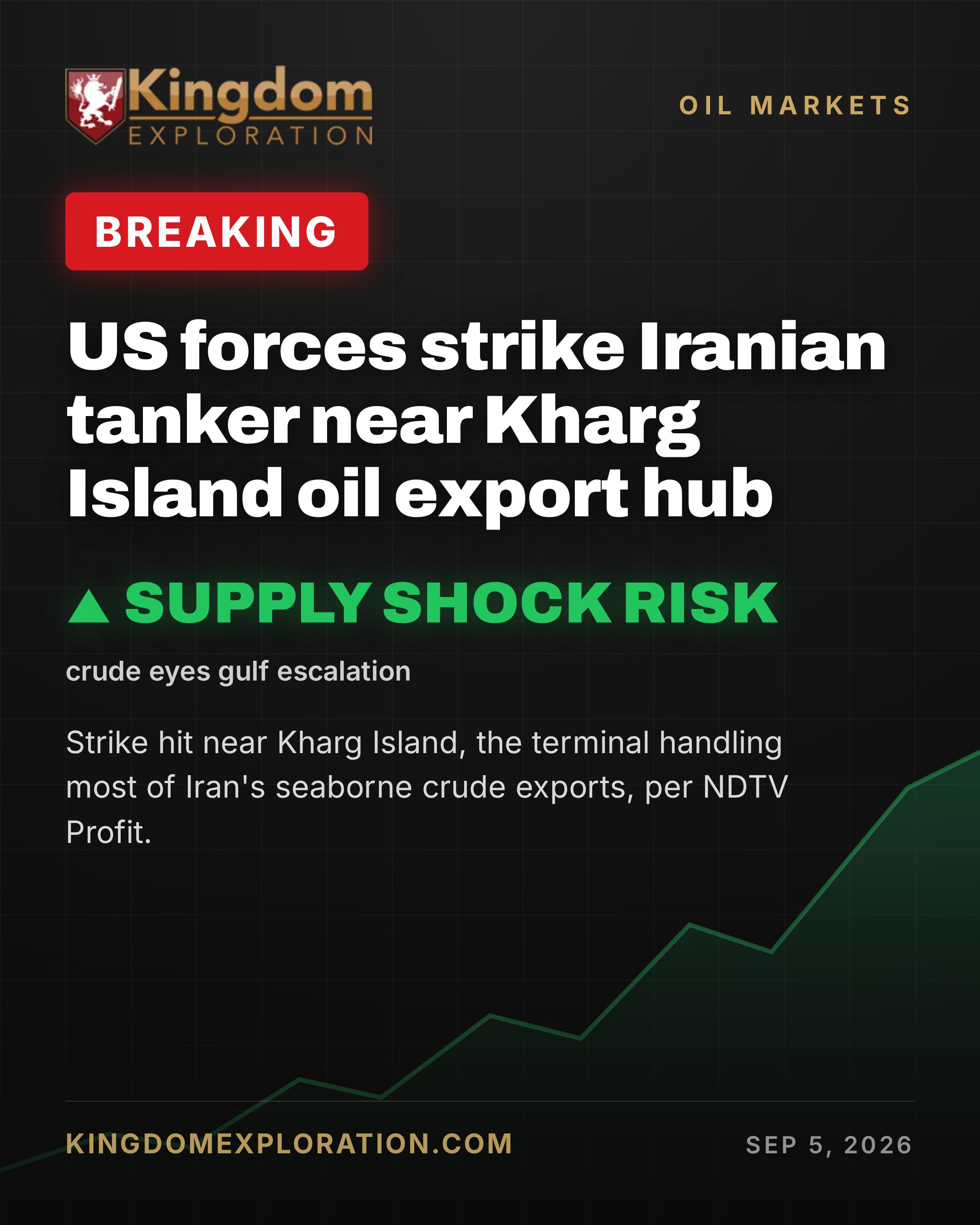
US forces struck an Iranian tanker near Kharg Island, Iran's primary crude oil export terminal, according to a report from NDTV Profit published minutes ago. The strike on a vessel so close to the Gulf's most important loading hub raises immediate questions about the security of Iranian barrels moving into the global market.
What Just Happened
Per NDTV Profit, US forces hit an Iranian tanker in waters near Kharg Island. The island, located in the northeast Persian Gulf, handles the overwhelming majority of Iran's seaborne crude exports and is one of the most strategically significant pieces of oil infrastructure in the world.
Any military action against tanker traffic at or near Kharg Island touches the heart of Iran's oil supply chain. The terminal's export volumes feed refiners across Asia, and a disruption at this chokepoint would ripple through physical crude markets quickly.
The Numbers
The initial report does not provide casualty figures, tonnage, cargo volumes, or price data. What matters to the market is the location: Kharg Island is the export gateway for the bulk of Iranian crude shipments, so even a single incident there carries outsized signaling weight for supply risk.
As additional details emerge, watch for confirmation of the vessel's cargo status, whether loading operations at the terminal are affected, and any official statements from Tehran or Washington.
Why Oil Prices Could Rise
Oil markets price risk as much as they price barrels. A direct strike near Iran's main export hub injects a geopolitical risk premium into crude for several reasons:
- Supply at risk: Kharg Island is the loading point for the majority of Iran's crude exports. Any threat to operations there puts real barrels in question.
- Escalation potential: Military contact between US and Iranian assets in the Gulf raises the odds of retaliation, insurance-cost spikes, and shipowners rerouting or pausing transits.
- Chokepoint proximity: The northern Gulf sits within the broader Strait of Hormuz corridor, through which a large share of the world's seaborne oil passes. Tension in these waters historically lifts crude on fear of wider disruption.
Kingdom Exploration's read: markets rarely wait for full confirmation when the target is oil infrastructure. Traders tend to bid in a risk premium first and reassess later, and Kharg Island is about as sensitive a location as exists on the global energy map.
What to Watch Next
Key developments to monitor in the coming hours:
- Official confirmation and framing from US and Iranian authorities.
- Whether crude loading and export operations at Kharg Island continue uninterrupted.
- Tanker-tracking and shipping-insurance reactions across the Persian Gulf.
- Any move by Tehran affecting traffic through the Strait of Hormuz.
- Front-month Brent and WTI response as Asian and European desks digest the report.
This is a fast-moving situation and details remain limited. We will update as verified information becomes available.
Reporting sourced from NDTV Profit. Developing story.
About Kingdom Exploration
Kingdom Exploration LLC is an Oklahoma-based oil and gas exploration company. Learn more at kingdomexploration.com.

