Live Updates
UPDATE — Jul 24, 1:52 PM CT: Trump meets top advisers as he weighs a major escalation against Iran
President Trump is huddling with his top national security advisers as he weighs a major escalation of the US campaign against Iran, The New York Times reports. The meeting comes as Trump has publicly floated a "massive attack" larger than the earlier Epic Fury strikes and threatened to hit Iran's deep-buried nuclear facilities.
The report offers no confirmed decision or timeline, but signals that the next phase of US action could be imminent. Kingdom Exploration's read: with the Strait of Hormuz already choked and Iran threatening regional energy infrastructure, any decision to widen strikes keeps a heavy risk premium on crude and raises the odds of further supply disruption through the Gulf.
UPDATE — Jul 24, 11:03 AM CT: Iran launches fresh attacks on US military as Trump vows 'major punishment'
Iran has launched fresh attacks on US military targets, per inkl, marking a sharp escalation as President Trump vowed "major punishment" in response. The report follows Trump's earlier threats of a "massive attack" and his pledge to strike Iran's deep-buried nuclear site.
The new strikes deepen a direct US-Iran military confrontation that markets have been watching closely, with the Strait of Hormuz — a chokepoint for roughly a fifth of global oil flows — already reported closed by Iran's military command.
Kingdom Exploration's read: renewed Iranian strikes plus a US retaliation pledge raise the risk of sustained conflict around key Gulf energy infrastructure, keeping a strong risk premium in crude prices as long as escalation continues.
UPDATE — Jul 23, 6:32 PM CT: US Air Force launches massive European airbridge to Middle East as Trump threatens bigger attack
The US Air Force has launched a massive airbridge from Europe to the Middle East as President Trump threatens a "bigger than ever" attack on Iran, per 247 Ureports. The report signals an accelerating US military buildup in the region.
Kingdom Exploration's read: a large-scale airbridge typically moves troops, munitions and support equipment at speed, pointing to preparations for sustained operations rather than a one-off strike. With the Strait of Hormuz already reported closed and Tehran threatening regional energy infrastructure, any escalation raises the risk premium on crude, as roughly a fifth of the world's oil flows through Hormuz.
UPDATE — Jul 23, 11:02 AM CT: Trump says he is close to deciding on "massive attack" on Iran, bigger than Epic Fury
President Trump says he is close to deciding on a "massive attack" on Iran that would be larger than Operation Epic Fury, adding that the U.S. is "all set for it" and does not need Israel, per @disclosetv on Telegram.
Trump said Israel would "join in two minutes" if asked but would face "consequences" for doing so. The remarks sharply escalate the U.S. posture after prior threats to strike Iran's deep-buried nuclear site and regional infrastructure.
Kingdom Exploration's read: with the Strait of Hormuz already reported closed and Iran threatening regional energy targets, any expanded U.S. strike raises the risk of supply disruption through the world's key oil chokepoint, keeping crude prices on edge.
UPDATE — Jul 22, 2:12 PM CT: Iran's military command says Strait of Hormuz remains closed, threatens regional oil infrastructure
Iran's military command declared that the Strait of Hormuz "remains closed" and warned it will target regional oil and gas infrastructure if the United States carries out strikes, per Iran International (@IranIntl_En).
Roughly a fifth of the world's oil flows through the Hormuz chokepoint, and any sustained closure removes a large volume of crude and LNG from global markets. The added threat to Gulf energy facilities widens the potential supply shock beyond the waterway itself.
Kingdom Exploration's read: an explicit "closed" declaration paired with infrastructure threats is a sharper escalation than earlier warnings, and traders will watch shipping and tanker activity closely for confirmation of disrupted flows.
UPDATE — Jul 22, 10:02 AM CT: Iran threatens to strike regional energy infrastructure after Trump's Hormuz threat
Iran has threatened to attack energy infrastructure across the region in response to President Trump's threats over the Strait of Hormuz, per Anadolu Ajansı. The warning marks a sharp escalation in the war of words between Tehran and Washington.
Anadolu Ajansı reported the threat roughly nine minutes ago; no specific targets, timing or scale were detailed in the report.
Kingdom Exploration's read: Any credible Iranian threat against Gulf energy infrastructure — refineries, export terminals or pipelines — raises the risk premium on crude. The region handles a major share of global oil flows, and even a limited strike could disrupt supply and lift prices sharply.
UPDATE — Jul 22, 8:43 AM CT: Trump vows to strike an Iranian bridge or power plant for every ship Iran attacks
President Trump has vowed to hit an Iranian bridge or power plant in retaliation for every ship Iran attacks, per Axios. The warning sharpens an ongoing standoff and signals a tit-for-tat escalation that could extend the conflict to Iran's shipping and civilian infrastructure.
Kingdom Exploration's read: an explicit threat tied to attacks on vessels raises the risk to tanker traffic in and around the Gulf, a corridor that moves a large share of the world's seaborne crude. Any disruption to shipping or to Iranian energy infrastructure would tighten supply expectations and keep a risk premium in oil prices.
UPDATE — Jul 22, 5:22 AM CT: Trump vows to hit Iran's deep-buried 'Pickaxe Mountain' site "very heavily"
President Trump says he will strike Iran's 'Pickaxe Mountain' nuclear site "pretty soon, and very heavily," adding there's "not a thing they can do about it," per @intelslava on Telegram.
The site, known in Iran as Kuh-e Kolang Gaz La, sits south of Natanz and is buried an estimated 100 meters beneath a mountain — one of the country's most protected facilities. Iran began digging it in 2020. Nuclear expert David Albright says it is large enough to hold both an enrichment plant and weaponization work, per the report, which Iran is signaling it intends to rebuild.
Kingdom Exploration's read: fresh threats against a fortified underground target keep the risk of prolonged US-Iran escalation alive, and any wider strike on Iranian territory would tighten the geopolitical premium baked into crude.
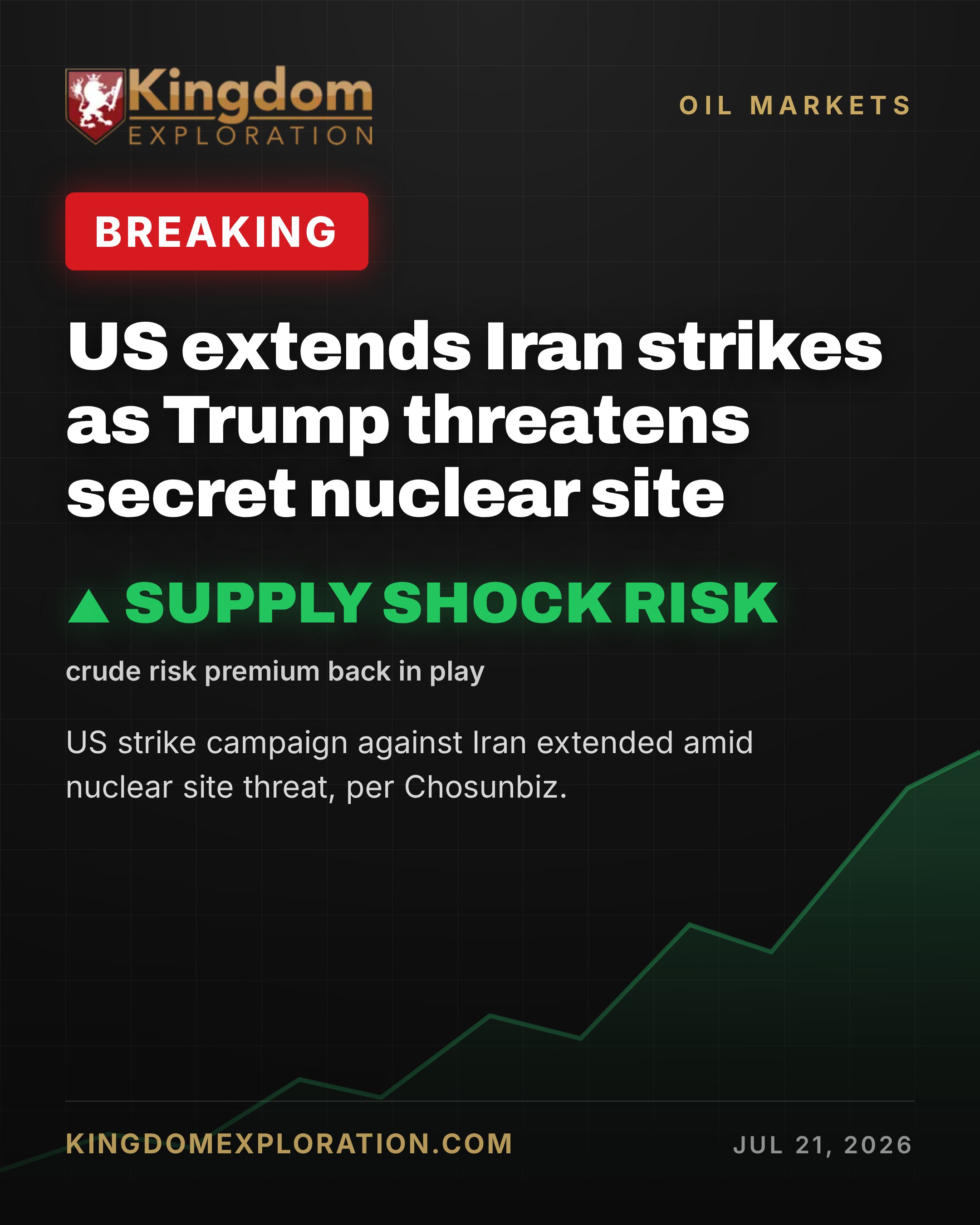
The United States has extended its military strikes against Iran, with President Trump threatening an attack on a secret nuclear site, according to a report from Chosunbiz published minutes ago. The development marks a fresh escalation in a region that sits at the heart of global crude supply, and energy markets are watching closely for any impact on oil flows.
What Just Happened
Per Chosunbiz, the U.S. has continued and extended its strike campaign against Iran. The same report indicates that President Trump has raised the threat of an attack targeting a secret Iranian nuclear site. Details beyond the headline remain limited as this is a developing story, and Kingdom Exploration is reporting only what has been confirmed by the outlet.
Iran is a major oil producer and a pivotal player in the geopolitics of the Persian Gulf. Any sustained military campaign involving the country immediately draws the attention of oil traders because of the potential for disruption to production and export routes.
The Numbers
At this early stage, the Chosunbiz report does not provide specific figures on barrels affected, casualties, or price movements. As concrete data becomes available - production volumes at risk, export flows, or crude benchmark reactions - it will be critical to the market's read on the situation.
- Confirmed: U.S. strikes on Iran have been extended.
- Confirmed: Trump has threatened an attack on a secret nuclear site.
- Not yet reported: barrels-per-day at risk, price changes, or timeline.
Why Oil Prices Could Rise
Escalating military conflict involving Iran introduces a geopolitical risk premium into crude prices. The mechanism is straightforward: when a major producing nation faces sustained strikes, markets price in the possibility that supply could be interrupted - whether through damage to infrastructure, retaliatory action, or disruption to key shipping lanes.
The Persian Gulf region is home to a substantial share of the world's crude exports. Even without an actual loss of barrels, the mere threat of disruption can push traders to bid up prices as a hedge against worst-case scenarios. Spare capacity elsewhere in the world can cushion a shock, but the market tends to react first and reassess later.
Kingdom Exploration's read: An extended strike campaign combined with rhetoric about nuclear sites keeps a geopolitical risk premium firmly in play. Until the scope of any supply disruption is clear, traders are likely to treat headlines out of the region as price-sensitive.
What to Watch Next
Several factors will determine whether this remains a headline-driven risk premium or becomes a genuine supply event:
- Whether the strikes damage Iranian oil production or export infrastructure.
- Any Iranian response affecting regional shipping, particularly Gulf transit routes.
- Official statements clarifying the scope and duration of the U.S. campaign.
- Movements in Brent and WTI crude benchmarks as markets digest the news.
As always, early reports in fast-moving conflicts can shift. We will update this story as verified details emerge.
Reporting sourced from Chosunbiz. Developing story.
About Kingdom Exploration
Kingdom Exploration LLC is an Oklahoma-based oil and gas exploration company. Learn more at kingdomexploration.com.

