Live Updates
UPDATE — Aug 18, 4:21 PM CT: UAE halts all trade ties with Iran after missile attack, per Al-Monitor
The UAE has suspended all trade ties with Iran following the missile attack, according to Al-Monitor. The move marks a sharp escalation after Abu Dhabi earlier said two missiles fired from Iran fell into the sea.
No further details on the scope or duration of the trade halt were provided in the report. Kingdom Exploration's read: a rupture between two major Gulf economies raises the risk of wider regional escalation around the Strait of Hormuz, a chokepoint for roughly a fifth of the world's oil supply.
Any disruption to Gulf shipping or export flows would tighten crude markets quickly. We are monitoring for official confirmation and market reaction.
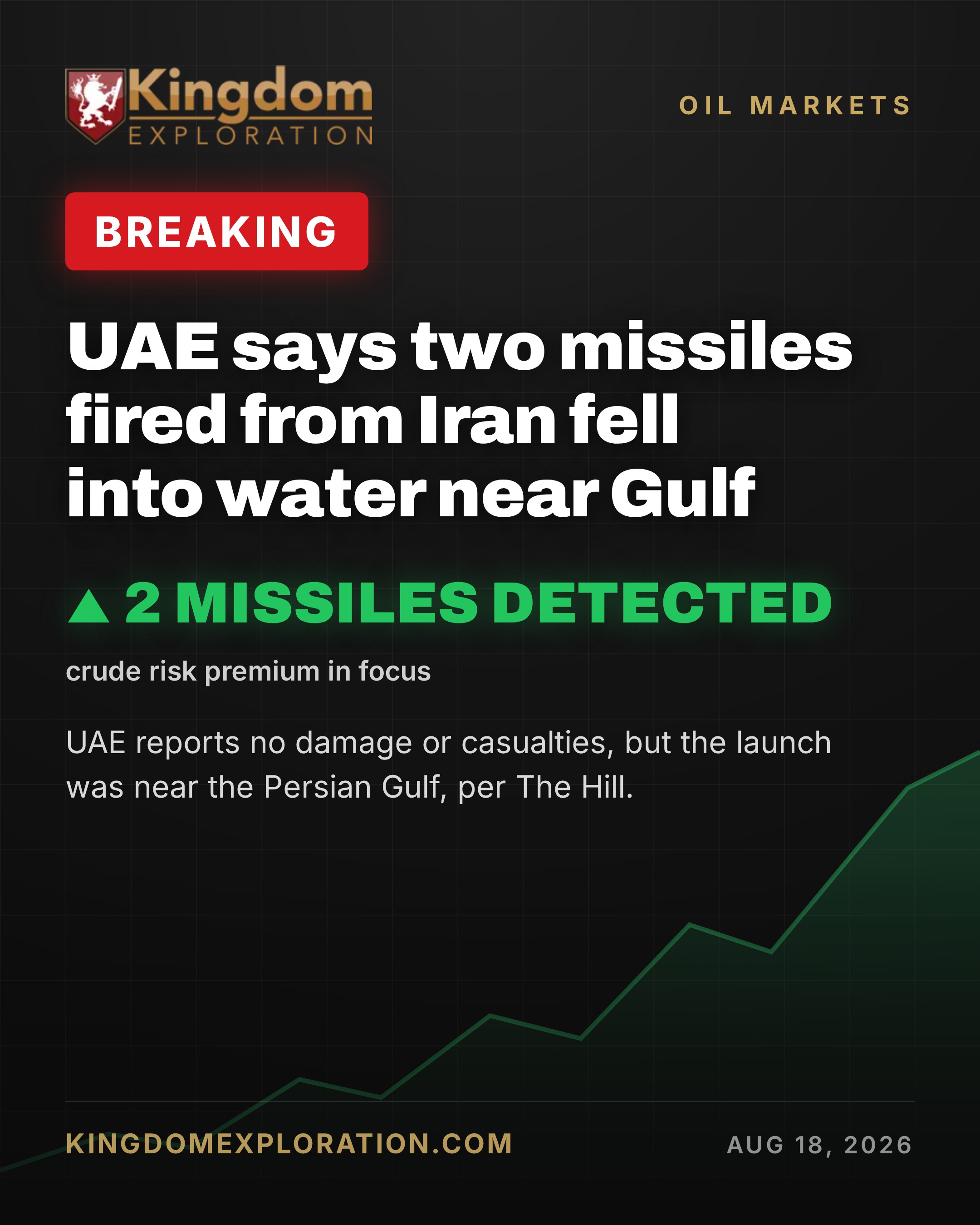
The United Arab Emirates said it detected two missiles fired from Iran, with both projectiles falling harmlessly into water, The Hill reported. The disclosure, surfacing in the last hour, puts fresh focus on the Persian Gulf — one of the most heavily trafficked energy corridors on Earth — and the ever-present threat that any miscalculation there poses to global crude flows.
What Just Happened
According to The Hill, UAE authorities reported detecting two missiles that originated from Iran. Both are said to have fallen into water rather than striking land or infrastructure. No casualties or damage were reported in the initial account.
While the incident produced no direct hit, the location is what matters to energy markets. The UAE sits along the southern edge of the Persian Gulf, adjacent to the Strait of Hormuz, the narrow chokepoint through which a large share of the world's seaborne oil moves each day. Any missile activity in or near these waters immediately raises the specter of disrupted shipping and damaged energy assets.
The Numbers
The only figures confirmed in the initial reporting are the two missiles detected and the fact that both landed in water. The Hill's account does not cite casualties, damage totals, or a specific launch origin beyond Iran. No official crude-price move has been tied to the event in the source reporting.
- Missiles detected: two
- Reported impact: both fell into water
- Reported damage or casualties: none stated
Why Oil Prices Could Rise
Oil markets price risk, not just barrels. When missiles are detected near the Persian Gulf, traders begin to weigh the possibility of a wider escalation that could threaten tanker traffic, offshore platforms, or export terminals concentrated in the region. That threat perception — the so-called geopolitical risk premium — can push crude higher even when no physical supply is lost.
The mechanism is straightforward: the Gulf and the Strait of Hormuz handle a substantial portion of global oil exports. If shipping insurers, tanker operators, or producers judge the route more dangerous, freight and insurance costs climb and cargoes can be delayed or rerouted. Should an incident ever strike energy infrastructure directly, spare capacity elsewhere would be tested, tightening an already sensitive market.
Kingdom Exploration's read: Two missiles into open water is not a supply disruption — but it is exactly the kind of headline that keeps a risk premium baked into Gulf crude. Markets tend to react first to proximity and intent, and only later to actual damage.
What to Watch Next
- Official statements from UAE and Iranian authorities confirming or disputing the origin and intent.
- Any change in tanker traffic, insurance rates, or shipping advisories through the Strait of Hormuz.
- Whether the incident is isolated or part of a broader pattern of Gulf activity.
- Reaction in Brent and WTI benchmarks as details firm up.
Reporting sourced from The Hill. Developing story.
About Kingdom Exploration
Kingdom Exploration LLC is an Oklahoma-based oil and gas exploration company. Learn more at kingdomexploration.com.

