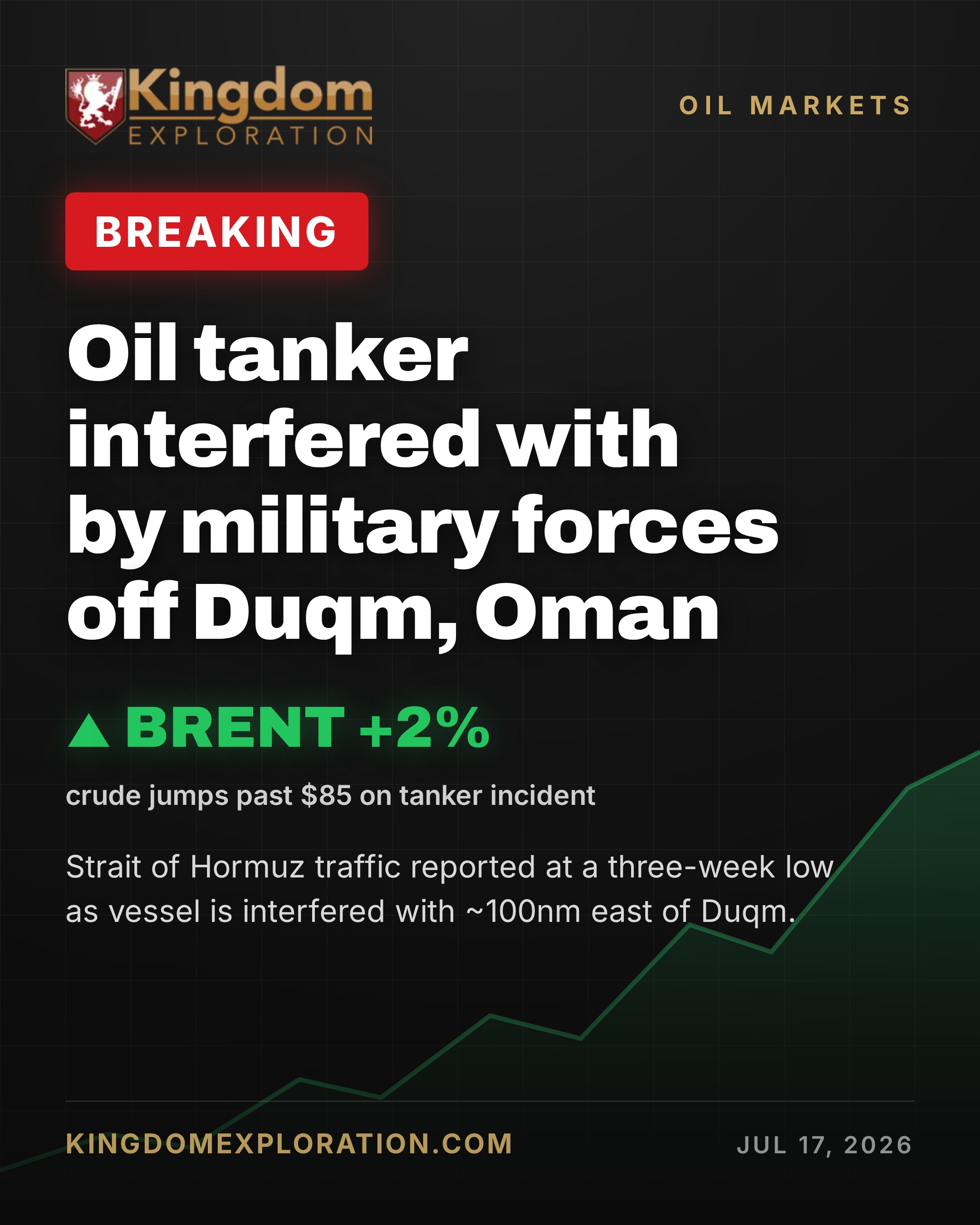
Brent crude jumped roughly 2% to trade past $85 a barrel after the UK Maritime Trade Operations (UKMTO) agency reported that an oil tanker was interfered with by military forces approximately 100 nautical miles east of Duqm, Oman, according to a post from @ME_Observer_ on X published within the last hour. The report also flagged that traffic through the nearby Strait of Hormuz has fallen to a three-week low.
What Just Happened
Per @ME_Observer_ relaying a UKMTO notice, an oil tanker was interfered with by military forces at a position roughly 100 nautical miles east of Duqm, on Oman's coastline facing the Arabian Sea. The incident sits just outside one of the world's most sensitive shipping corridors, and it landed alongside a report that vessel traffic through the Strait of Hormuz has thinned to its lowest level in three weeks.
The combination — a direct interference with a tanker and reduced flow through Hormuz — is the kind of pairing that focuses trader attention immediately, because it touches both an active security event and a measurable change in shipping behavior at the same chokepoint region.
The Numbers
- Brent crude: up about 2%, trading past $85 per barrel
- Location: approximately 100 nautical miles east of Duqm, Oman
- Strait of Hormuz traffic: reported at a three-week low
- Timing: UKMTO report relayed within the past hour
These are the only figures confirmed in the source. Further specifics — the vessel's flag, cargo, operator, or the identity of the military forces involved — were not detailed in the report.
Why Oil Prices Could Rise
The waters off Oman and the Strait of Hormuz form a critical artery for global crude. Any event suggesting that tanker movements can be disrupted introduces a risk premium into pricing, because buyers and shippers must weigh the possibility that supply could be delayed, rerouted, or curtailed.
Three mechanisms are in play here:
- Supply at risk: An interference incident near a major chokepoint raises the perceived probability that barrels may not move freely, tightening expectations even before any physical shortfall occurs.
- Risk premium: Traders price uncertainty. A 2% move past $85 reflects the market pricing in the chance of escalation rather than a confirmed loss of barrels.
- Traffic slowdown: Hormuz traffic at a three-week low signals that shippers may already be exercising caution, which can compound scheduling delays and firm up prices.
Kingdom Exploration's read: markets aren't waiting for confirmation of damage — the mere signal that a tanker can be interfered with near Hormuz is enough to build a risk premium into Brent. Watch whether Hormuz traffic recovers or keeps thinning in the next 24–48 hours.
What to Watch Next
- Official confirmation: Follow-up statements from UKMTO, regional navies, or the vessel's operator that clarify what happened and whether the tanker is safe.
- Hormuz flow: Whether transit traffic continues to decline or normalizes — a sustained drop would be more meaningful than a single-day dip.
- Further incidents: Any additional reports of interference or escalation in the same corridor.
- Price follow-through: Whether Brent holds above $85 or eases as details emerge and initial risk premium fades.
For now, the market reaction is clear: a 2% jump reflects heightened sensitivity to anything affecting tanker movement near the Gulf's approaches. The physical impact of this specific incident remains unconfirmed.
Reporting sourced from @ME_Observer_ on X, citing UKMTO. Developing story.
About Kingdom Exploration
Kingdom Exploration LLC is an Oklahoma-based oil and gas exploration company. Learn more at kingdomexploration.com.

