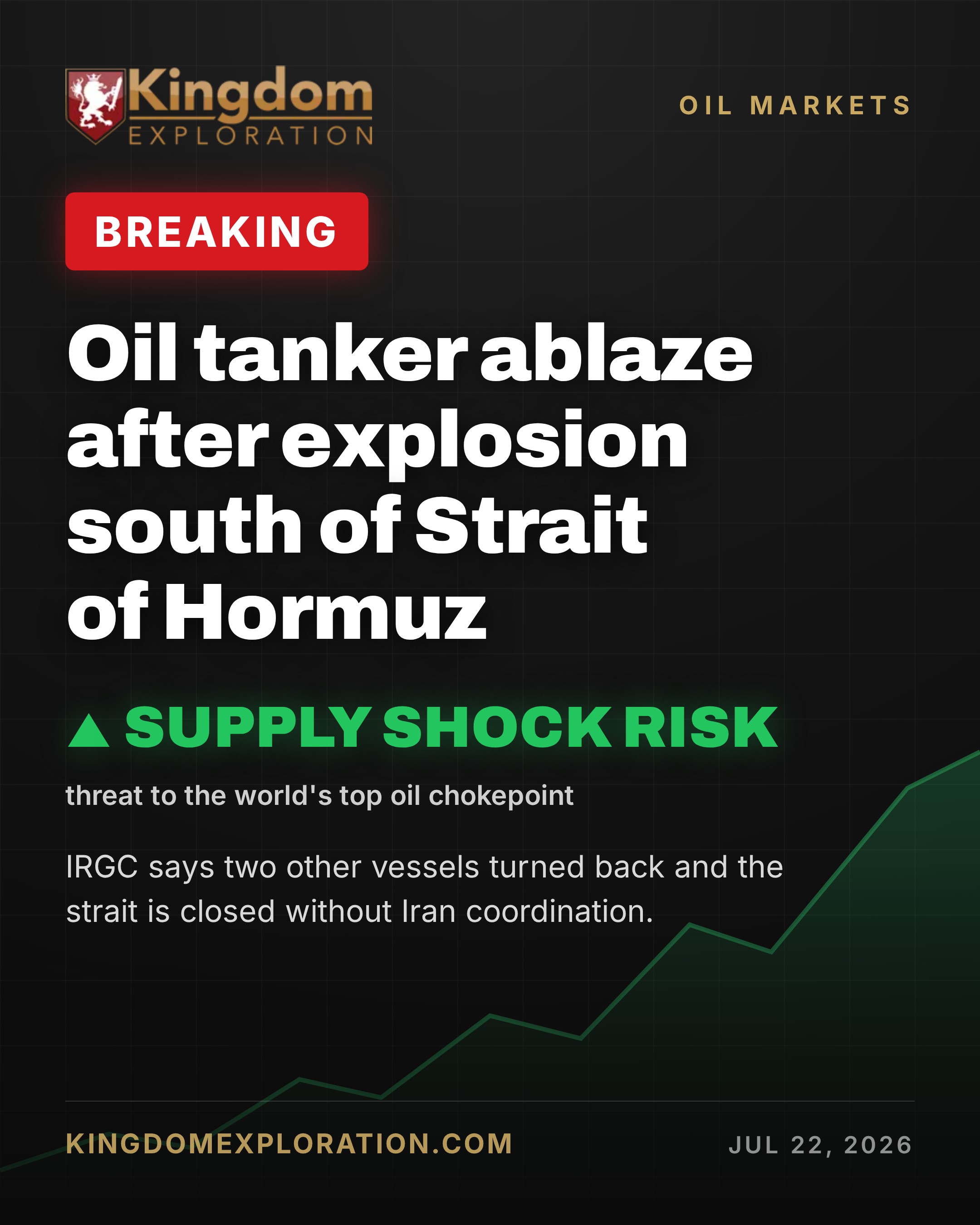
An oil tanker caught fire following an explosion south of the Strait of Hormuz, according to a statement attributed to Iran's Islamic Revolutionary Guard Corps (IRGC) circulated by @FirstSquawk. The report, published roughly nine minutes ago, adds that two other vessels turned back and that the strait is closed without Iranian coordination.
What Just Happened
Per @FirstSquawk, the IRGC says an oil tanker is ablaze after an explosion at a location south of the Strait of Hormuz. In the same statement, two additional vessels reportedly turned back from the area. The IRGC also asserted that the strait is closed without Iran's coordination.
The Strait of Hormuz is the single most important chokepoint in global energy trade, connecting the Persian Gulf to the Arabian Sea and the wider ocean. Any incident involving tankers or vessel movement in and around this passage draws immediate attention from oil markets because of the sheer volume of crude and refined products that transit it daily.
The Numbers
The available report does not provide specific figures for barrels affected, casualties, price moves, or vessel identities. What the source states plainly:
- One oil tanker on fire after an explosion south of the Strait of Hormuz.
- Two other vessels reportedly turned back.
- The strait described as closed without Iran coordination, per the IRGC statement.
Kingdom Exploration will update this story with concrete figures as verified reporting emerges. At this stage, no confirmed volume-at-risk or price data is available from the source.
Why Oil Prices Could Rise
Incidents in and around the Strait of Hormuz strike directly at the flow of crude that markets depend on. When a tanker is damaged and other vessels reverse course, traders price in the possibility that transit could slow, insurance and freight costs could climb, and physical barrels could be delayed or rerouted.
The mechanism is straightforward: crude markets attach a risk premium to supply that could be interrupted, even before any actual barrels are lost. A reported explosion, a vessel on fire, and language about the strait being closed all feed uncertainty about whether the world's most critical oil passage remains fully open. Uncertainty of this kind tends to lift prices as buyers seek to secure supply and hedge against disruption.
Kingdom Exploration's read: the market reaction here will hinge less on this single tanker and more on whether the incident signals a broader, sustained threat to Hormuz transit. A one-off fire is a headline; a contested chokepoint is a price story.
What to Watch Next
- Confirmation: Independent verification from maritime authorities, shipping trackers, and major outlets of the explosion, the fire, and the status of the strait.
- Transit status: Whether tanker traffic through Hormuz continues normally or shows signs of slowing, rerouting, or delay.
- Official response: Statements from regional governments, naval forces, and shipping operators on vessel safety and passage.
- Insurance and freight: Any moves in war-risk insurance premiums or tanker rates, which often react fast to chokepoint threats.
- Volume at risk: Concrete figures on barrels per day potentially affected, once reliable data is published.
This is a fast-moving situation built on an early social-media report attributed to the IRGC. Details, and the market's interpretation of them, may change quickly.
Reporting sourced from X @FirstSquawk. Developing story.
About Kingdom Exploration
Kingdom Exploration LLC is an Oklahoma-based oil and gas exploration company. Learn more at kingdomexploration.com.

