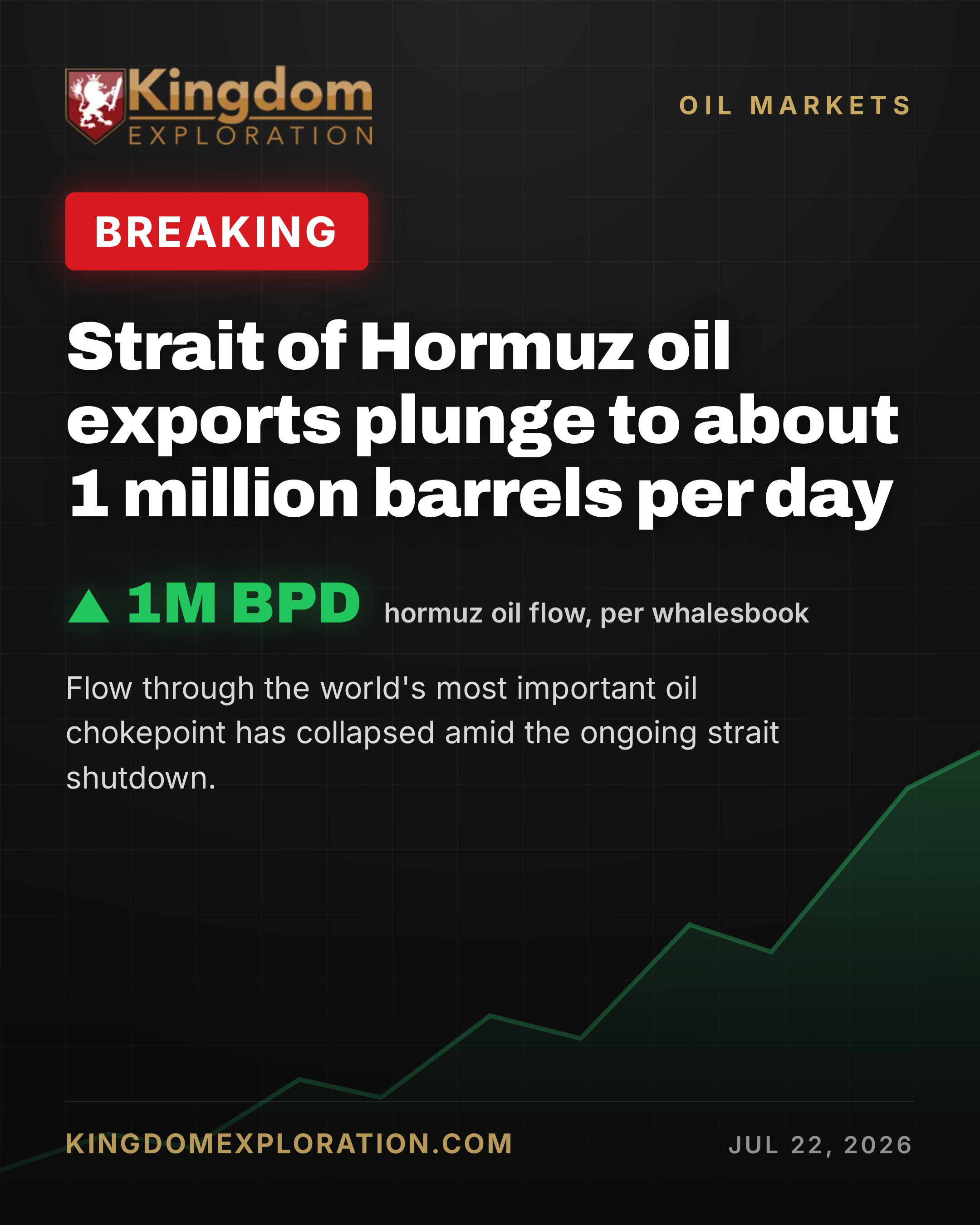
Oil exports through the Strait of Hormuz have collapsed to roughly 1 million barrels per day, according to a breaking report from Whalesbook published minutes ago. The plunge marks a sharp escalation in the disruption at the world's single most important oil chokepoint, following reports that Iran had moved to shut the waterway amid tensions with the United States.
Related coverage: Iran Shuts Down Strait of Hormuz Amid US Tensions
What Just Happened
Per Whalesbook, throughput of crude and refined products moving out through the Strait of Hormuz has fallen to approximately 1 million barrels per day. Under normal conditions the strait carries the lion's share of Gulf seaborne oil exports, so a drop to seven-figure daily volumes represents a dramatic reduction in flows reaching global markets.
The development builds on our earlier reporting that Iran had moved to shut the strait amid rising friction with Washington. The new data point — the collapse to around 1 million bpd — quantifies just how severely traffic through the chokepoint has been constrained.
The Numbers
- ~1 million bpd: current oil export flow through the Strait of Hormuz, per Whalesbook.
- ~11 minutes: how recently the report was published as of writing.
The single figure that matters here is the flow itself. A waterway that ordinarily handles a very large share of Gulf oil exports moving at roughly 1 million bpd points to a substantial volume of barrels being held back from world markets.
Why Oil Prices Could Rise
The Strait of Hormuz is the primary maritime route for crude produced by several of the world's largest exporters. When flows through it are curtailed, the mechanics that pressure prices higher are straightforward:
- Physical supply at risk: barrels that cannot transit the strait cannot reach refiners, tightening available crude in the near term.
- Risk premium: traders price in the possibility of a longer or wider disruption, adding a geopolitical premium to every barrel regardless of whether volumes recover quickly.
- Limited alternatives: pipeline capacity that bypasses the strait is finite, so a large share of stranded barrels has no easy alternate path to market.
- Spare capacity questions: the more that flows through a single chokepoint are cut, the harder it is for other producers to fully offset the shortfall, even where spare capacity exists.
Kingdom Exploration's read: a collapse to around 1 million bpd is the kind of headline number that keeps a persistent bid under crude until traffic through the strait is demonstrably restored. The market tends to price the worst credible outcome first and unwind the premium only once flows normalize.
What to Watch Next
- Confirmation and updated flow data: whether other trackers corroborate the roughly 1 million bpd figure from Whalesbook and how the number trends over the coming days.
- Duration: any signals on how long the disruption may last — a brief interruption and a sustained closure carry very different price implications.
- Rerouting: whether exporters can shift volumes to pipeline routes that avoid the strait.
- Official statements: comments from Gulf producers, Iran, the United States and shipping authorities that clarify the status of the waterway.
Reporting sourced from Whalesbook. Developing story.
About Kingdom Exploration
Kingdom Exploration LLC is an Oklahoma-based oil and gas exploration company. Learn more at kingdomexploration.com.

