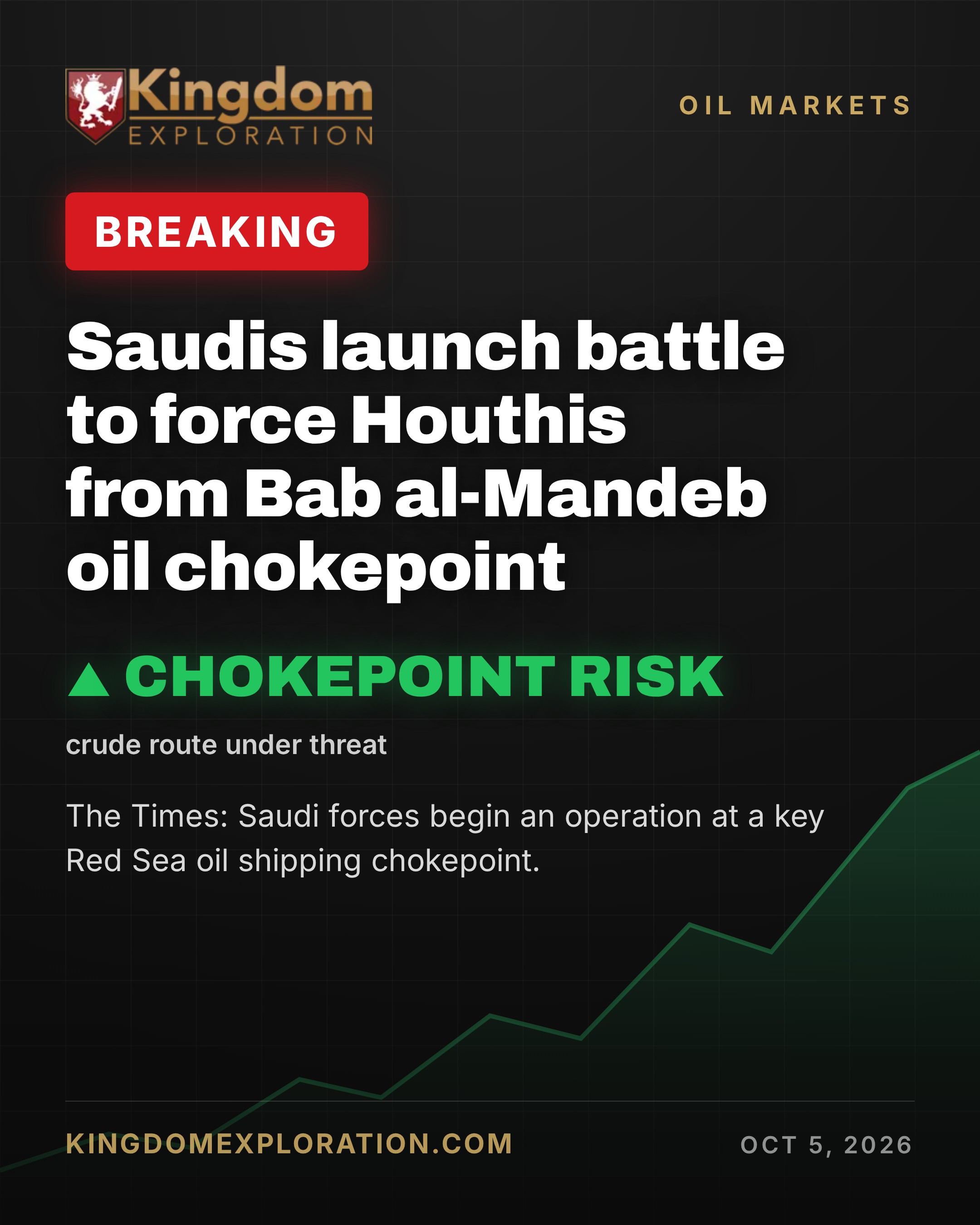
Saudi forces have begun a military operation aimed at forcing Houthi fighters out of the Bab al-Mandeb Strait, one of the world's most strategic maritime chokepoints for oil and commodity shipping, The Times reported. The development, published within the hour, raises fresh questions about the security of crude flows through a narrow waterway that connects the Red Sea to the Gulf of Aden.
What Just Happened
According to The Times, Saudi Arabia has launched a battle to push Houthi forces away from the Bab al-Mandeb Strait. The strait sits between the Arabian Peninsula and the Horn of Africa and serves as a primary transit route linking the Indian Ocean to the Mediterranean via the Red Sea and the Suez Canal.
Any active military engagement around this corridor immediately draws the attention of energy markets, because a significant share of seaborne crude and refined products passes through the passage on the way to Europe, Asia and beyond. Full details of the operation's scope and timeline were still emerging at the time of reporting.
The Numbers
The Times report focused on the launch of the operation rather than casualty figures or barrels-per-day disruption, and no specific volumes or price moves were provided in the initial account. What markets will watch closely is how much tanker traffic reroutes or pauses as the situation develops.
Historically, the Bab al-Mandeb is counted among a handful of global oil chokepoints alongside the Strait of Hormuz and the Suez Canal. Disruptions at any of these points tend to lengthen voyage times, raise shipping and insurance costs, and tighten the physical supply of crude reaching refiners.
Why Oil Prices Could Rise
The mechanism is straightforward. When a key chokepoint becomes a conflict zone, shipowners face a choice: accept elevated risk sailing through the contested waters, or divert vessels on longer, costlier routes. Either path adds friction to the supply chain.
- Supply at risk: A contested Bab al-Mandeb threatens the smooth passage of crude and products that would otherwise reach market on schedule.
- Risk premium: Active fighting near a chokepoint typically injects a geopolitical premium into crude benchmarks as traders price in the probability of disruption.
- Rerouting costs: Vessels diverting around the Cape of Good Hope face far longer transit times, tying up tonnage and tightening available supply.
None of these pressures guarantee a price move, but each is a channel through which escalation around the strait can feed into crude markets.
Kingdom Exploration's read: markets don't need a single barrel to actually stop flowing for prices to react - the mere threat to a chokepoint like Bab al-Mandeb is often enough to put a risk premium back into crude.
What to Watch Next
- Whether tanker operators pause, reroute, or continue transits through the strait.
- Shipping insurance rates for Red Sea voyages, an early signal of perceived risk.
- Any confirmed disruption to crude or product volumes moving through the corridor.
- The duration and intensity of the Saudi operation and any Houthi response.
For energy watchers, the core question is simple: how long does the fighting last, and does it meaningfully interrupt the flow of oil through one of the planet's busiest sea lanes?
Reporting sourced from The Times. Developing story.
About Kingdom Exploration
Kingdom Exploration LLC is an Oklahoma-based oil and gas exploration company. Learn more at kingdomexploration.com.