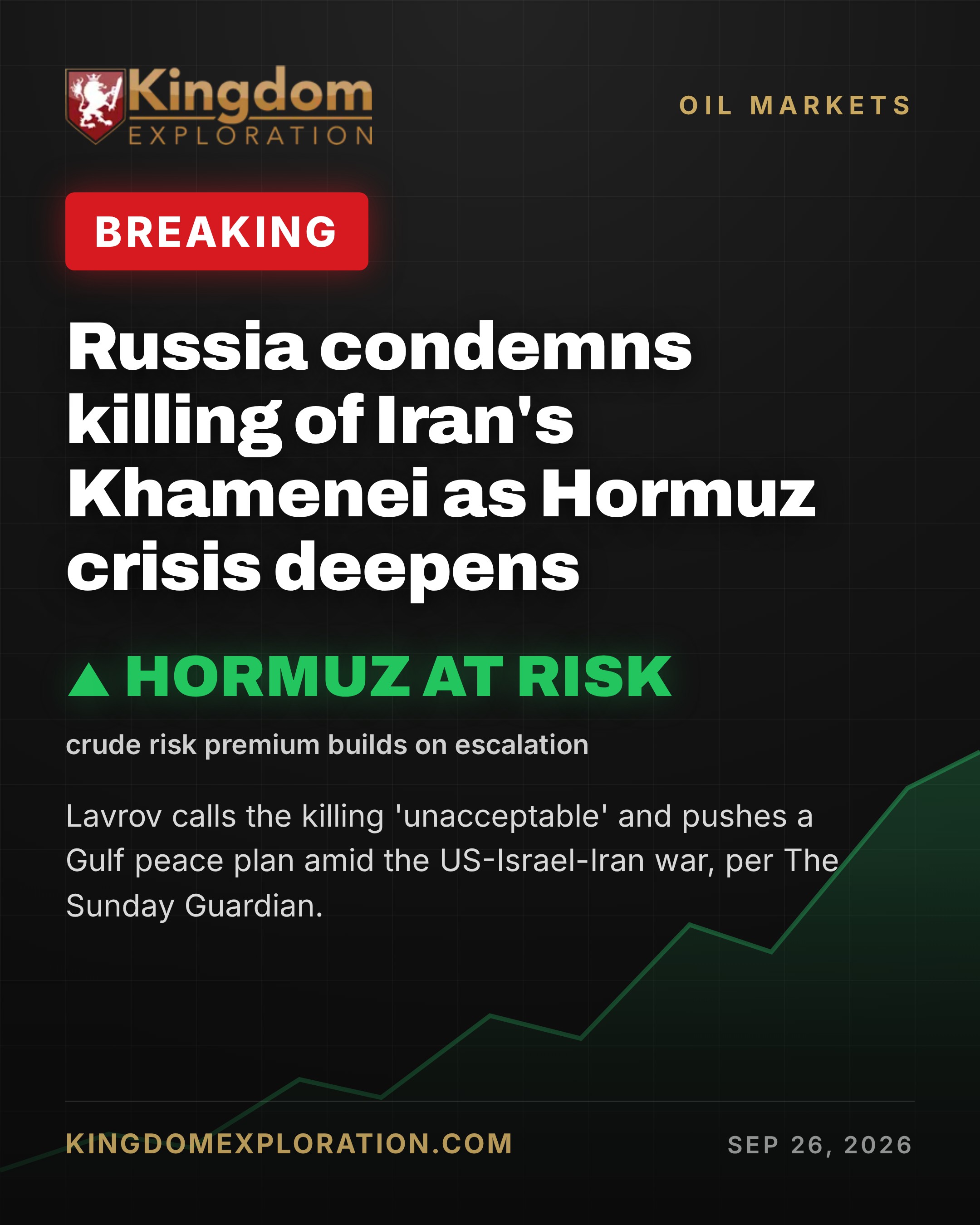
Russian Foreign Minister Sergey Lavrov has condemned the killing of Iran's Supreme Leader Ali Khamenei and members of his family as "unacceptable," while pressing Moscow's proposed Gulf peace initiative to defuse a spiraling crisis around the Strait of Hormuz, The Sunday Guardian reported in a live update published roughly an hour ago.
The intervention lands amid an active US-Israel-Iran conflict that has put the world's most sensitive oil chokepoint directly in the crosshairs. For crude markets, any confrontation touching Hormuz carries outsized weight.
What Just Happened
According to The Sunday Guardian's live coverage, Lavrov characterized the killing of Khamenei and family members as "unacceptable" and used the moment to advance Russia's Gulf peace initiative aimed at cooling what the outlet described as the "Hormuz crisis."
The framing is significant: Russia positioning itself as a would-be mediator signals that major powers view the escalation as serious enough to threaten regional stability — and, by extension, the flow of oil through the Persian Gulf.
The Numbers
The Sunday Guardian's update did not attach specific figures — no barrel-per-day disruption totals, no price moves, and no confirmed casualty counts beyond the reference to Khamenei and family members. What the report establishes is the fact set that matters to energy markets: a leadership decapitation event inside Iran, an ongoing multi-party war, and a named crisis over the Strait of Hormuz.
Kingdom Exploration will update this story with hard figures as verified numbers become available.
Why Oil Prices Could Rise
The Strait of Hormuz is the single most important artery in the global oil trade, the narrow passage through which a large share of seaborne crude and condensate transits from Gulf producers to world markets. When conflict threatens that corridor, traders price in a risk premium — the extra cost baked into crude to account for the possibility that barrels simply stop moving.
- Supply at risk: A crisis centered on Hormuz threatens tanker traffic that cannot be easily rerouted. There is no equivalent alternative for much of the region's exports.
- Escalation risk premium: The killing of a head of state raises the odds of retaliation, drawing more actors into the conflict and widening the zone of danger for shipping and infrastructure.
- Spare capacity strain: If Gulf barrels are interrupted, the cushion of unused production elsewhere is finite — and markets tend to move first and confirm later.
Kingdom Exploration's read: markets don't wait for tankers to actually stop; the mere credible threat to Hormuz, combined with a leadership killing that invites retaliation, is the kind of setup that pulls a risk premium into crude fast.
What to Watch Next
Key signals from here: whether Iran confirms and responds to the reported killing, whether shipping and insurance costs through Hormuz spike, whether Russia's proposed peace initiative gains any traction among the warring parties, and whether any physical disruption to Gulf oil flows materializes. Each of those would sharpen — or ease — the supply picture for crude.
Reporting sourced from The Sunday Guardian. Developing story.
About Kingdom Exploration
Kingdom Exploration LLC is an Oklahoma-based oil and gas exploration company. Learn more at kingdomexploration.com.