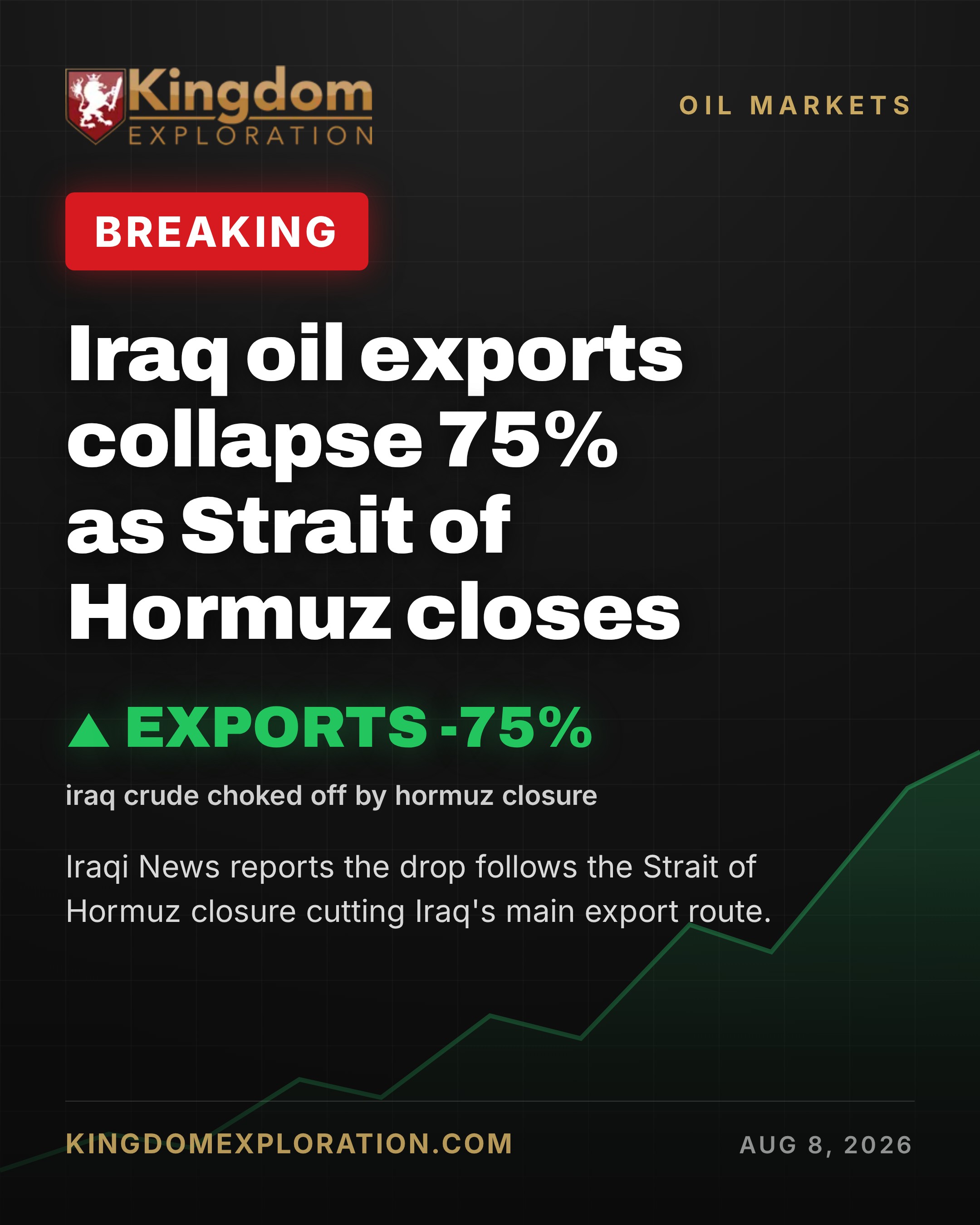
Iraq's crude oil exports have plunged by 75% as the closure of the Strait of Hormuz chokes off the country's primary export route, according to a report published by Iraqi News. The development marks a sharp escalation in a supply crisis that has been building around the world's most critical oil chokepoint.
Related coverage: Iraq Oil Exports HIT by Hormuz Closure and Kurdistan Outages · Iraq Declares Force Majeure on Foreign-Run Oilfields Over Hormuz
What Just Happened
Iraqi News reports that Iraq's oil exports have fallen 75% in connection with the closure of the Strait of Hormuz. Iraq ships the overwhelming majority of its crude from southern terminals in the Persian Gulf, and virtually all of that volume must transit Hormuz to reach global buyers. With the strait closed, the outlet reports the country's export flow has been slashed to a fraction of its normal level.
The 75% collapse follows earlier disruptions we have tracked, including the initial hit to Iraqi exports from the Hormuz closure and Kurdistan outages, and Baghdad's declaration of force majeure on foreign-run oilfields. This latest figure signals the situation is deepening rather than stabilizing.
The Numbers
- 75% — the reported drop in Iraq's oil exports amid the Hormuz closure, per Iraqi News.
Iraqi News did not provide additional figures in the summary available at the time of this report. Iraq is one of OPEC's largest producers, so a decline of this magnitude removes a substantial volume of barrels from the seaborne market.
Why Oil Prices Could Rise
The mechanism here is straightforward and severe. The Strait of Hormuz is the single most important maritime chokepoint for global crude, and Iraq's southern exports depend on it entirely. When a producer of Iraq's scale sees three-quarters of its export volume disappear, the barrels lost cannot be quickly replaced through alternate routes.
That kind of physical shortfall does two things to price. First, it tightens actual supply — buyers competing for fewer cargoes bid prices up. Second, it inflates the risk premium, because a Hormuz closure threatens not just Iraqi flows but the exports of every Gulf producer that shares the strait. Traders price in the possibility of further, broader disruption, and that fear alone can lift crude before a single additional barrel is lost.
Spare capacity matters here too. The world's ability to cushion a shock depends on producers who can bring extra barrels online quickly — but much of that spare capacity sits inside the very Gulf region affected by a Hormuz closure, which limits its usefulness in this scenario.
Kingdom Exploration's Read
A 75% cut to Iraqi exports is not a routine outage — it is a structural break in one of OPEC's core supply lines. Kingdom Exploration's read: the market's focus will shift fast from whether Hormuz reopens to how long the closure lasts and whether other Gulf exporters get pulled in. The longer the strait stays shut, the harder it becomes to argue the lost barrels are temporary.
What to Watch Next
- Duration of the closure — any official timeline or reopening signal for the Strait of Hormuz.
- Contagion to other Gulf exporters — Saudi, UAE, Kuwait and Qatari flows all transit or border the same waters.
- Confirmed export volumes — updated bpd figures from Iraq's oil ministry or SOMO to quantify the shortfall.
- OPEC and IEA response — any move to release reserves or adjust output policy.
- Insurance and shipping rates — rising war-risk premiums often precede and amplify price moves.
Reporting sourced from Iraqi News. Developing story.
About Kingdom Exploration
Kingdom Exploration LLC is an Oklahoma-based oil and gas exploration company. Learn more at kingdomexploration.com.