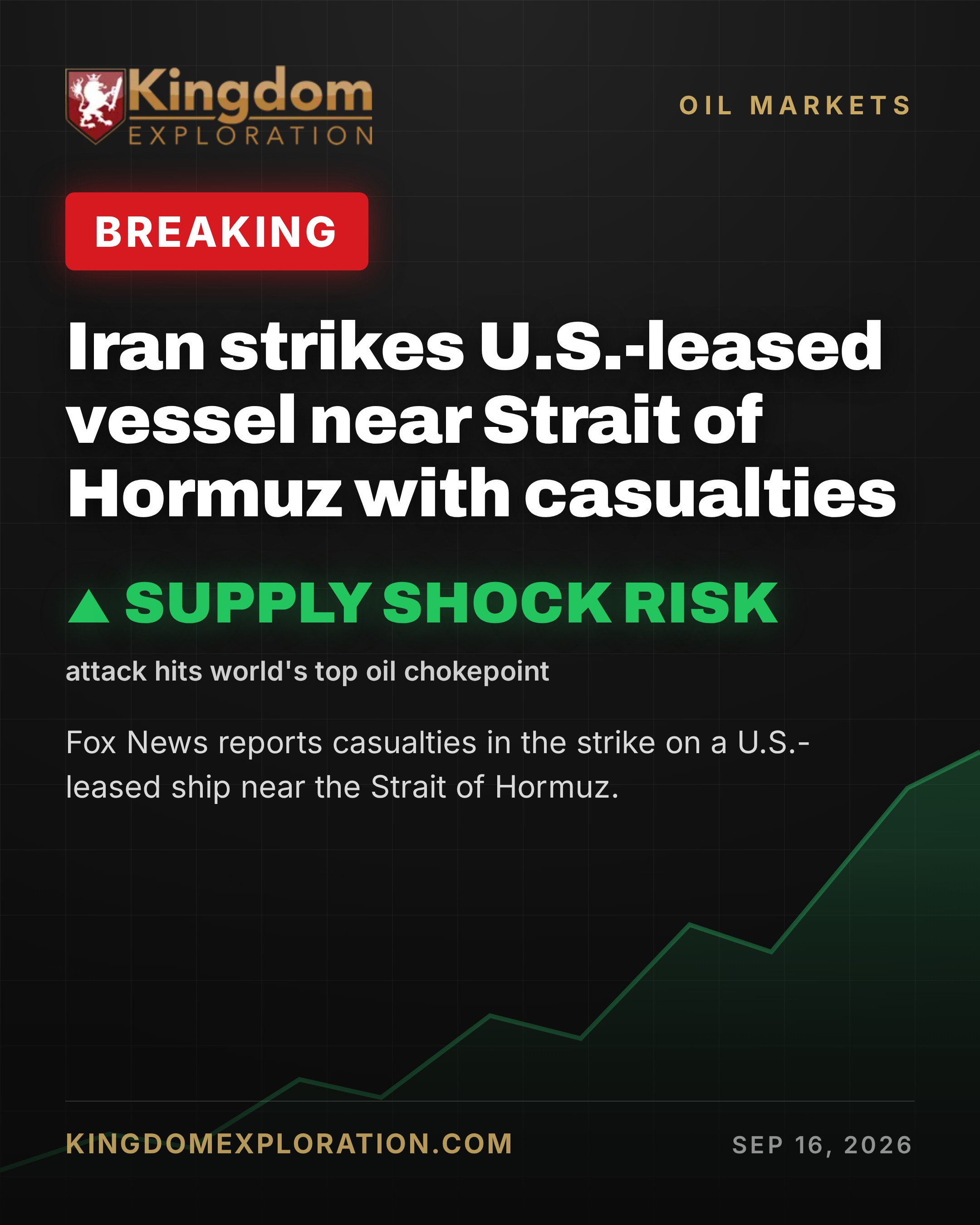
Iran attacked a U.S.-leased vessel near the Strait of Hormuz, with casualties reported, according to Fox News as relayed by Ukrainian outlet UNN. The incident, reported within the past hour, strikes at one of the most sensitive chokepoints in the global oil trade and immediately raises the specter of a fresh geopolitical risk premium on crude.
What Just Happened
Per Fox News, Iran carried out an attack on a vessel leased by the United States operating near the Strait of Hormuz. Casualties have been reported. Precise details on the ship, the nature of the weapon used, and the scale of the losses were not immediately available in the initial reporting.
Any hostile action against commercial or leased shipping in or around the Strait of Hormuz carries outsized significance for energy markets. The waterway is the single most important transit point for seaborne crude and refined products, and an attack on a U.S.-linked vessel there marks a clear escalation in maritime risk.
The Numbers
The initial reporting from Fox News, via UNN, confirms an attack and casualties but does not provide specific figures on the number of people affected, the tonnage of the vessel, or any cargo involved. No verified price move had been attached to the incident at the time of this report. As the story develops, watch for concrete data on the vessel, casualties, and any tanker traffic disruption.
Why Oil Prices Could Rise
The mechanism is straightforward. The Strait of Hormuz is a narrow chokepoint through which a large share of the world's seaborne oil must pass. When a vessel is attacked there \u2014 particularly one tied to the United States \u2014 traders immediately price in the possibility of:
- Disrupted transit: Shippers may reroute, slow, or pause voyages through the strait, tightening near-term supply availability.
- Higher insurance and freight costs: War-risk premiums on tankers transiting the region can spike, feeding into delivered crude costs.
- Escalation risk: An attack on a U.S.-leased ship with casualties raises the odds of a military response, and markets tend to bid up a risk premium when the path to further conflict widens.
None of these outcomes require an actual barrel to be lost to move price \u2014 the market prices the threat to supply. With spare capacity concentrated in the Gulf region, any perceived threat to Hormuz transit magnifies the sensitivity of crude to headlines like this one.
Kingdom Exploration's read: chokepoint attacks tend to put a floor under crude quickly, because the market cannot easily discount the tail risk of a wider closure. The key question is whether this remains an isolated incident or the opening move in a broader confrontation.
What to Watch Next
- Official confirmation and details from U.S. authorities and the vessel's operator.
- Any statement from Iran claiming or denying responsibility.
- Tanker tracking data showing whether ships slow or divert around Hormuz.
- War-risk insurance rates for Gulf transits.
- Whether Washington signals a military or diplomatic response.
This is a fast-moving situation and figures may change as more is confirmed. Investors and energy watchers should treat early casualty and damage reports as preliminary.
Reporting sourced from \u0423\u043a\u0440\u0430\u0457\u043d\u0441\u044c\u043a\u0456 \u041d\u0430\u0446\u0456\u043e\u043d\u0430\u043b\u044c\u043d\u0456 \u041d\u043e\u0432\u0438\u043d\u0438 (\u0423\u041d\u041d), citing Fox News. Developing story.
About Kingdom Exploration
Kingdom Exploration LLC is an Oklahoma-based oil and gas exploration company. Learn more at kingdomexploration.com.