Live Updates
UPDATE — Jul 28, 1:32 PM CT: Iran says Strait of Hormuz stays closed unless Oman accepts its proposal
Iran has hardened its stance on the Strait of Hormuz, declaring it does not recognize the strait's southern shipping route and warning that the passage will "remain closed" unless Oman accepts an Iranian proposal, per MTV Lebanon. The statement, reported roughly half an hour ago, links the fate of the world's most critical oil chokepoint directly to a bilateral demand on Muscat.
Kingdom Exploration's read: tying Hormuz access to a specific condition Oman may not meet sharpens the supply risk. Roughly a fifth of global oil flows transit the strait, and any sustained closure or contested transit rules would pressure crude and freight markets. This follows Iran's rejection of a US ceasefire proposal and earlier warnings to ships over Hormuz transit.
UPDATE — Jul 28, 10:42 AM CT: Iran rejects Trump frozen-funds offer, warns ships of Hormuz transit ban
Iran has rejected a proposal from US President Donald Trump tied to frozen funds and has warned ships of a possible transit ban through the Strait of Hormuz, per Al Jazeera. The report marks a sharper turn from Tehran's earlier ceasefire rejection, moving from diplomatic refusal toward a direct threat against shipping.
Details of the frozen-funds plan and the scope of any ban were not specified in the report. But the Strait of Hormuz is the world's most critical oil chokepoint, carrying roughly a fifth of global crude and condensate flows.
Kingdom Exploration's read: an explicit warning to ships is a meaningful escalation beyond words. Any real disruption to Hormuz traffic would tighten seaborne supply fast and put upward pressure on crude prices and freight and insurance costs.
UPDATE — Jul 27, 6:11 AM CT: Iran's Foreign Ministry says it is bound to no ceasefire, formal or informal
Iran's Foreign Ministry has issued a categorical denial of any diplomatic track with Washington, per Telegram channel @Middle_East_Spectator. The statement reads: 'We currently have no negotiations with the United States, no type of silent understanding, and are not bound to any ceasefire, formal or informal.'
The declaration hardens Tehran's earlier rejection of the US ceasefire proposal delivered via the Iraqi prime minister, removing any suggestion of a quiet back-channel arrangement.
Kingdom Exploration's read: an explicit disavowal of even informal understandings keeps the risk premium on crude elevated, as markets weigh continued escalation and the recurring threat to shipping through the Strait of Hormuz.
UPDATE — Jul 24, 12:32 PM CT: Araghchi ties ceasefire rejection to Hormuz demands
Iran has rejected any temporary ceasefire unless its demands over the Strait of Hormuz are addressed, Foreign Minister Abbas Araghchi said, according to The Siasat Daily. The comments sharpen Tehran's stance after it turned down the US ceasefire proposal delivered via the Iraqi prime minister.
By explicitly linking a truce to conditions involving Hormuz, Araghchi has put the world's most critical oil chokepoint at the center of the diplomatic standoff. Roughly a fifth of global oil flows transit the strait.
Kingdom Exploration's read: framing Hormuz as a bargaining chip raises the perceived supply risk premium, and traders will watch closely for any signal that tanker traffic could be disrupted.
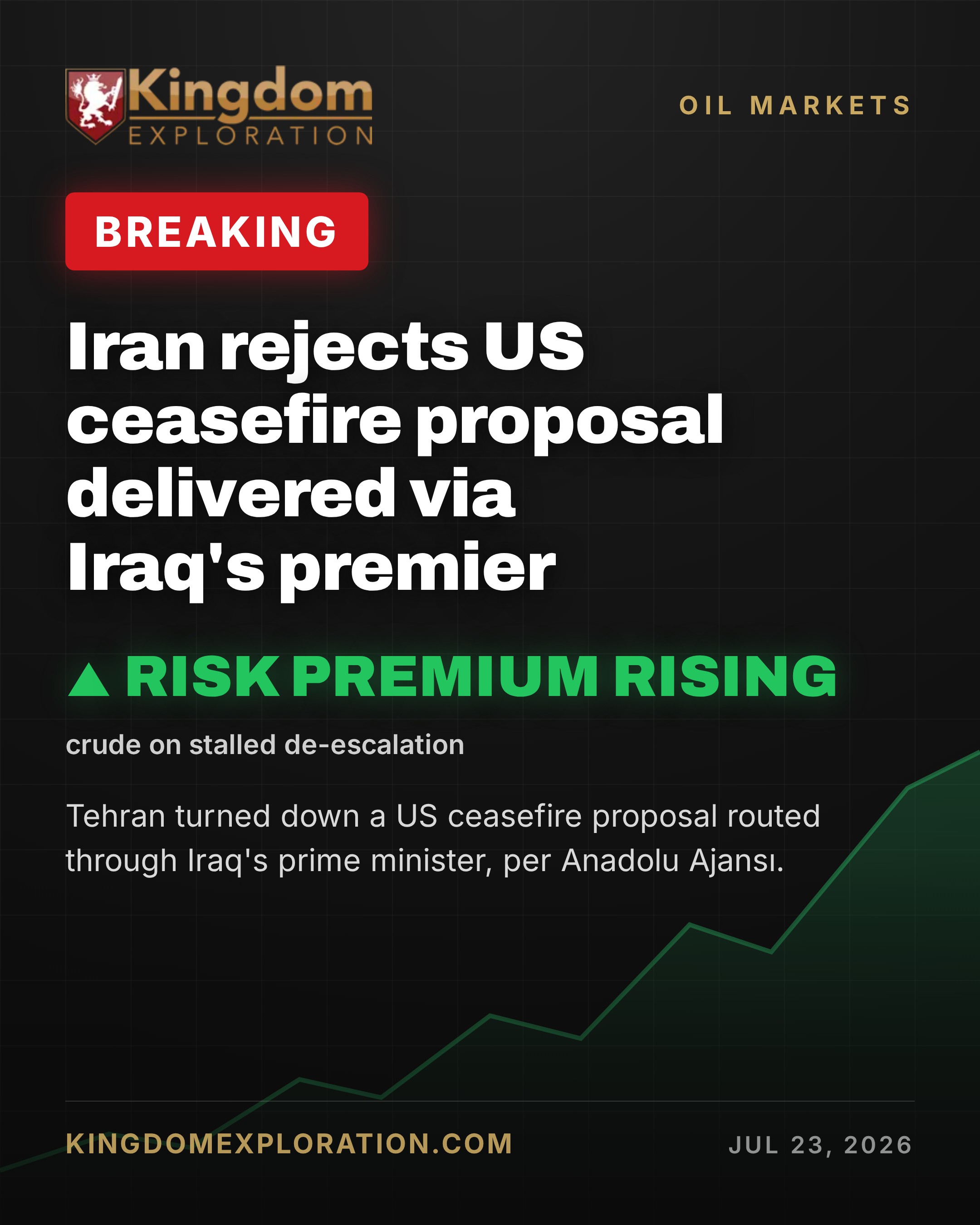
Iran has turned down a US ceasefire proposal that was delivered through Iraq's prime minister, according to a report published by Anadolu Ajansı. The development, reported within the past hour, signals that diplomatic efforts to de-escalate regional tensions have hit a fresh obstacle — a dynamic energy markets tend to watch closely given the Middle East's central role in global crude supply.
What Just Happened
Per Anadolu Ajansı, Iran rejected a ceasefire proposal that Washington had routed through the Iraqi premier, who was acting as an intermediary. The report frames the rejection as a setback for efforts to broker a pause in hostilities. Beyond the fact of the rejection itself, additional details on the proposal's specific terms were not provided in the available reporting.
Iraq has frequently served as a diplomatic channel between the United States and Iran given its ties to both, so its involvement underscores the seriousness of the outreach — and the significance of Tehran declining it.
The Numbers
The available report does not include specific figures on production volumes, price moves, or barrels at risk. What matters for the market at this stage is the qualitative signal: a diplomatic off-ramp has been rejected, leaving the door open to continued or escalating tension in a region that supplies a large share of the world's oil.
- Ceasefire proposal: rejected by Iran, per Anadolu Ajansı
- Channel: delivered via Iraq's prime minister
- Reported: within the past hour
Why Oil Prices Could Rise
Geopolitical risk in the Middle East is a core driver of the crude oil risk premium. When diplomacy advances, traders tend to price out the probability of supply disruptions; when a ceasefire is rejected, that same probability moves the other way.
The mechanism is straightforward. The region hosts major producers and critical transit chokepoints through which a substantial volume of seaborne crude flows daily. Any perceived rise in the odds of conflict — or the continuation of one — raises the chance that production, export terminals, or shipping lanes could be affected. Markets respond by building in a premium to compensate for that risk, even before any barrel is physically lost.
Kingdom Exploration's read: A rejected ceasefire keeps the geopolitical risk premium alive. For oil, the market often reacts to the direction of diplomacy as much as to events on the ground — and this is a step away from de-escalation.
What to Watch Next
Traders and energy watchers will be looking for several follow-on signals in the hours and days ahead:
- Official confirmation and any statements from Washington, Tehran, or Baghdad clarifying the proposal and the rejection.
- Whether further mediation attempts follow, or whether both sides harden their positions.
- Any reports of activity affecting production facilities, export infrastructure, or key shipping routes.
- Crude benchmark reaction — Brent and WTI — as the market digests the diplomatic setback.
As with any developing geopolitical story, initial reports can evolve quickly. The signal to monitor is whether this rejection remains an isolated diplomatic stumble or becomes the start of renewed escalation.
Reporting sourced from Anadolu Ajansı. Developing story.
About Kingdom Exploration
Kingdom Exploration LLC is an Oklahoma-based oil and gas exploration company. Learn more at kingdomexploration.com.

