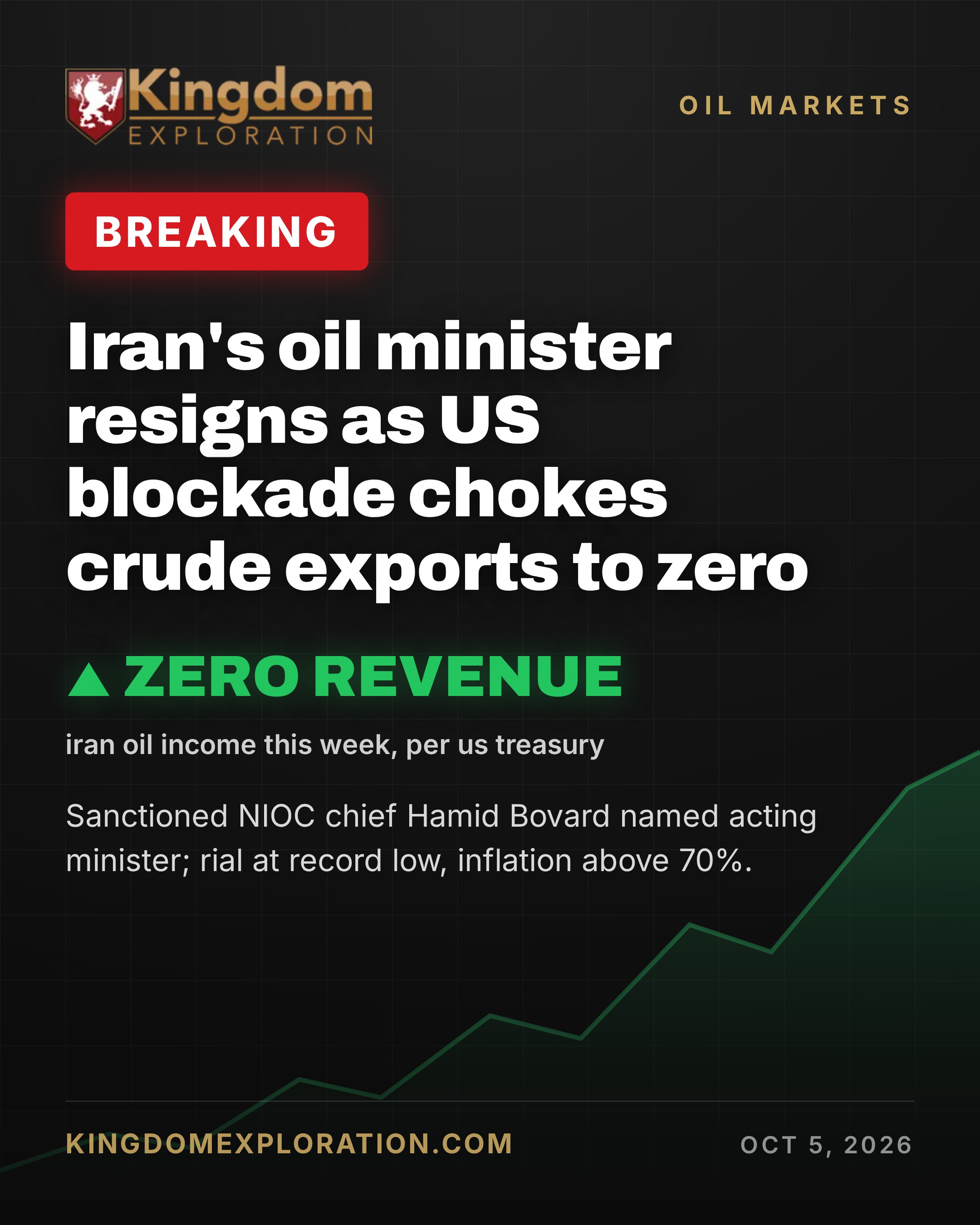
Iran's oil minister has resigned as a U.S. blockade pushes the country's crude exports and oil revenues toward zero, per Reuters. President Masoud Pezeshkian accepted Mohsen Paknejad's resignation on Sunday and appointed National Iranian Oil Company chief Hamid Bovard as acting oil minister, handing control of Iran's most important industry to a man already under U.S. sanctions.
Related coverage: US MOVES to Kill License Behind Iranian Oil Sales
What Just Happened
Pezeshkian's office said Paknejad had asked to resign for personal reasons "a long time ago" and that the president had previously rejected the request, according to Reuters. Just hours before the resignation was announced, Paknejad was quoted as saying revenues from oil already sold were still reaching Iran and would continue.
His successor, Hamid Bovard, 62, has led NIOC since 2024 and previously ran the National Iranian South Oil Company and the Iranian Offshore Oil Company. He takes the post with Washington trying to shut off Iran's remaining oil exports entirely. Bovard himself is already a U.S. sanctions target: the Treasury designated him in February 2025 for operating in Iran's petroleum sector as part of measures aimed at Iran's oil industry and its so-called shadow fleet.
The Numbers
The figures describe an industry under extreme strain:
- U.S. Treasury Secretary Scott Bessent said Saturday that Iran had no oil shipments remaining at sea and would generate zero oil revenue this week, according to Anadolu.
- Iran's central bank governor said in August that the country's oil exports had effectively fallen to zero.
- Iran faces a domestic gasoline deficit of roughly 10 million liters per day, The National reports.
- The rial fell to a record low of about 2.688 million to the dollar last week, with inflation climbing above 70%, per Reuters.
Paknejad had run the Oil Ministry since August 2024. His departure leaves Bovard responsible for maintaining production and finding a route to market for Iranian crude while Washington works to keep those barrels from leaving the country.
Why Oil Prices Could Rise
Iran is a significant OPEC producer, and a full collapse of its exports removes real barrels from global supply. When a source of crude is squeezed off the market, the remaining spare capacity cushion thins, and traders tend to price in a higher risk premium.
The leadership shake-up compounds that uncertainty. Installing a sanctioned official as acting minister signals Tehran is digging in rather than seeking relief, raising the odds of a prolonged standoff. Domestic distress — a record-low currency, 70%-plus inflation, and fuel shortages at home — adds to the risk that Iran could act unpredictably to defend its interests, a factor energy markets watch closely given the volume of crude that transits the region.
Kingdom Exploration's read: when a major producer's exports go to zero and its oil ministry changes hands under pressure, the market loses both barrels and predictability. Both tend to push crude risk premiums higher.
What to Watch Next
- Whether Iranian exports stay at zero or Tehran finds new routes to market through its shadow fleet under Bovard.
- Any U.S. follow-up enforcement action tightening the blockade further.
- Iran's domestic fuel crisis and whether shortages spark wider instability.
- Signs of a regional response as Tehran's revenue and currency crisis deepens.
Reporting sourced from Oilprice. Developing story.
About Kingdom Exploration
Kingdom Exploration LLC is an Oklahoma-based oil and gas exploration company. Learn more at kingdomexploration.com.