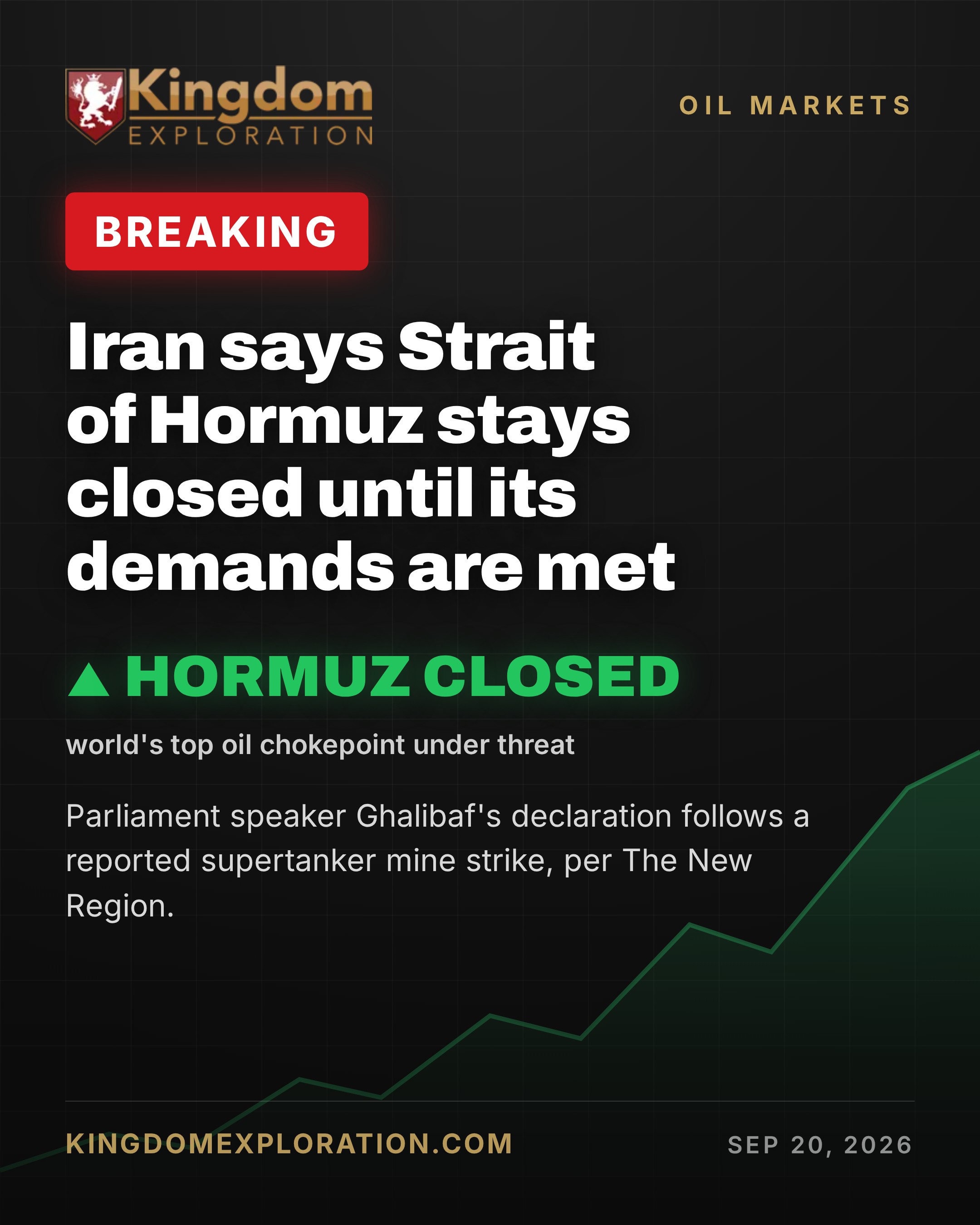
Iran's parliament speaker Mohammad Baqer Ghalibaf declared that the Strait of Hormuz will remain closed until Tehran's demands are met, The New Region reported. The statement raises the stakes over the world's single most important oil transit chokepoint and follows earlier reports of a supertanker striking mines in the same waterway.
Related coverage: Supertanker STRIKES 2 Mines in Strait of Hormuz
What Just Happened
According to The New Region, Ghalibaf stated that the Strait of Hormuz stays closed until Iran's demands are met. The remark hardens Tehran's posture around a narrow waterway that separates the Persian Gulf from the Gulf of Oman and serves as the exit route for a large share of the world's seaborne crude and liquefied natural gas.
The comment comes on the heels of prior reporting that a supertanker struck mines in the strait, an incident that had already put shippers, insurers and oil traders on alert. A political declaration that the passage remains shut escalates a physical-security scare into an open standoff over access to the chokepoint.
The Numbers
The New Region's report centers on the political statement itself and does not attach specific figures such as barrels-per-day affected, tanker counts or price moves. Kingdom Exploration is not assigning numbers the source did not provide. What matters is the identity of the chokepoint: the Strait of Hormuz is the busiest oil transit lane in the world, and any sustained closure or perceived closure removes a major artery of global supply from the market.
Why Oil Prices Could Rise
The mechanism is straightforward. When a waterway carrying a large volume of global crude exports is threatened or declared closed, the market prices in the risk that those barrels may not reach buyers. That risk premium can lift crude prices before a single additional barrel is actually lost.
- Supply at risk: Crude and LNG that transit Hormuz have no easy alternative route at full volume; overland pipelines cannot absorb the entire flow.
- Insurance and freight: A closure threat, layered on top of a reported mine strike, pushes war-risk premiums and tanker rates higher, raising the delivered cost of oil.
- Spare capacity distance: Much of the world's spare production capacity sits inside the Gulf - behind the very chokepoint now in question - which limits how quickly producers could offset a disruption.
Kingdom Exploration's read: a political declaration that Hormuz stays closed, following a physical mine incident, is exactly the kind of one-two combination that keeps a geopolitical risk premium embedded in crude until the passage is visibly and reliably open again.
What to Watch Next
- Confirmation of whether traffic through the strait is actually halted, slowed, or continuing despite the statement.
- Responses from Gulf exporters, shippers and naval forces operating in the region.
- Insurance and war-risk premium changes for vessels transiting the area.
- Any clarification of what "demands" Tehran is tying to reopening, and from whom.
- Crude benchmark reaction as the market weighs the threat against actual flows.
Reporting sourced from The New Region. Developing story.
About Kingdom Exploration
Kingdom Exploration LLC is an Oklahoma-based oil and gas exploration company. Learn more at kingdomexploration.com.