Live Updates
UPDATE — Aug 11, 1:31 PM CT: Iran ties Hormuz reopening to US ceasefire in Lebanon and Gaza
Iran's National Security Council Secretary says the Strait of Hormuz will stay closed until the United States also agrees to a ceasefire in Lebanon and Gaza, per MTV Lebanon.
The demand widens the list of conditions Tehran has attached to reopening the waterway, folding the strait's status into broader regional ceasefire diplomacy rather than a standalone shipping agreement.
Kingdom Exploration's read: linking the world's most critical oil chokepoint to ceasefires on two additional fronts pushes any reopening further out and keeps a supply-risk premium under crude prices while transit uncertainty persists.
UPDATE — Aug 10, 6:26 PM CT: Iran's compensation demand from Trump stalls Hormuz reopening hopes
Hopes for a quick reopening of the Strait of Hormuz are on hold after Iran's demand that the Trump administration provide compensation, per 香港電台. The reporting indicates the reparations condition remains a central sticking point blocking any deal to restore normal traffic through the vital waterway.
Kingdom Exploration's read: the fresh confirmation that Tehran is anchoring talks to a compensation demand signals no near-term resolution, keeping a risk premium on crude. The Strait of Hormuz carries roughly a fifth of the world's oil, and prolonged uncertainty over transit rules leaves supply routes exposed.
UPDATE — Aug 10, 2:02 PM CT: Iran rules out US talks until Trump's term ends, per FXStreet
Iran will not negotiate with the United States until President Trump's term is complete, FXStreet reported, hardening Tehran's stance in the standoff over the Strait of Hormuz.
The position signals that a diplomatic path to restoring normal transit through the chokepoint could be pushed back years, with no near-term breakthrough in sight. It follows Iran's earlier rejection of US proposals and its refusal to reopen the strait while American strikes continue.
Kingdom Exploration's read: an extended diplomatic freeze keeps a supply-risk premium baked into crude, as roughly a fifth of global oil flows normally move through Hormuz. Any prolonged uncertainty over transit keeps the market on edge.
UPDATE — Aug 8, 6:31 PM CT: Iran issues new demands over Strait of Hormuz, per NBC News
Iran has issued a fresh set of demands tied to the Strait of Hormuz, NBC News reported minutes ago. The outlet did not immediately detail the specific terms, and the report adds to a rapidly shifting standoff over the world's most critical oil chokepoint.
The move follows earlier Iranian conditions and denials over reopening the strait to normal traffic. Kingdom Exploration's read: each new set of demands keeps a supply-risk premium in the market, as roughly a fifth of global oil flows through the waterway and any prolonged uncertainty threatens tanker transits.
UPDATE — Aug 8, 1:31 PM CT: Iran demands US war reparations before reopening Strait of Hormuz
Iran is now demanding that the United States pay war reparations as a precondition for reopening the Strait of Hormuz, according to The Times. The report adds a new financial demand to the list of conditions Tehran has already laid out, hardening its negotiating position over the world's most critical oil chokepoint.
The Times did not detail a specific figure for the reparations sought. The demand comes on top of earlier conditions, including proposed transit tolls and restrictions barring US and Israeli vessels.
Kingdom Exploration's read: attaching reparations to any reopening deal signals Tehran sees little urgency to ease the standoff, keeping a supply-risk premium on crude as roughly a fifth of global oil flows through the strait remains under threat.
UPDATE — Aug 8, 12:17 PM CT: Iran sets sweeping US demands to reopen Strait of Hormuz, per Newsmax
Iran has laid out a set of far-reaching demands directed at the United States as a condition for reopening the Strait of Hormuz, Newsmax reports. The move signals Tehran is hardening its negotiating stance rather than easing the standoff over the world's most critical oil chokepoint.
The report adds to earlier signals that Iran will not restore pre-war transit conditions freely, following its published draft plan floating tolls and vessel restrictions. Kingdom Exploration's read: with Tehran attaching sweeping conditions to any reopening, uncertainty over Hormuz flows persists, keeping a risk premium under crude prices while roughly a fifth of global seaborne oil hangs on the outcome.
UPDATE — Aug 8, 10:42 AM CT: Iran's Supreme National Security Council sets six conditions for reopening Strait of Hormuz
Iran's Supreme National Security Council has laid out six conditions that must be met before the Strait of Hormuz returns to normal transit, per WANA News Agency. The move marks the most formal statement yet from Tehran's top security body on the passage, following earlier signals that the strait would not revert to its pre-war status.
WANA did not detail all six conditions in the summary available, and the specifics remain unconfirmed. Kingdom Exploration's read: elevating the issue to the Supreme National Security Council signals Tehran intends to keep leverage over the world's most critical oil chokepoint, through which roughly a fifth of global crude flows.
Any prolonged uncertainty over Hormuz access keeps a risk premium under crude prices, which have already jumped on Iran's restrictive draft plan.
UPDATE — Aug 7, 5:51 AM CT: Iran says Oman deal bars U.S. and Israeli vessels from Strait of Hormuz - NPR
Iran now says it has reached an agreement with Oman over the Strait of Hormuz that prohibits U.S. and Israeli vessels from transiting the waterway, according to NPR. The claim marks a shift from Tehran's earlier denials that any deal existed, and aligns with the restrictive draft plan reported earlier in this story.
NPR reports the agreement targets U.S. and Israeli-flagged shipping specifically. No implementation date, enforcement mechanism, or scope details were provided in the summary.
Kingdom Exploration's read: roughly a fifth of the world's oil passes through Hormuz, so any move to restrict traffic by nationality raises the risk premium on crude - though the practical impact depends on how, and whether, Iran actually enforces such a ban.
UPDATE — Aug 6, 2:43 PM CT: Iran draft plan would bar US, Israel vessels from Hormuz transit; US pushes back
Iran's draft plan for the Strait of Hormuz would bar U.S. and Israeli-linked vessels from transiting the waterway, with Washington pushing back on the proposal, Newsmax reports.
The report sharpens earlier drafts that floated tolls and restrictions on inbound ships, signaling Tehran wants to formalize discriminatory access rules rather than a simple reopening. U.S. objections underscore that no agreement is settled.
Kingdom Exploration's read: roughly a fifth of the world's seaborne oil moves through Hormuz, so any move to selectively block flagged tankers keeps a risk premium in crude and raises the odds of confrontation over enforcement.
UPDATE — Aug 6, 2:01 PM CT: Iran proposes 5-7% toll on Strait of Hormuz passage amid US tensions
Iran has proposed a 5-7% toll on vessels transiting the Strait of Hormuz, per Crypto Briefing, the latest sign Tehran is seeking to impose new conditions on traffic through the vital waterway rather than restore pre-war free passage.
The figure aligns with earlier reports of a restrictive Iranian draft plan and demands for control over inbound vessels. A formal levy on one of the world's most important oil chokepoints would raise shipping costs and reignite concerns over supply reliability.
Kingdom Exploration's read: any toll or gatekeeping mechanism on Hormuz — which handles roughly a fifth of global oil flows — adds a risk premium to crude, even if tankers keep moving. The key question is whether shippers and Washington accept the terms.
UPDATE — Aug 6, 12:27 PM CT: Oil prices jump after Iran publishes restrictive Hormuz draft plan
Oil prices jumped after Iran published a restrictive draft plan for traffic through the Strait of Hormuz, CNBC reports. The move follows days of conflicting reports about talks with Oman and denials of any deal with the U.S. to reopen the waterway.
Kingdom Exploration's read: the release of a formal draft, rather than mere statements, signals Tehran is moving to codify tighter controls over the strait, through which a large share of global seaborne crude passes. Any restriction on transit raises the risk premium on oil and can lift prices quickly, as today's move suggests.
UPDATE — Aug 6, 11:41 AM CT: Telegraph reports 'bizarre' Iran-Oman Hormuz deal that cuts out Trump
The Telegraph reports that an Iran-Oman arrangement over the Strait of Hormuz is taking shape in a way that sidelines the Trump administration, describing the emerging deal as "bizarre." The report signals that Tehran and Muscat may be moving toward managing traffic through the vital waterway without direct U.S. involvement.
This follows earlier conflicting signals, including Iran's denials of any U.S. talks and its insistence the strait will not return to pre-war status. Roughly a fifth of the world's oil supply passes through Hormuz.
Kingdom Exploration's read: any framework that excludes Washington raises uncertainty over how and when transit rules are enforced, keeping a risk premium under crude prices until terms are clear.
UPDATE — Aug 6, 8:22 AM CT: Iran and Oman reported nearing deal that would shape Strait of Hormuz traffic
Iran and Oman are nearing a deal that would shape how traffic moves through the Strait of Hormuz, according to en.bd-pratidin.com. The report points to advancing coordination between Tehran and Muscat over transit arrangements in the critical chokepoint.
Kingdom Exploration's read: the framing tracks earlier reports that Iran is seeking control over inbound vessels as talks with Oman progress, even as Tehran has publicly denied any deal with the U.S. to reopen the strait. With roughly a fifth of global crude flows passing through Hormuz, any negotiated regime governing tanker access would be closely watched by oil markets for its impact on supply certainty and shipping risk.
UPDATE — Aug 4, 3:57 PM CT: Iran seeks control over inbound vessels as Hormuz talks with Oman advance, report says
Iran is pushing for authority over inbound vessels as talks with Oman on reopening the Strait of Hormuz advance, livemint.com reported. The framing marks a shift from Tehran's earlier flat denials, pointing to a negotiated mechanism rather than an unconditional reopening.
Kingdom Exploration's read: if any reopening comes with Iranian screening or approval powers over ships entering the waterway, transit could resume in stages rather than all at once. That conditional access keeps a risk premium on crude, since roughly a fifth of global oil flows through Hormuz and any friction over vessel permissions could stall tanker movement.
UPDATE — Aug 3, 12:01 PM CT: Iran says there are no talks with the U.S. on the Strait of Hormuz, per WSJ
Iran says it is holding no talks with the United States over the Strait of Hormuz, according to the Wall Street Journal. The statement further undercuts earlier reports that a deal was in the works to restore normal traffic through the vital waterway.
The remarks reinforce Tehran's recent messaging that the strait will not return to its pre-war status while tensions with Washington persist. Roughly a fifth of global oil supply moves through Hormuz, so any prolonged uncertainty over transit keeps a risk premium in crude markets.
Kingdom Exploration's read: with no negotiating channel confirmed, the standoff over Hormuz looks set to drag on, leaving tanker traffic and oil flows exposed to further disruption.
UPDATE — Aug 3, 10:22 AM CT: Iran rejects US proposal to reopen Strait of Hormuz, per Iran International
Iran has rejected a U.S. proposal to reopen the Strait of Hormuz, Iran International reported, citing Al Mayadeen. The rebuff hardens Tehran's earlier position that the vital waterway will not return to its pre-war status while hostilities continue.
Kingdom Exploration's read: with roughly a fifth of the world's oil supply passing through Hormuz, a formal rejection of a diplomatic off-ramp keeps a significant risk premium on crude. Tankers reportedly still await permission to transit, and any prolonged disruption to flows could tighten global supply and push prices higher.
UPDATE — Aug 2, 12:41 PM CT: Baghaei says Strait of Hormuz will not return to pre-war status, per WANA
Iranian Foreign Ministry spokesman Esmaeil Baghaei stated that the Strait of Hormuz "will not return to its pre-war status," according to WANA News Agency. The remark signals that Tehran intends to keep tighter controls or altered conditions over the vital waterway even as tensions persist.
The comment follows earlier Iranian statements that tankers were "waiting for permission" to transit and reports that Iran would not fully reopen the strait while U.S. strikes continued.
Kingdom Exploration's read: roughly a fifth of the world's oil flows through Hormuz, so any signal of lasting restrictions keeps a risk premium under crude prices and leaves shippers facing continued uncertainty.
UPDATE — Aug 2, 10:31 AM CT: Iran says tankers 'waiting for permission' to transit Strait of Hormuz
Iran now says tankers are "waiting for permission" to transit through the Strait of Hormuz, according to africanews.com. The framing suggests Tehran is asserting authority over vessel movements through the vital chokepoint, even as it denies any formal deal on reopening the waterway.
No figures on the number of tankers affected or the length of any delays were provided in the report.
Kingdom Exploration's read: any suggestion that Iran is gating traffic through Hormuz keeps a supply-risk premium alive. Roughly a fifth of global oil flows through the strait, so even talk of permissions and waiting vessels can put a bid under crude prices until transit normalizes.
UPDATE — Aug 2, 6:51 AM CT: Iran reportedly won't reopen Hormuz while U.S. strikes continue, per Haaretz
Iran is reportedly not planning to reopen the Strait of Hormuz for as long as U.S. strikes continue, according to live updates from Haaretz. The report ties any restoration of normal traffic through the chokepoint directly to a halt in American military action.
The development sharpens the standoff after Tehran's earlier denial of a deal to reopen the strait. Roughly a fifth of the world's seaborne oil moves through Hormuz, so a prolonged closure keeps a supply-risk premium firmly in view for crude markets.
Kingdom Exploration's read: conditioning reopening on an end to U.S. strikes signals the disruption could persist, leaving traders to price ongoing uncertainty over Gulf oil flows.
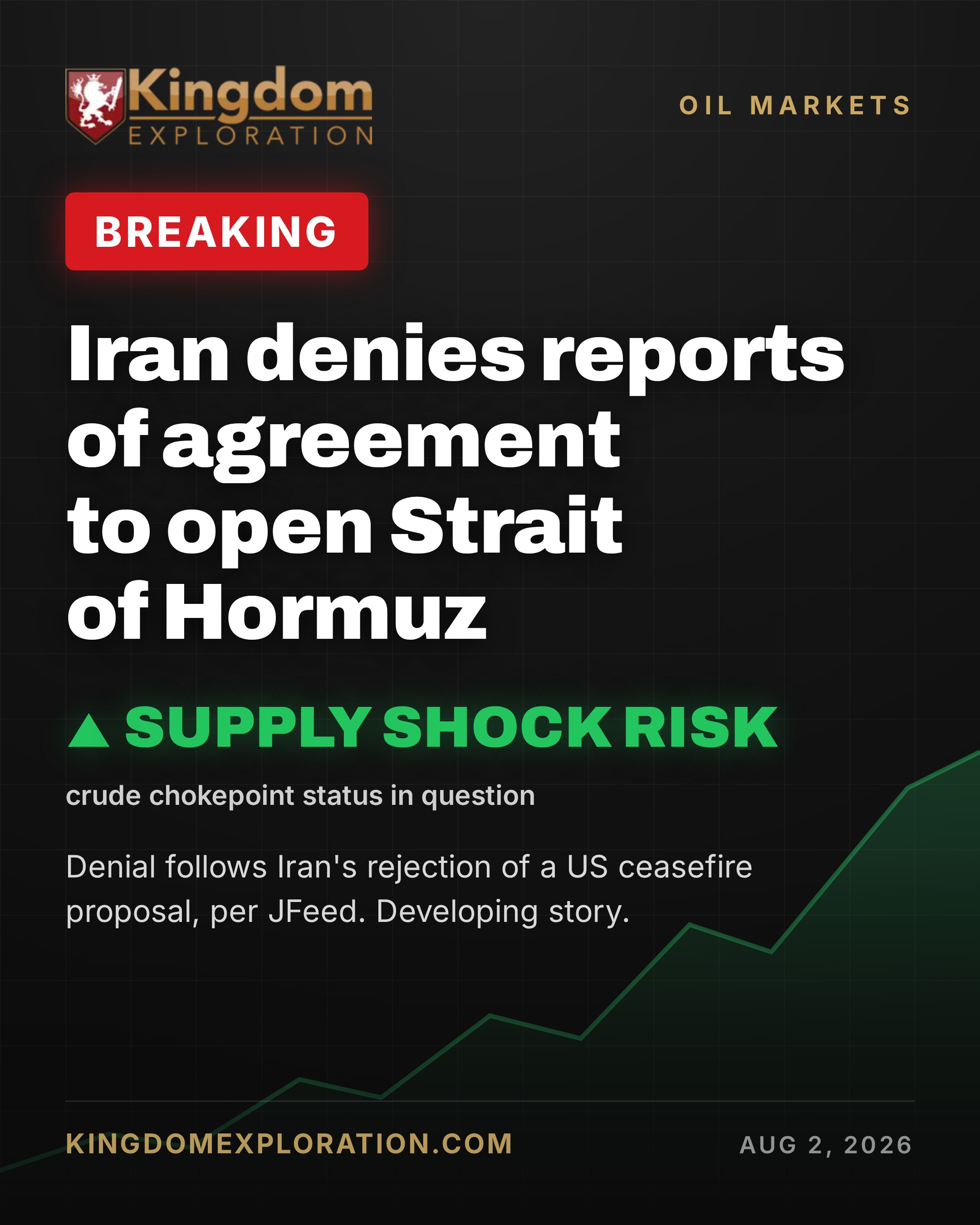
Iran has denied reports that it agreed to open the Strait of Hormuz, according to JFeed, in a development that keeps the status of the world's most critical oil chokepoint in question. The denial, reported just minutes ago, pushes back against earlier claims of any agreement to normalize traffic through the strait.
Related coverage: Iran Rejects US Ceasefire Proposal Delivered via Iraqi PM
What Just Happened
Per JFeed, Iran has publicly denied reports suggesting it reached an agreement to open the Strait of Hormuz. The denial directly contradicts circulating claims of a deal, leaving markets without confirmation that the passage will operate freely.
The move follows Iran's earlier rejection of a US ceasefire proposal delivered via the Iraqi prime minister, as Kingdom Exploration previously reported. Taken together, the two developments point to continued tension rather than de-escalation around the strait.
The Numbers
JFeed's report centers on the denial itself and does not provide new figures on shipping volumes, prices, or barrels affected. What is well established about the Strait of Hormuz is its outsized role as a conduit for a significant share of the world's seaborne crude and condensate, along with major liquefied natural gas flows.
Because the source text carries no specific new statistics, we are not attaching figures that were not reported. The core fact is qualitative but material: Iran says there is no agreement to open the strait.
Why Oil Prices Could Rise
The Strait of Hormuz is the single most important maritime chokepoint for global oil. Any uncertainty over whether traffic can move freely through it feeds directly into the risk premium priced into crude.
- Supply at risk: A large portion of global oil exports must transit Hormuz. Doubt about free passage raises the perceived probability of disrupted flows.
- Risk premium: When a deal to keep the strait open is denied rather than confirmed, traders tend to add a geopolitical premium to hedge against a supply shock.
- Limited alternatives: Pipeline bypass capacity around Hormuz is finite, so barrels that cannot transit the strait cannot easily be rerouted at full volume.
Kingdom Exploration's read: a denial is not a closure, but it removes the reassurance a confirmed agreement would have provided. Until there is clarity, the market is likely to treat Hormuz as a live risk rather than a resolved one.
What to Watch Next
- Official confirmation: Whether Iranian authorities issue further statements clarifying the strait's operational status.
- Shipping signals: Any changes in tanker traffic, insurance costs, or rerouting through or around the strait.
- Diplomatic track: Follow-through on the rejected ceasefire proposal and any renewed negotiation efforts.
- Price reaction: How Brent and WTI respond as the denial circulates and is either corroborated or contradicted.
The situation remains fluid, and reports around the strait have been shifting quickly. Investors and energy watchers should weigh headlines against confirmed action on the water.
Reporting sourced from JFeed. Developing story.
About Kingdom Exploration
Kingdom Exploration LLC is an Oklahoma-based oil and gas exploration company. Learn more at kingdomexploration.com.

