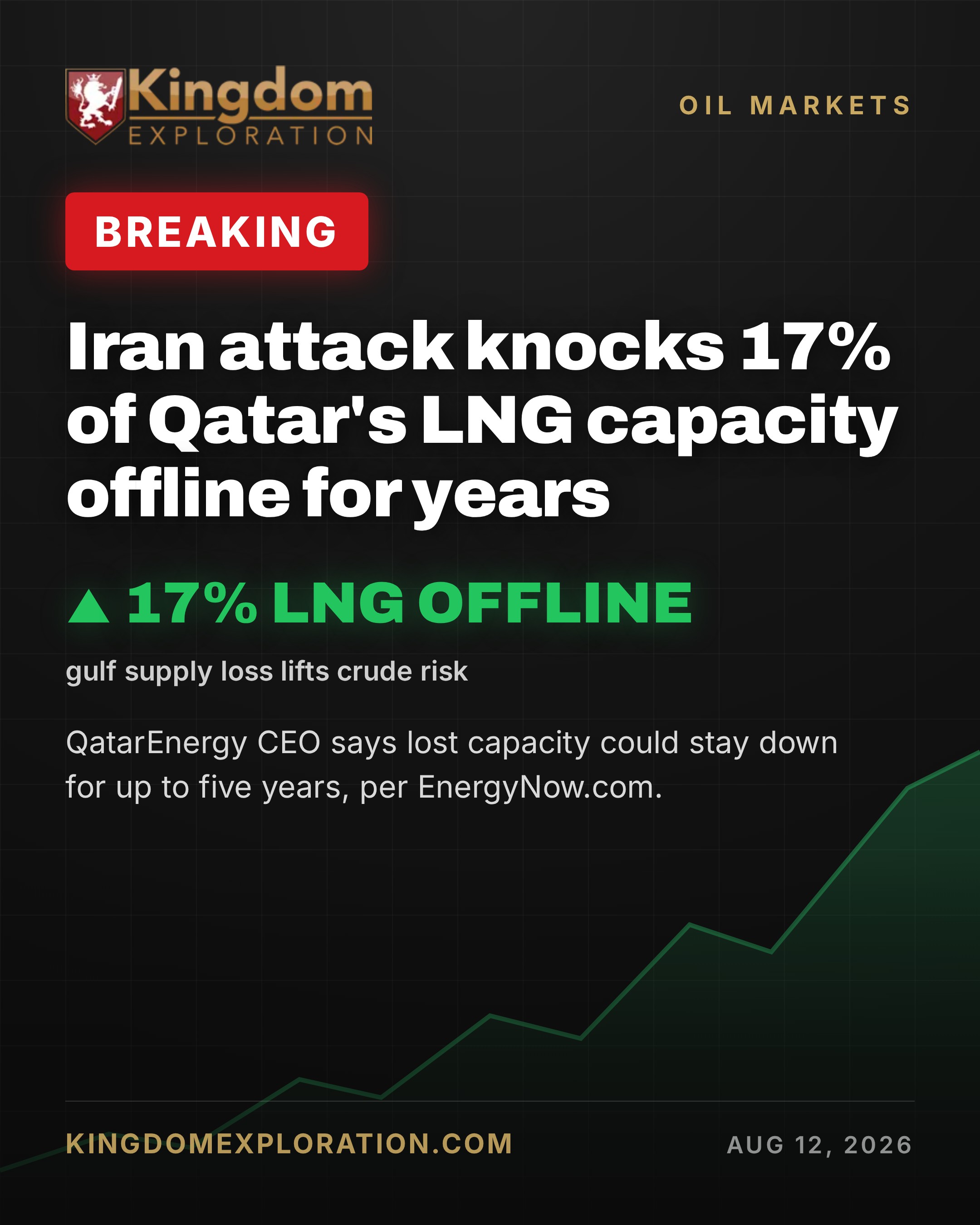
An Iranian attack has wiped out roughly 17% of Qatar's liquefied natural gas (LNG) production capacity, and the damage could keep that output offline for as long as five years, QatarEnergy's chief executive said, according to EnergyNow.com. The disclosure marks a dramatic escalation in the fallout from recent hostilities around the Persian Gulf and puts one of the world's largest energy exporters squarely in the crosshairs.
Related coverage: Qatari LNG Tanker Struck in Strait of Hormuz - Bloomberg
What Just Happened
Qatar, one of the top LNG suppliers on the planet, has confirmed through its state energy company that an Iranian strike inflicted damage severe enough to remove a significant slice of its export capacity from the market. Per EnergyNow.com, QatarEnergy's CEO put the figure at 17% of the country's LNG capacity, with a recovery timeline stretching up to five years.
A multi-year outage of that magnitude is not a routine supply disruption. It signals structural damage to critical energy infrastructure rather than a temporary halt, and it raises the stakes for every buyer that depends on Gulf energy flows.
The Numbers
- 17% of Qatar's LNG capacity knocked offline, per QatarEnergy's CEO.
- Up to 5 years — the estimated time the lost capacity could remain out of service.
- Follows an earlier strike on a Qatari LNG tanker in the Strait of Hormuz, as reported by Bloomberg.
These are the only figures confirmed in the source reporting. The full scope of the damage and any timeline for partial restoration remain to be detailed.
Why Oil Prices Could Rise
Although the headline damage is to LNG, the mechanism that could lift crude prices is broader. Energy markets tend to move together when a major Gulf producer's infrastructure is attacked. Removing 17% of Qatari LNG for years tightens global gas supply, which can push power generators and industrial buyers toward oil-based fuels — adding demand pressure to crude.
Just as important is the risk premium. An attack that causes multi-year damage to a key exporter's facilities tells traders that regional energy assets are vulnerable to sustained disruption. That fear alone can add a premium to every barrel, independent of any single day's physical supply loss. With the earlier tanker strike in the Strait of Hormuz — a chokepoint through which a large share of the world's seaborne energy transits — the market is now pricing in the possibility that shipping and production alike could face further interruption.
Kingdom Exploration's read: a five-year capacity loss reframes this from a headline event into a structural supply story. Markets can shrug off a brief outage; they cannot easily shrug off years of missing molecules from a top-tier exporter sitting next to the world's most sensitive energy chokepoint.
What to Watch Next
- Confirmation of the exact facilities hit and any independent damage assessments.
- Whether Qatar can restore partial capacity faster than the five-year worst case.
- Any further attacks on tankers or infrastructure in or around the Strait of Hormuz.
- Shifts in LNG spot prices and whether buyers pivot toward oil-linked fuels.
- Insurance and shipping-cost responses for Gulf energy cargoes.
Reporting sourced from EnergyNow.com. Developing story.
About Kingdom Exploration
Kingdom Exploration LLC is an Oklahoma-based oil and gas exploration company. Learn more at kingdomexploration.com.