Live Updates
UPDATE — Aug 12, 7:32 AM CT: IEA sees Q3 oil deficit hitting 1.8 million bpd, deepest since late 2021
The IEA has deepened its supply gloom, now projecting a 1.8-million-bpd global oil deficit for the July-September quarter — a 1-million-bpd downward revision from July and the largest quarterly shortfall since Q4 2021, per Oilprice. For the full year, 2026 supply is now seen plunging 4.3 million bpd (versus 3.7 million last month) to 102.02 million bpd, leaving a 1.27-million-bpd shortfall against demand.
The agency cited the Hormuz shutdown, the U.S. blockade of Iranian exports, Bab el-Mandeb attacks and reduced Kazakh CPC flows. Global stocks have fallen 410 million barrels since the Iran war began, dropping below 7.9 billion barrels in July.
Kingdom Exploration's read: a record quarterly deficit with inventories draining fast keeps upward pressure on crude — even as high prices erode demand, now seen contracting 1.6 million bpd this year.
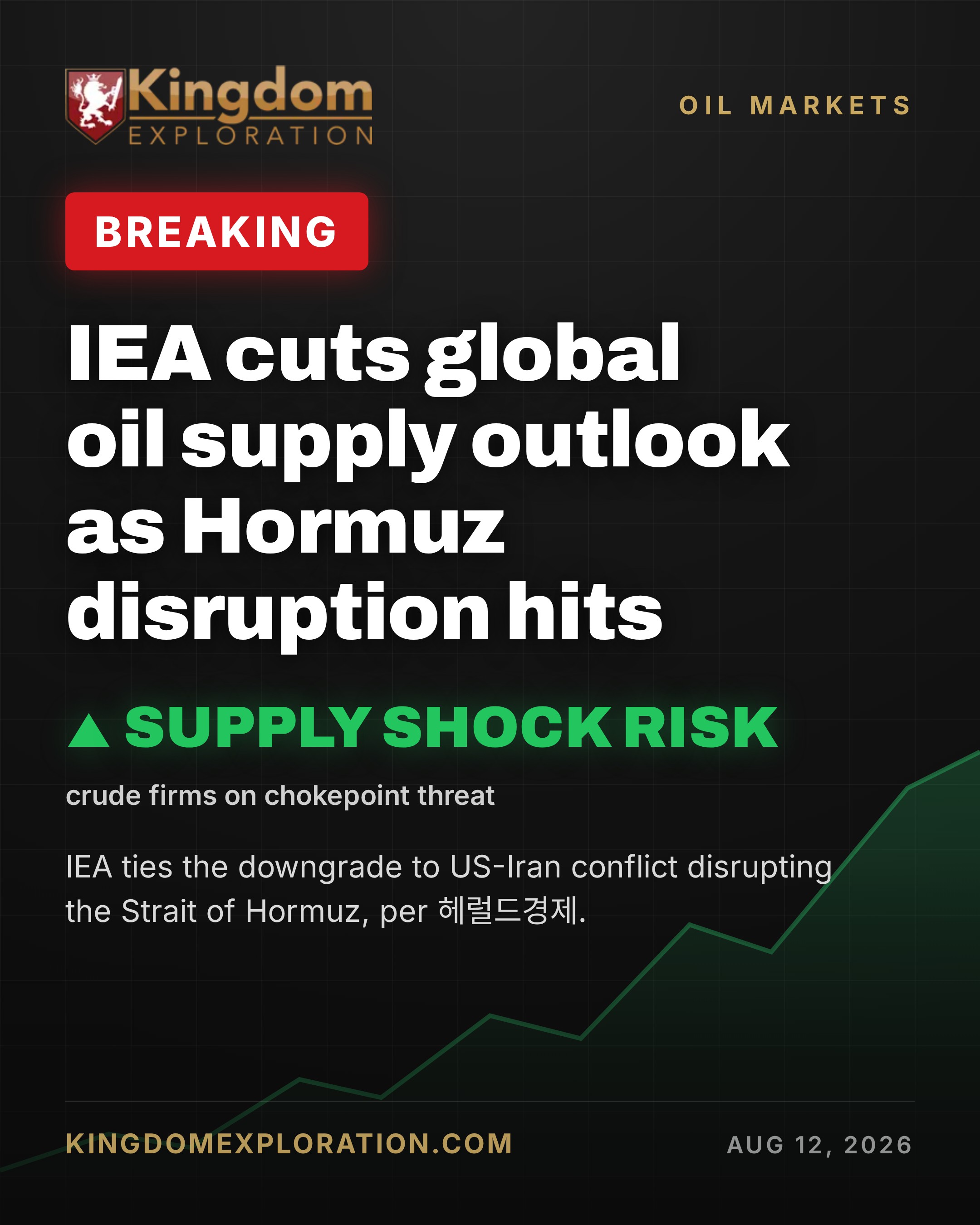
The International Energy Agency has lowered its global oil supply outlook, citing disruption to the Strait of Hormuz stemming from the US-Iran conflict, according to a report by 헤럴드경제. The revision puts a fresh spotlight on the world's most critical oil chokepoint and the volume of crude that moves through it every day.
What Just Happened
Per 헤럴드경제, the IEA has trimmed its projection for global oil supply. The agency tied the downgrade directly to conflict between the United States and Iran that is disrupting shipping through the Strait of Hormuz, the narrow waterway connecting the Persian Gulf to the open ocean.
The Strait of Hormuz is the single most important transit point for seaborne crude and refined products. Any disruption there ripples immediately through freight rates, insurance costs and the physical availability of barrels to refiners across Asia, Europe and beyond.
The Numbers
The source report confirms the direction of the IEA's move — a cut to the global supply outlook — but did not provide specific barrel-per-day figures or a revised headline number in the material available to us. We are not going to attach figures that were not published.
- Action: IEA lowers global oil supply outlook
- Cause cited: US-Iran conflict disrupting the Strait of Hormuz
- Source: 헤럴드경제
Why Oil Prices Could Rise
When a forecasting body as closely watched as the IEA cuts its supply outlook, traders price in a tighter market. The mechanism is straightforward: if fewer barrels are expected to reach the market, the balance between supply and demand narrows, and prices tend to firm.
The Hormuz angle adds a risk premium on top of the fundamentals. A large share of the world's crude exports passes through the strait, and any threat to that flow forces buyers to compete harder for available cargoes and hedge against the possibility of a sharper interruption. Even when barrels keep moving, the fear of disruption alone can lift prices as shippers reroute, insurers raise rates and refiners build precautionary inventory.
Kingdom Exploration's read: the combination of an official supply downgrade and a live chokepoint threat is exactly the kind of setup that keeps a floor under crude and can trigger fast upside moves on any fresh escalation headline.
What to Watch Next
- Whether the IEA follows with detailed revised supply figures in its monthly reporting.
- Any change in tanker traffic, insurance premiums or rerouting around the Strait of Hormuz.
- Further US-Iran developments that could tighten or ease the disruption.
- How OPEC+ producers and holders of spare capacity respond to a tighter outlook.
Reporting sourced from 헤럴드경제. Developing story.
About Kingdom Exploration
Kingdom Exploration LLC is an Oklahoma-based oil and gas exploration company. Learn more at kingdomexploration.com.