Live Updates
UPDATE — Aug 5, 3:37 PM CT: Ballistic missile forces targeted tanker to turn back in Red Sea
Yemen's Houthi forces targeted a tanker with a ballistic missile, forcing the vessel to reverse course and abandon its Red Sea transit, per TradeWinds News. The report, published minutes ago, marks an escalation from the earlier tanker attacks to the use of ballistic weaponry against merchant shipping.
Kingdom Exploration's read: a vessel turning back rather than running the gauntlet signals that owners now view the corridor as too dangerous to transit, reinforcing the blockade declared by Yemeni forces. Fewer ships willing to cross the Red Sea means more crude diverted around Africa, adding freight cost and transit time that can tighten near-term supply and keep a risk premium under oil prices.
UPDATE — Aug 5, 3:02 PM CT: Houthis target two Saudi oil tankers in dual Red Sea attacks
Yemen's Houthi forces have targeted two Saudi oil tankers in dual attacks in the Red Sea, per Rudaw. The latest strikes come after the group declared a Red Sea blockade following an earlier tanker attack.
Details on the vessels, their locations and any damage were not immediately available. The reported dual assault marks an escalation of the campaign against Saudi shipping in one of the world's most critical maritime energy corridors.
Kingdom Exploration's read: repeated attacks on Saudi tankers raise the risk premium on crude, as shippers weigh rerouting away from the Red Sea and Bab el-Mandeb chokepoint, tightening the flow of oil to global markets.
UPDATE — Aug 5, 8:16 AM CT: Yemeni forces declare Red Sea blockade after targeting Saudi oil tanker
A Yemeni (Houthi) military spokesman says forces have targeted a Saudi oil tanker in the Red Sea and declared a blockade, per ISNA News Agency. The declaration signals an intent to widen action against Saudi-linked shipping in one of the world's most important maritime oil corridors.
ISNA did not detail the tanker's cargo, its condition, or any casualties in the summary available. Kingdom Exploration's read: a declared blockade — if enforced — raises the stakes well beyond a single strike, threatening tanker traffic through the Bab el-Mandeb chokepoint that links Gulf crude to the Suez Canal and European markets. Insurers and shipowners typically respond to blockade language with higher war-risk premiums and rerouting, which can tighten effective supply and lift crude prices.
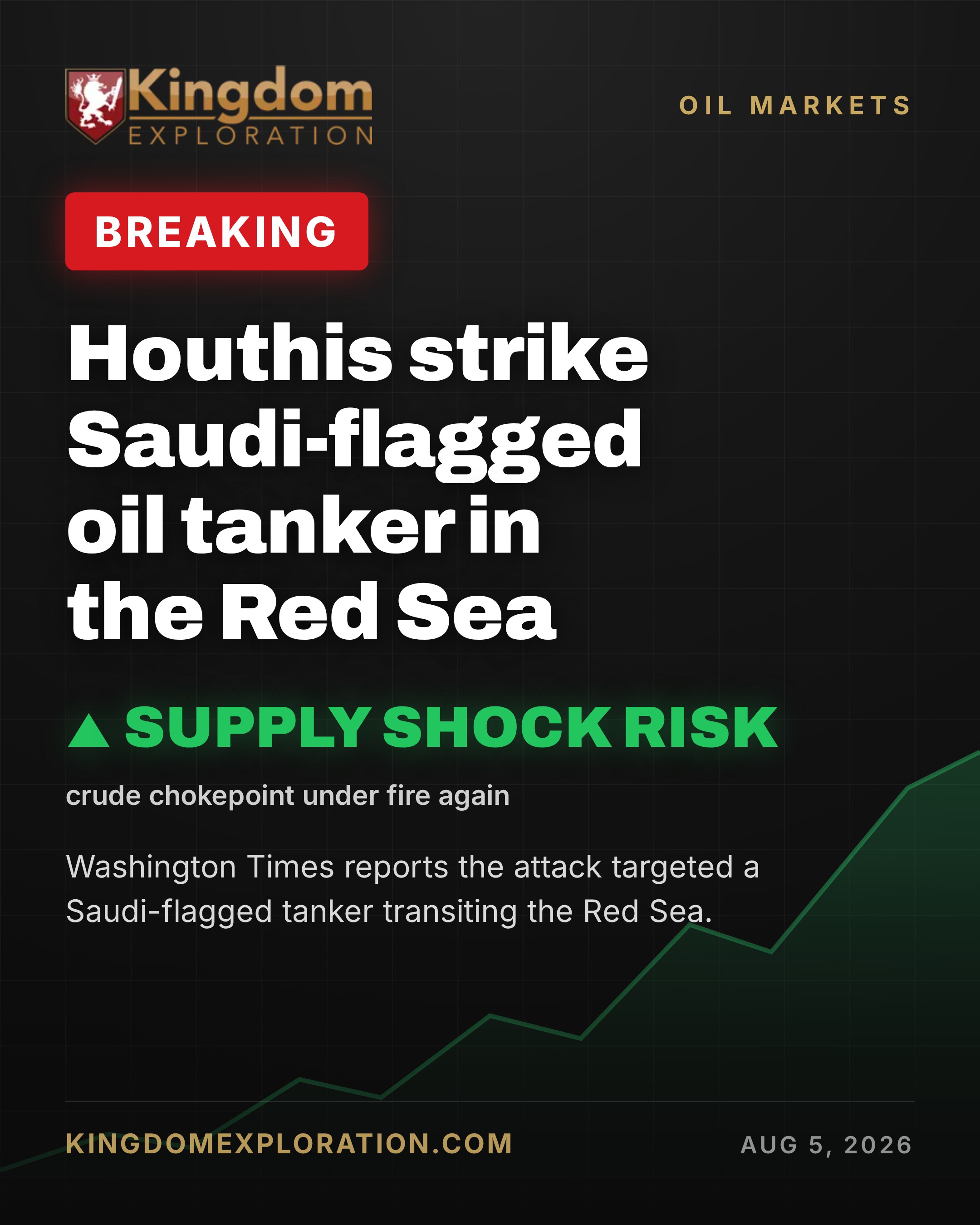
Yemen's Houthi movement struck a Saudi-flagged oil tanker in the Red Sea, according to the Washington Times, marking a fresh escalation along one of the world's most critical maritime energy corridors. The report emerged within the last hour and adds to a run of attacks that have repeatedly put Red Sea crude shipments in the crosshairs.
What Just Happened
Per the Washington Times, the Houthis targeted and struck a Saudi-flagged oil tanker as it transited the Red Sea. The Red Sea is a chokepoint that funnels a large share of seaborne crude and refined product between the Middle East, Europe, and beyond via the Bab el-Mandeb Strait and the Suez Canal to its north.
The strike on a Saudi-flagged vessel is notable because it directly implicates one of the world's largest oil exporters. Any attack that threatens the safe passage of tankers through this corridor raises the risk calculus for every shipowner and cargo moving through the region.
The Numbers
Specific figures on casualties, cargo volume, or vessel damage were not detailed in the initial Washington Times report. As this is a developing story, concrete data on any spill, crude tonnage at risk, or insurance and freight-rate moves had not yet been confirmed at the time of publication.
- Target: Saudi-flagged oil tanker
- Location: Red Sea
- Attacker: Yemen's Houthi movement
- Source: Washington Times
Why Oil Prices Could Rise
Attacks on tankers in the Red Sea feed directly into the oil market's risk premium. When vessels come under fire in a chokepoint, several supply-side pressures can stack up at once:
- Rerouting: Shipowners may divert cargoes around the Cape of Good Hope, adding thousands of miles and weeks of transit time, which tightens near-term availability and lifts freight costs.
- Insurance: War-risk premiums on Red Sea transits tend to spike after strikes, raising the delivered cost of every barrel that still moves through.
- Supply at risk: A direct hit on a Saudi-flagged tanker signals that even vessels tied to the region's largest exporter are not immune, broadening the perceived threat to flows.
Each of these mechanisms can push crude benchmarks higher as traders price in the possibility of interrupted or delayed barrels.
Kingdom Exploration's read: A strike on a Saudi-flagged tanker is exactly the kind of chokepoint headline that revives the Red Sea risk premium. The market doesn't need a confirmed barrel count to react - it reacts to the threat itself.
What to Watch Next
Key follow-ups in the hours ahead include official confirmation from Saudi authorities and the vessel's operator, any Houthi statement claiming responsibility, and reports of casualties, fire, or an oil spill. Watch for shifts in Red Sea war-risk insurance rates, fresh rerouting announcements from major carriers, and whether other shipowners pause transits through Bab el-Mandeb. Any of these would sharpen the supply picture and the oil market's response.
Reporting sourced from Washington Times. Developing story.
About Kingdom Exploration
Kingdom Exploration LLC is an Oklahoma-based oil and gas exploration company. Learn more at kingdomexploration.com.