Live Updates
UPDATE — Jul 28, 12:13 PM CT: Houthis target Saudi tanker NCC Ghazal with ballistic missiles over blockade violation
Houthi forces targeted the Saudi oil tanker NCC Ghazal with ballistic missiles, citing a violation of the maritime blockade they declared on Saudi Arabia, per X account @OSINTNewsqrb. The report marks the latest named vessel struck as the group escalates its campaign against Saudi crude shipping.
Kingdom Exploration's read: the naming of a specific tanker and the shift to ballistic missiles signals a hardening of the blockade enforcement. With Bab al-Mandab crude flows already near zero and Saudi barrels rerouting via Suez, each fresh strike deepens the risk premium on Red Sea oil traffic and keeps Brent elevated near $100.
UPDATE — Jul 26, 5:21 PM CT: Ansarallah says it targeted three Saudi oil tankers while maintaining Red Sea blockade
The Houthis' Ansarallah movement says it targeted three Saudi oil tankers and is maintaining its declared blockade of the Red Sea, according to the Palestine Chronicle. The claim, published about 14 minutes ago, points to a widening campaign against Saudi crude shipping rather than a de-escalation.
The figure of three targeted tankers aligns with earlier reports of multiple Saudi vessels struck or turned back in recent days, and reinforces that the group intends to keep pressure on the corridor. No new casualty or damage details were provided in the summary.
Kingdom Exploration's read: with Ansarallah publicly reaffirming the blockade and tanker targeting, the risk premium on Red Sea crude flows stays elevated. Continued disruption to Saudi exports through Bab al-Mandab keeps upward pressure on Brent as vessels avoid the route.
UPDATE — Jul 26, 2:21 PM CT: Zero crude tankers cross Bab al-Mandab for three straight days amid Houthi threats
No crude oil tankers have transited the Bab al-Mandab Strait over the past three days, according to a post by economist Steve Hanke (@steve_hanke) on X. The claim points to a de facto freeze of one of the world's most critical energy chokepoints as Houthi attacks and warnings deter shipowners from the Red Sea corridor.
Kingdom Exploration's read: a multi-day, near-total halt of crude flows through Bab al-Mandab forces cargoes onto longer routes around Africa, tightening prompt supply and lengthening voyage times. Sustained zero throughput here keeps a firm risk premium under oil prices while owners weigh whether the passage is navigable at all.
UPDATE — Jul 26, 9:42 AM CT: Saudi Arabia reroutes crude via Suez as Bab Al Mandeb oil exports fall to near zero
Saudi Arabia is shifting oil shipments to the Suez route as crude flows through the Bab Al Mandeb strait collapse to near zero, per thenationalnews.com. The chokepoint, which links the Red Sea to the Gulf of Aden, has been effectively emptied of Saudi tanker traffic following repeated Houthi attacks.
Kingdom Exploration's read: rerouting around the Bab Al Mandeb adds days and cost to voyages that would normally pass south toward Asia, tightening effective supply even if barrels are not lost outright. With the southern Red Sea corridor now largely shut to Saudi crude, pressure on Brent stays elevated as the market prices in longer, more expensive shipping routes.
UPDATE — Jul 25, 2:12 PM CT: Another oil tanker struck by projectile 130km SW of al-Shuqaiq, fire reported
A further oil tanker has been struck by a projectile roughly 130km southwest of al-Shuqaiq in the Saudi Red Sea, with a fire reported on board, per @twisted_eagle on X. The report was posted minutes ago and adds to the growing tally of vessels hit along Saudi Arabia's Red Sea coast.
Al-Shuqaiq lies in Saudi Arabia's southern Red Sea, near key crude and refined-product terminals. Kingdom Exploration's read: repeated strikes on tankers in these waters keep a war-risk premium locked into crude, as owners weigh whether to keep transiting a corridor the Houthis have declared off-limits.
UPDATE — Jul 24, 4:41 PM CT: Coalition strikes Houthi military sites in Al-Hudaydah after Red Sea tanker attacks
A Saudi-led coalition has launched strikes on Houthi military sites in the Yemeni port city of Al-Hudaydah, retaliation for the recent attacks on Saudi oil shipments in the Red Sea, per posts circulating on X (@BShtwtr).
The move marks a sharp escalation from maritime attacks to direct military action on land, raising the risk of a wider confrontation around one of the world's busiest oil transit corridors.
Kingdom Exploration's read: with a shooting war now spanning both the Red Sea shipping lanes and Yemeni territory, insurers and shippers face fresh uncertainty over routing Gulf crude — keeping upward pressure on prices already testing near $100 Brent.
UPDATE — Jul 24, 3:12 PM CT: Saudi state news agency reports one vessel took only minor hull damage in Red Sea attack
A Saudi vessel sustained only minor hull damage in the Red Sea attack, the kingdom's state news agency said, per AOL.com. The report offered the first official Saudi characterization of damage to a targeted ship, tempering earlier accounts of a tanker left ablaze.
No casualties or spill were detailed in the summary available. Kingdom Exploration's read: an official downgrade of the damage could ease some of the immediate supply-disruption premium building in crude, though the blockade threat and repeated strikes keep Red Sea shipping risk elevated.
UPDATE — Jul 23, 4:53 PM CT: Attack on two Saudi tankers now corroborated across dozens of outlets
The Red Sea assault on two Saudi oil tankers is now being carried by a wide swath of outlets, with NewsCord counting roughly 40 sources reporting the attack, including 19 in the Western mainstream press. The aggregation, published within the last hour, points to broad corroboration of earlier reports that Yemen's Houthis struck the vessels.
Kingdom Exploration's read: the spread of reporting reinforces that this is a sustained campaign against Saudi crude shipping rather than an isolated strike, keeping a risk premium under oil prices while traffic through the Red Sea stays exposed to further attacks.
UPDATE — Jul 23, 8:23 AM CT: Two more Saudi tankers hit in Red Sea; VLCC ablaze as Brent nears $100
Houthi forces have struck two more Saudi tankers in the Red Sea, with one very large crude carrier (VLCC) reported on fire, per X account @ryan_c814. The strikes come as the group presses its declared maritime blockade on Saudi Arabia.
Oil markets are reacting sharply, with Brent crude reported trading near $100 a barrel. A VLCC can carry roughly 2 million barrels of crude, and repeated attacks on that class of vessel raise the stakes for tanker traffic through one of the world's most critical export routes.
Kingdom Exploration's read: with a VLCC now ablaze and Brent testing $100, insurers and owners face growing pressure to reroute or suspend Saudi Red Sea shipments, threatening a fresh squeeze on crude supply.
UPDATE — Jul 23, 5:33 AM CT: Houthi attack sets Saudi oil tanker Insylia on fire in Red Sea
A Houthi attack has set the Saudi oil tanker Insylia on fire in the Red Sea, according to X account @Alishqer_. It is the first reported strike on a vessel since the group declared a maritime blockade on Saudi Arabia and warned ships away from Saudi ports.
Further details on casualties, cargo and the tanker's location were not immediately available. Kingdom Exploration's read: an actual hit on a laden Saudi tanker marks a sharp escalation from warnings and turnarounds to physical damage, raising the risk premium on Red Sea crude flows and pressuring shippers to reroute or pause voyages through the corridor.
UPDATE — Jul 21, 9:13 AM CT: Two Saudi crude tankers turn back in Red Sea after Yemeni warning
Two tankers loaded with Saudi crude oil have turned back in the Red Sea following a warning from Yemeni armed forces, per Reuters. It marks the first concrete disruption to shipping since the Houthis declared a maritime blockade on Saudi Arabia.
The reversal signals that the threat is now translating into real diversions of crude cargoes rather than rhetoric. Kingdom Exploration's read: even a handful of tankers rerouting away from the Red Sea raises freight and insurance costs and pressures Saudi export flows, a bullish signal for oil prices if the pattern spreads.
UPDATE — Jul 21, 7:53 AM CT: Houthis warn ships away from Saudi ports and threaten to attack vessels
Yemen's Houthis have warned commercial vessels to steer clear of Saudi ports, threatening to attack ships that dock there, per Caliber.Az. The warning sharpens the maritime blockade the group declared on Saudi Arabia.
No specific timeline, vessel names or attack figures were provided in the report. The threat targets shipping tied to Saudi Arabia, the world's largest crude exporter, raising the prospect of disrupted loadings at key Red Sea and Gulf terminals.
Kingdom Exploration's read: any credible threat to Saudi port traffic injects a fresh risk premium into oil, as insurers and shippers reassess routes near an already tense waterway.
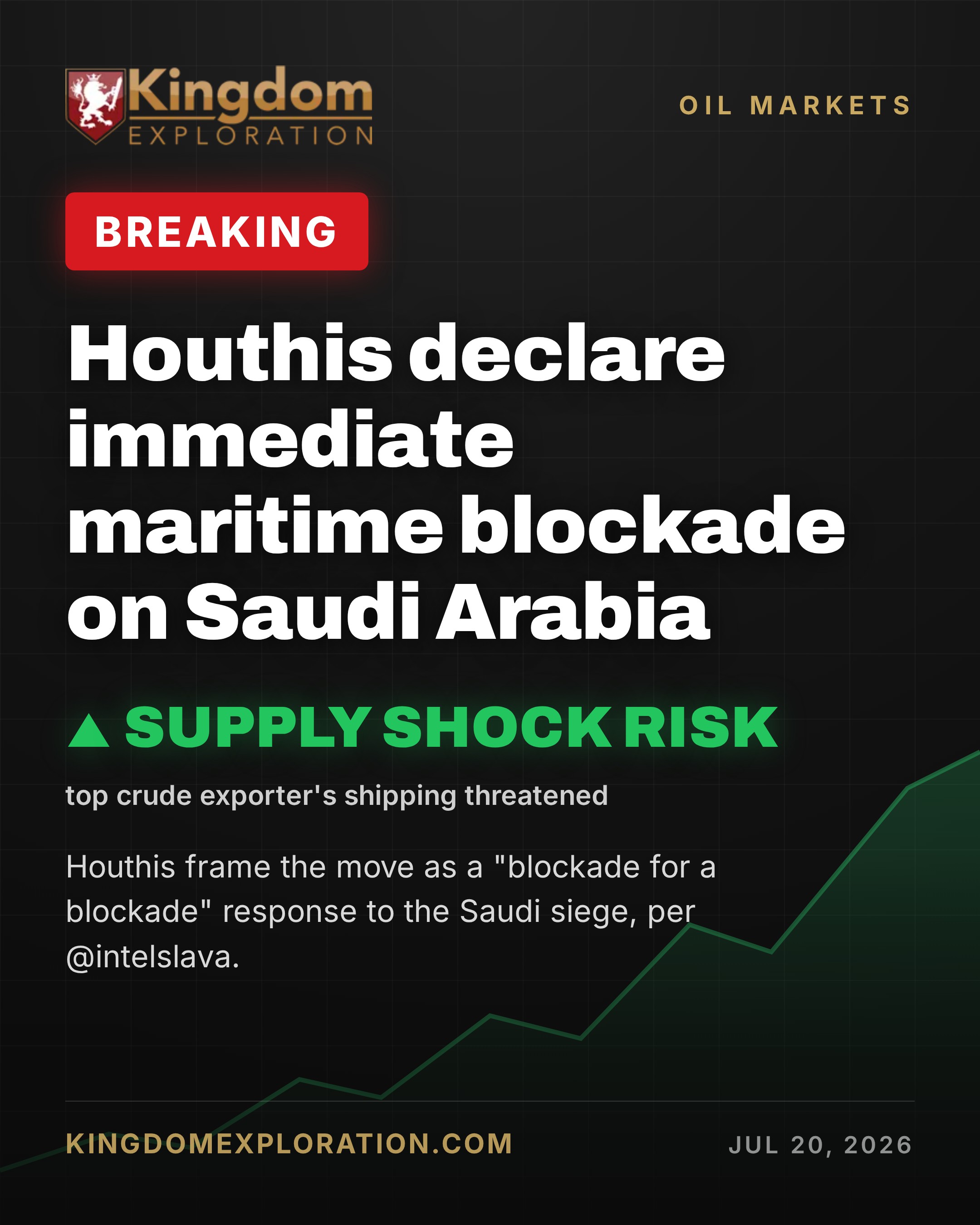
The Houthi movement announced an immediate maritime blockade on Saudi Arabia, framing the move as a "blockade for a blockade" in response to what it calls an ongoing Saudi siege, according to a breaking report circulated on Telegram by @intelslava on the day of the announcement. The declaration marks a sharp escalation of the maritime standoff around the Arabian Peninsula and puts one of the world's largest crude exporters directly in the crosshairs of a shipping threat.
Related coverage: Houthis Threaten to Close Second Oil Chokepoint Amid Hormuz Tensions
What Just Happened
Per the Telegram report from @intelslava, the Houthis announced a maritime blockade on Saudi Arabia effective immediately. The group characterized the action as a direct, symmetrical response to what it describes as a Saudi siege, using the phrase "blockade for a blockade."
The announcement follows earlier warnings — covered previously by Kingdom Exploration — in which the Houthis threatened to close a second oil chokepoint amid tensions around the Strait of Hormuz. Today's declaration moves the rhetoric from threat to stated action, targeting a nation that borders both the Red Sea and the Persian Gulf and sits at the center of global crude flows.
Context and caveats
The information available so far comes from a single Telegram channel, @intelslava, and the full underlying text was not available at the time of writing. The scope of the declared blockade, the specific waters or ports affected, and any enforcement capability have not been independently detailed in the source. This remains a developing story and details may change.
The Numbers
The source did not provide specific figures — no volumes of oil at risk, no price moves, and no vessel counts were included in the report. What is known is qualitative: an immediately effective maritime blockade declared against Saudi Arabia, one of the world's top crude exporters. As concrete figures emerge, they will be added to this coverage.
Why Oil Prices Could Rise
Saudi Arabia is a cornerstone of global oil supply, exporting crude through both Red Sea and Persian Gulf terminals. Any credible threat to the safe passage of tankers serving the Kingdom introduces a direct supply-security risk to the market.
- Risk premium: Traders typically price in a geopolitical premium the moment a major exporter's shipping lanes are threatened, even before any physical disruption occurs.
- Supply at risk: A blockade — if enforced — could complicate or delay loadings and force rerouting, raising insurance and freight costs that ripple into delivered crude prices.
- Chokepoint sensitivity: The Red Sea corridor and the approaches to the Arabian Peninsula are already stress points for global shipping; renewed threats compound existing caution among carriers.
- Spare capacity questions: Because Saudi Arabia also holds much of the world's spare production capacity, threats aimed at the Kingdom cut at the market's primary shock absorber.
Kingdom Exploration's read: markets tend to react first to the headline and confirm later with the facts. Until the scope and enforceability of this blockade are clear, expect elevated attention to any tanker-traffic, insurance, and loading data out of Saudi terminals.
What to Watch Next
- Independent confirmation of the blockade declaration beyond the initial Telegram report.
- Any statement from Saudi authorities, Aramco, or coalition partners on shipping and export operations.
- Signs of tanker rerouting, higher war-risk insurance premiums, or loading delays at Red Sea and Gulf terminals.
- Whether the Houthis specify which waters, ports, or vessels the blockade covers, and any demonstrated enforcement capability.
- Reaction across the broader oil complex as more established outlets pick up the story.
Reporting sourced from Telegram @intelslava. Developing story.
About Kingdom Exploration
Kingdom Exploration LLC is an Oklahoma-based oil and gas exploration company. Learn more at kingdomexploration.com.

