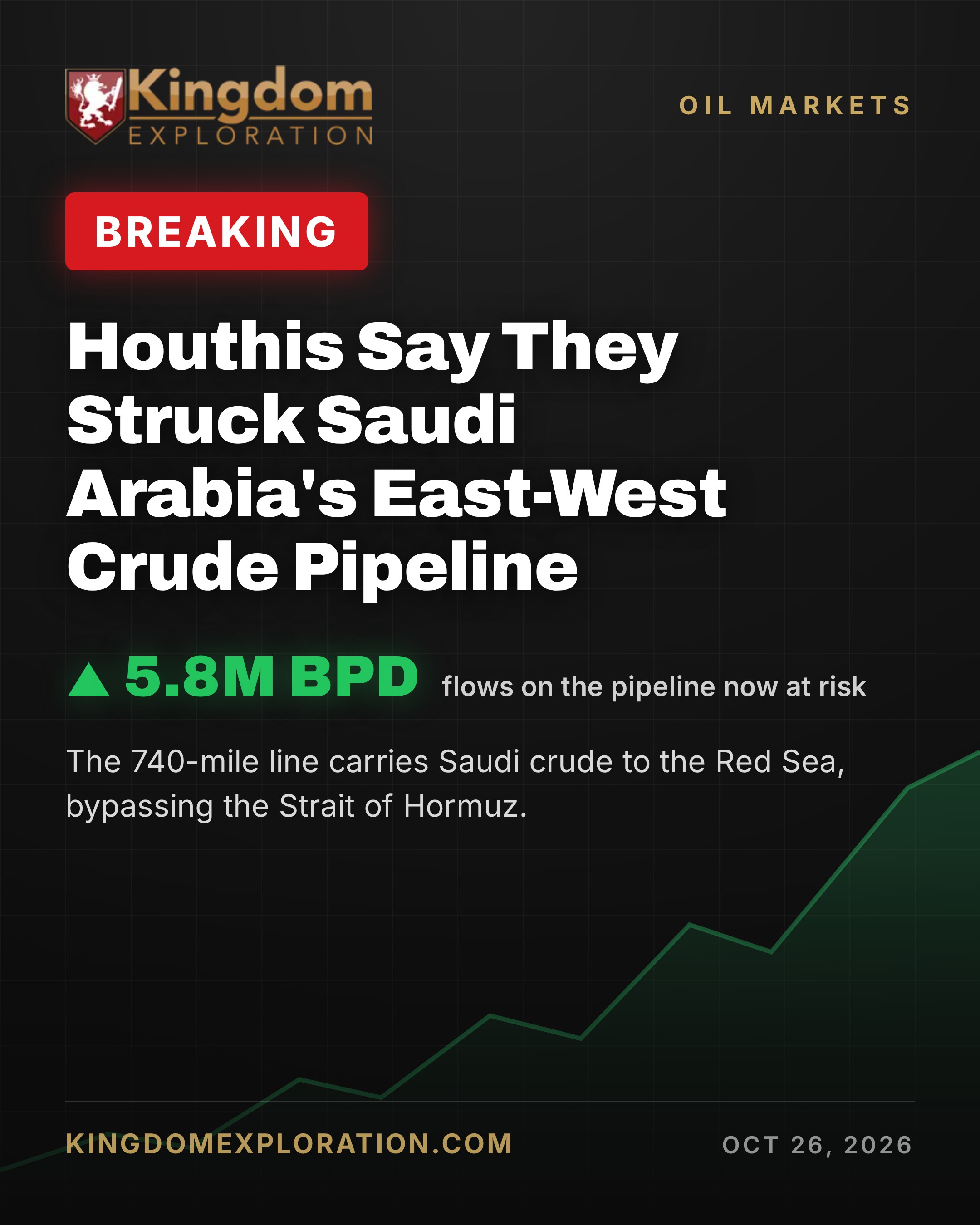
Yemen's Houthis on Monday claimed attacks on pumping stations along Saudi Arabia's East-West crude pipeline and on Riyadh's King Khalid International Airport, the same day Egypt's parliament authorized military support to help defend the kingdom, per oilprice. Riyadh had not confirmed any pipeline damage by Monday morning, but the claims put one of the world's most strategically important oil arteries back in the crosshairs.
What Just Happened
The Houthi movement said it struck pumping stations on the 740-mile pipeline that carries Saudi crude across the kingdom to the Red Sea port of Yanbu, bypassing the Strait of Hormuz. The group did not name the stations hit, and Saudi Arabia had not confirmed any damage as of Monday morning. On Saturday, the Houthis had separately claimed strikes on the Rabigh refinery and an Aramco facility in Yanbu, which Riyadh also has not confirmed.
The escalation came as Egypt's parliament voted to authorize President Abdel Fattah al-Sisi to send forces if Riyadh requests help against the Houthis. Sisi has said any Egyptian support would be limited to defending Saudi territory and borders, with no attacks inside Yemen. The Houthis had warned Cairo against the move.
Joining the conflict "would pose a grave danger" to Egypt's national security. — Yahya Al Raei, speaker of the Houthi-run parliament in Sanaa, in a letter to Egyptian Speaker Hisham Badawy
The Numbers
- 740 miles — length of the East-West pipeline carrying crude to Yanbu, bypassing the Strait of Hormuz.
- 5.8 million bpd — flows reported recovered by Energy Minister Prince Abdulaziz bin Salman on October 6, against a capacity of about 7 million bpd.
- ~3 million bpd — Saudi exports from Yanbu averaged so far in October, according to Kpler.
- 2 weeks — how long the pipeline was shut after September 10 drone attacks blamed on Iran-backed Iraqi militias damaged pumping stations.
The Saudi-led coalition said it destroyed two ballistic missile launchers in Sanaa, including one used to fire a missile toward Riyadh that was intercepted, plus five missile storage tunnels and four additional launchers.
Why Oil Prices Could Rise
The East-West pipeline is the kingdom's primary route for moving crude to the Red Sea without passing through the Strait of Hormuz. Repeated strikes on its pumping stations threaten a critical piece of Saudi export infrastructure at a moment when flows had only recently recovered to 5.8 million bpd following the September shutdown.
Any confirmed damage would renew the risk premium baked into crude as traders price the possibility of lost barrels. With roughly 3 million bpd of Yanbu exports in play this month and a backdrop of expanding regional conflict — now potentially drawing in Egyptian forces — markets have ample reason to watch Saudi supply closely.
Kingdom Exploration's read: the market impact hinges on confirmation. Houthi attack claims have repeatedly outrun Saudi acknowledgment, but each strike on pumping infrastructure chips at the thin margin between the kingdom's 5.8 million bpd of flows and its roughly 7 million bpd of capacity.
What to Watch Next
- Whether Saudi Arabia confirms any damage to the pipeline, Rabigh, or Yanbu facilities.
- Whether Riyadh formally requests Egyptian military support under the new parliamentary authorization.
- The outcome of de-escalation diplomacy — Saudi Defence Minister Prince Khalid bin Salman led a surprise delegation to Tehran on Monday, with Qatar and Pakistan mediating.
- Iranian signals: Foreign Minister Abbas Araghchi said indirect talks with Washington continue and that Tehran is ready to resume fighting but diplomacy remains possible.
Reporting sourced from oilprice. Developing story.
About Kingdom Exploration
Kingdom Exploration LLC is an Oklahoma-based oil and gas exploration company. Learn more at kingdomexploration.com.

