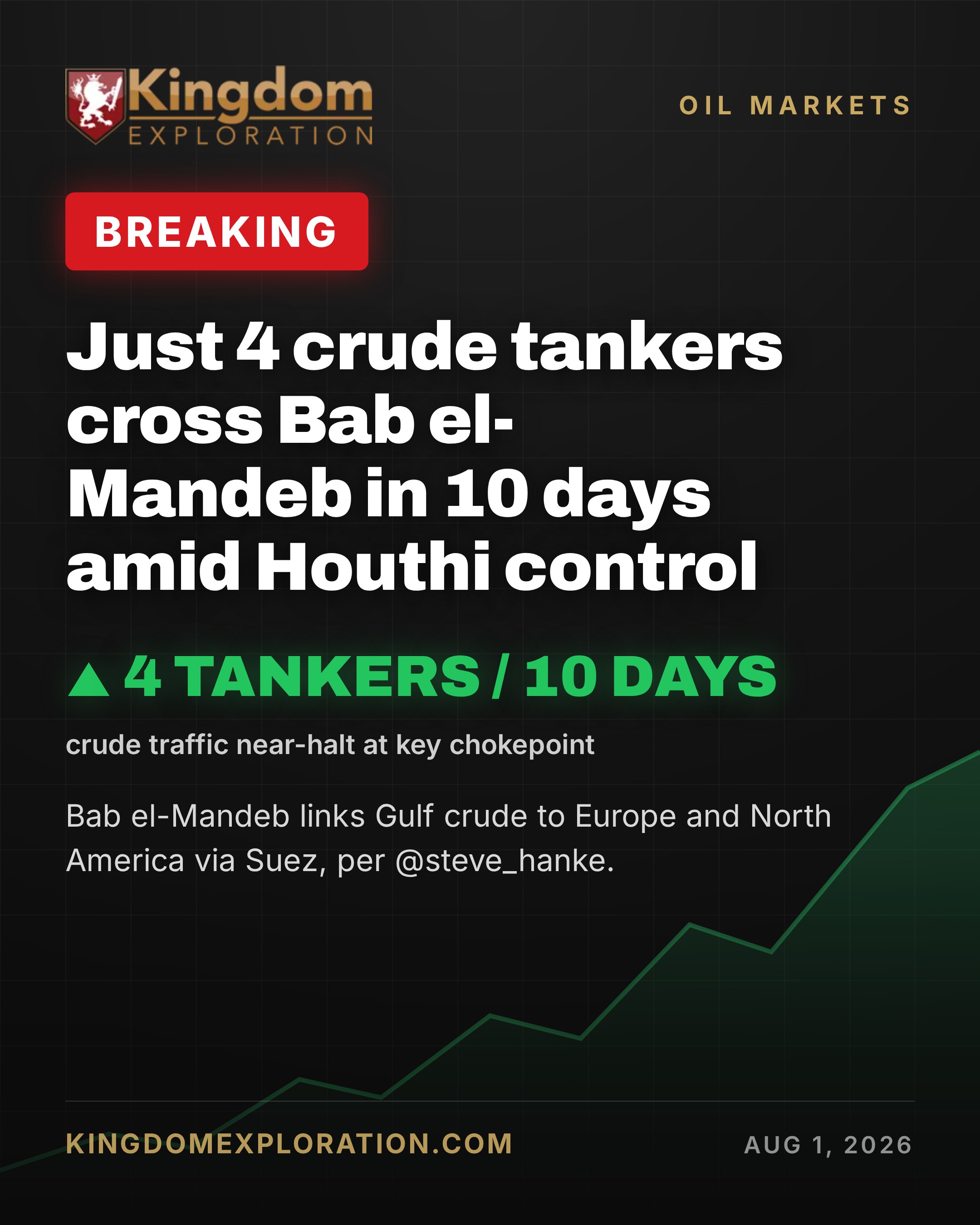
Crude tanker traffic through the Bab el-Mandeb Strait has all but collapsed, with only four crude tankers crossing the chokepoint in the past 10 days amid Houthi control of the waterway, according to a post from economist Steve Hanke (@steve_hanke) on X on the date of publication.
Related coverage: Houthis Declare Maritime Blockade on Saudi Arabia
What Just Happened
The Bab el-Mandeb Strait — the narrow gateway between the Red Sea and the Gulf of Aden that links the Suez Canal route to the Indian Ocean — has seen crude tanker traffic dwindle to a trickle. Per the @steve_hanke post, just four crude tankers transited the strait over a 10-day span while Houthi forces exert control over the passage.
The near-halt of tanker movement follows the Houthi declaration of a maritime blockade on Saudi Arabia, which Kingdom Exploration covered previously. The latest data point quantifies just how sharply shipping has pulled back from the corridor as vessel operators weigh the risk of transiting a contested waterway.
The Numbers
- 4 crude tankers crossed Bab el-Mandeb in the past 10 days, per @steve_hanke.
- 10-day window is the measurement period cited in the report.
No additional figures — such as barrels-per-day displaced or price moves — were provided in the source. Kingdom Exploration is reporting only the numbers as stated.
Why Oil Prices Could Rise
Bab el-Mandeb is one of the world's critical maritime chokepoints for energy trade. Crude and refined products moving from the Persian Gulf toward Europe and North America via the Suez Canal must pass through this strait. A collapse in transit volumes means barrels are either being rerouted the long way around the Cape of Good Hope &mdash adding weeks of sailing time and cost — or not moving at all.
When a chokepoint of this importance sees traffic fall to a handful of tankers, the market prices in a supply risk premium. Longer voyages tie up tanker capacity, tighten available shipping, and can delay cargoes reaching refineries. If the disruption persists, the physical availability of crude in destination markets can tighten even without a change in wellhead production.
The mechanism is straightforward: any threat to the free flow of oil through a strait that normally carries millions of barrels raises the perceived probability of a supply shortfall. That risk premium tends to show up in benchmark crude prices before any barrels are physically lost.
Kingdom Exploration's read: four tankers in ten days is not a slowdown — it is a shutdown in all but name. When traders see a chokepoint effectively closed, the risk premium builds fast, and the longer the diversion around Africa lasts, the more it strains global tanker supply.
What to Watch Next
- Transit counts: whether tanker crossings recover, stay near zero, or fall further in the coming days.
- Rerouting: confirmation of how many cargoes are diverting around the Cape of Good Hope and the added freight cost.
- Escalation: any expansion of the Houthi blockade or naval response affecting the Red Sea corridor.
- Price reaction: how Brent and WTI benchmarks respond as the market digests the traffic data.
The situation remains fluid, and figures could change as additional shipping data and official confirmation emerge.
Reporting sourced from X @steve_hanke. Developing story.
About Kingdom Exploration
Kingdom Exploration LLC is an Oklahoma-based oil and gas exploration company. Learn more at kingdomexploration.com.